
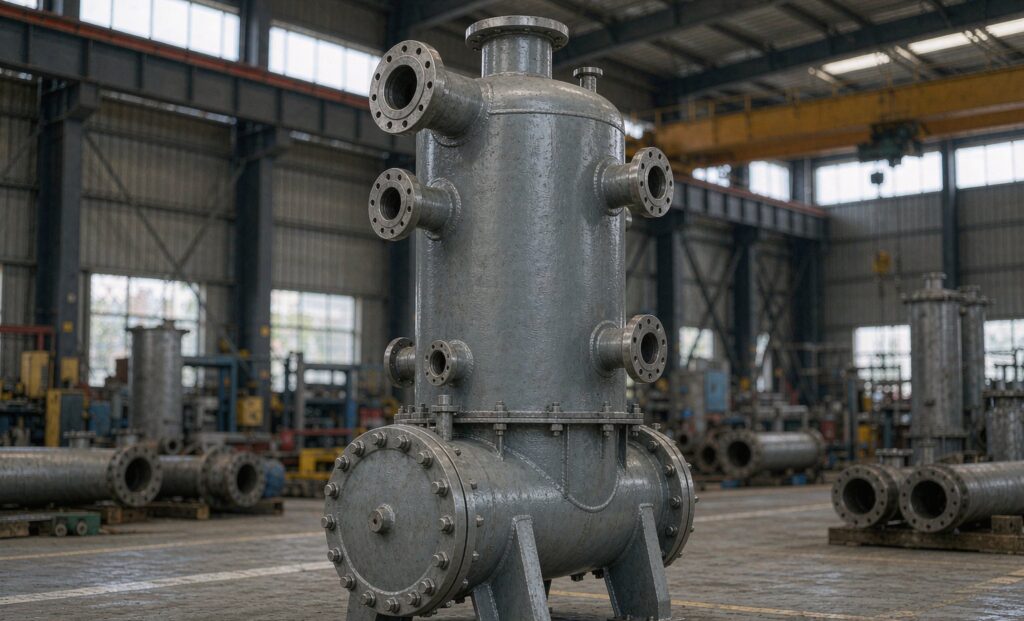
The Reboiler Is a Hydraulic Problem Before It Is a Thermal One
A thermosiphon reboiler has no pump. Circulation through the tube bundle is driven entirely by the density difference between the liquid in the column sump and the two-phase mixture in the heated tubes, so the heat exchanger and the column form one hydraulic loop that either finds a stable operating point or does not work at all.
This is why thermosiphon reboiler problems are almost never thermal. The unit is clean, the steam supply is adequate, the tubes were sized with a reasonable overall coefficient — and yet the column floods, or the reboiler oscillates, or the duty falls 30% short of design. In nearly every case the diagnosis is in the hydraulics: not enough static head, too much vapour fraction at the outlet, a return line that cannot disengage, or a specified temperature difference that exceeds what the loop can stably sustain.
This guide covers the four arrangements used in distillation service, what decides between them, and the numbers a fabricator needs to design a thermosiphon that circulates properly instead of one that merely fits.
How a Thermosiphon Loop Actually Works
Liquid enters the bottom of the heated tubes, rises, and begins to boil as it passes the point where the tube wall temperature exceeds the local saturation temperature. The mixture leaving the top of the bundle is a froth of vapour and liquid with a density far below that of the column liquid. The static head of liquid in the sump minus the weight of the two-phase column plus the friction losses in the loop gives the available driving head that pushes the flow around.
That balance produces a circulation ratio — the mass of liquid circulated per mass of vapour generated. For vertical thermosiphons in typical organic service the ratio lands between 3 and 10. A low ratio means high vapour fraction at the outlet, which means the return line carries a fast-moving froth that may not disengage cleanly in the column. A high ratio means good wetting but a large sensible heat penalty, because all that liquid is being heated to boiling point and then returned.
Why the temperature difference is capped
The driving head available is fixed by the sump level and the two-phase density, and both are properties of the process. Push the steam temperature up to get more duty and the boiling becomes violent, the outlet vapour fraction rises, the mixture density falls, the driving head drops, and circulation collapses. That instability — a rise in ΔT producing a fall in duty — is the defining constraint of a thermosiphon, and it is why vertical units are usually designed at 10 to 25 °C temperature difference and rarely above 30 °C.
A horizontal thermosiphon can tolerate higher ΔT because the bundle is longer and the boiling side is the shell, which gives more disengagement volume. A kettle can tolerate almost any ΔT because vaporisation happens in an enlarged shell with a vapour space above the bundle. Each step away from the vertical thermosiphon buys stability and costs money.
Comparing the Four Reboiler Arrangements
| Factor | Vertical thermosiphon | Horizontal thermosiphon | Kettle | Forced circulation |
|---|---|---|---|---|
| Boiling side | Tube side, upward | Shell side | Shell side, submerged bundle | Tube side, pumped |
| Circulation | Natural, 3–10 ratio | Natural, 2–6 ratio | Natural, low ratio | Pumped, ratio set by design |
| Typical ΔT | 10–25 °C, 30 °C max | 20–50 °C | Wide, limited by film temperature | Any, decoupled from hydraulics |
| Typical U (organic, W/m²·K) | 500–900 | 400–800 | 400–800 | 600–1200 |
| Vapour disengagement | In the column, above the return | In the column or a separator | Built in — large vapour space | Separate vessel required |
| Footprint | Very small — under the column | Large | Large, heavy shell | Largest — plus pump and separator |
| Fouling tolerance | Poor to moderate — tube side | Better — shell side cleanable | Moderate — bundle removable | Best — high velocity scours tubes |
| Turndown | Limited at low load | Moderate | Excellent | Excellent |
| Relative cost | Lowest | Moderate | High | Highest |
| Best for | Clean, low-viscosity, moderate ΔT | Viscous or high ΔT, fouling process | Wide boiling range, small ΔT, high turndown | Crystallising, fouling, viscous, high ΔT |
The pattern is consistent: the vertical thermosiphon is the cheapest and most compact option and the least forgiving. Every column that can use one should, and every column that cannot will pay for a kettle or a forced circulation loop.
Choosing Between Them in Practice
Four questions resolve most selections.
How viscous is the bottom product at boiling point? Above roughly 10 cP at operating temperature, tube-side natural circulation in a vertical unit becomes marginal and a horizontal thermosiphon with a shell-side bundle usually performs better. Above 100 cP, forced circulation is the honest answer.
What temperature difference is available? If the heating medium is low-pressure steam or a hot oil loop that only offers 40 °C above the bottoms temperature, a vertical thermosiphon will be unstable and a kettle is indicated. If the medium is high-pressure steam with 80 °C available, a forced circulation loop may be needed to keep the film temperature below the point where the product degrades.
Does the product foul or crystallise? Any duty with a deposition tendency should not rely on natural circulation, because the flow falls exactly when the fouling begins. Forced circulation maintains velocity independent of the boiling, which is the whole point.
How wide is the boiling range? A narrow-range mixture boils at essentially one temperature and a kettle’s large vapour space is wasted money. A wide-range mixture needs that space so the light ends can disengage without entraining liquid.
The Design Numbers a Fabricator Needs
Thermosiphon design starts from the column, not from the exchanger. Send these and the circulation calculation can be done properly rather than assumed.
- Bottom product composition, and the bubble point at column pressure.
- Column pressure at the reboiler draw-off point, and the maximum allowable pressure drop through the loop.
- Duty in kW, and the vapour rate generated.
- Sump liquid level above the lower tubesheet, and the elevation of the return nozzle relative to the top tubesheet — these two dimensions set the driving head.
- Return line diameter, length and the number of fittings, including any elbow into the column.
- Heating medium, its supply temperature and pressure, and the maximum allowable film temperature on the process side.
- Fouling resistance assumed on both sides, and the cleaning method available.
- Turndown requirement — the minimum rate at which the column must still operate.
The sump level and return elevation are the two items most often missing from an enquiry, and without them any circulation ratio quoted is a guess. A fabricator who quotes a thermosiphon without asking for them is designing a heat exchanger, not a reboiler.
Mechanical Details That Decide Service Life
Tube length and diameter. Vertical thermosiphons are usually built with 25 to 38 mm tubes, 3 to 6 m long, on a triangular pitch. Long tubes give more driving head but a higher outlet vapour fraction; the design point is a compromise, and it shifts with the process.
Nozzle arrangement. The inlet nozzle at the bottom must be large enough that the liquid enters without maldistribution across the bundle, and the outlet must not create a back-pressure that the loop cannot overcome. Undersized nozzles are a common cause of a reboiler that meets its duty on the test bed and not in the plant.
Tube-to-tubesheet joint. A boiling service with thermal cycling puts more load on the joint than a single-phase exchanger, and a leaking joint in a reboiler contaminates the product with steam condensate. Welded and expanded joints are the norm for anything with a hazardous or high-value process stream.
Vapour space in a kettle. The shell is enlarged so the vapour velocity above the bundle stays low enough to avoid entrainment, typically below 0.3 m/s for a low-pressure vapour. The weir height, the bundle submersion and the nozzle position all follow from that one velocity limit.
Operating Problems and What They Mean
Shortfall in duty with a clean bundle. Almost always a hydraulic limit — insufficient sump head, a return line too small, or a ΔT pushed beyond stability. Raising the steam temperature makes it worse, not better.
Oscillation or surging. The loop is hunting between a stable and an unstable operating point. Usually caused by too little subcooling at the tube inlet or a return line that is partly liquid-filled.
Loss of circulation at low load. Thermosiphons have a minimum stable duty. Below it the vapour fraction at the outlet drops, the driving head falls, and circulation stalls. If the column must run at 30% of design, that belongs in the specification.
Product discolouration or fouling on the tube wall. Local film temperature is too high. The fix is more surface and a lower ΔT, not more steam.
Where a Thermosiphon Reboiler Fits in the Column Design
A reboiler cannot be retrofitted into a column that was laid out for a different arrangement — the sump elevation, the return nozzle and the structural steel all follow from the choice. That is why the selection belongs in the basic design, alongside the tray or packing choice.
Zhenggong builds vertical and horizontal thermosiphon reboilers and kettle-type reboilers on TEMA shell and tube construction, in carbon steel, stainless and duplex, under D1/D2 pressure vessel certification and ISO 9001 and ISO 14001 systems. The certification and inspection page lists the design codes and the third-party inspection scope supplied with each unit, and the stainless steel shell and tube range shows the standard bundle and header configurations.
For the thermal side of a shell and tube design — LMTD, fouling allowance and the correction factor for a non-ideal pass arrangement — our step-by-step sizing calculation guide walks through the arithmetic. For the steam side of the duty, the steam heat exchanger selection guide covers condensate subcooling, stall and trap selection, which is where a reboiler with a condensing heating medium most often loses performance.
Frequently Asked Questions
Can a thermosiphon reboiler be replaced by a plate heat exchanger?
Sometimes, as a forced circulation falling-film or rising-film arrangement, but not as a direct like-for-like swap. A plate unit has no natural circulation path and needs a pump, a separator and a level control scheme. It is worth pricing for a heat-sensitive product where the inventory and residence time matter, and rarely worthwhile where a shell and tube kettle already works.
What circulation ratio should be specified?
Do not specify it — specify the sump level, return elevation and line sizes, and let the designer calculate it. Fixing a ratio without the hydraulic data produces a bundle that fits the number and not the column.
Why does the reboiler foul faster than the rest of the column?
Because it is the hottest surface in the system and the fluid is at its bubble point, which is exactly the condition where inverse-soluble salts deposit and polymerisation accelerates. A lower ΔT with more surface area is the standard remedy; a larger bundle is nearly always cheaper than the lost production from a fouled one.
Talk to an Engineer About the Duty
Send the column pressure, bottoms composition, duty and the sump geometry, and our engineers will size a vertical thermosiphon against a horizontal and a kettle alternative so the comparison is on real numbers rather than catalogue ranges. Begin with the engineering service scope, review the full product range, or send the data sheet through the contact form for a quotation.
