
The Cheapest Heat in Your Plant Is Leaving Through the Condenser
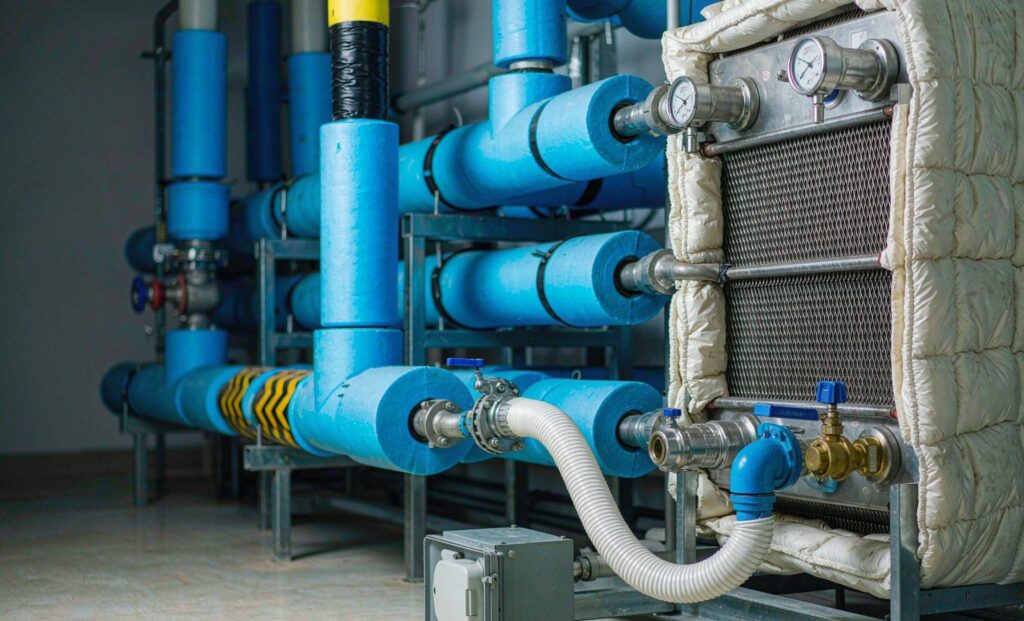
A refrigeration desuperheater is a small water-cooled heat exchanger inserted in the compressor discharge line, ahead of the condenser, that strips the superheat out of the hot gas before it reaches the condensing surface. It is the least glamorous piece of equipment in a refrigeration plant and it is usually the fastest-paying one, because the heat it captures is already paid for — it is compressor work and evaporator load on their way out of the building.
For a cold store, a dairy, a brewery or a supermarket with a year-round hot water demand, a desuperheater can supply 55–65 °C water at a fraction of the cost of the electric immersion heater or the gas boiler it displaces. For a plant with no simultaneous hot water demand, it is a pressure drop with no benefit. The difference between those two outcomes is decided at the specification stage, not at commissioning.
This guide covers what a desuperheater can and cannot recover, how the three tiers of refrigeration heat reclaim compare, and the numbers needed to size one properly.
What a Desuperheater Actually Recovers
Compressor discharge gas leaves the cylinder or screw at 70–90 °C on R448A, R449A or R404A systems, and at 80–110 °C on a transcritical CO₂ system. The condensing temperature for the same system is 35–45 °C. Everything between those two figures is superheat, and it is where a desuperheater works.
That distinction matters because superheat is only a slice of the total heat rejection. Total heat rejection is the evaporator load multiplied by (1 + 1/COP). For a plant running at COP 2.2, heat rejection is about 145% of evaporator load, and the superheat fraction of that total is typically 10–20%. So a 200 kW evaporator load rejects roughly 290 kW, of which the desuperheater can access about 40–55 kW — and that slice arrives at the highest temperature in the whole circuit, which is what makes it useful.
The three tiers of refrigerant heat reclaim are worth separating clearly, because vendors quote them interchangeably and they are not the same product:
| Recovery tier | What is recovered | Share of total heat rejection | Water temperature achievable | Typical use |
|---|---|---|---|---|
| Desuperheater (hot gas to water) | Superheat only, gas stays a vapour | 10–20% | 55–65 °C, up to 80 °C with CO₂ transcritical | Domestic hot water, CIP, wash-down, boiler feed preheat |
| Partial condensing recovery | Superheat plus part of the latent load | 30–50% | 40–55 °C | Space heating, low-temperature process water |
| Full condensing recovery | Superheat, latent and subcooling; condenser largely bypassed | 70–95% | 30–50 °C, high volume | District heating, large hydronic systems |
The trade is always temperature against volume. A desuperheater gives you the smallest quantity of heat at the highest temperature; full condensing recovery gives you the largest quantity at a temperature too low for domestic hot water without a booster. Most industrial plants with a 60 °C hot water demand are better served by a desuperheater sized correctly than by a heat reclaim condenser sized optimistically.
Sizing a Refrigeration Desuperheater: Four Numbers and One Constraint
Desuperheater sizing is a straightforward energy balance, and it fails for one reason only: the designer treats the duty as constant when it is not.
- Refrigerant mass flow and discharge temperature at the design condensing condition, taken from the compressor selection software rather than a rule of thumb.
- Discharge pressure, which sets the saturation temperature the gas must be cooled towards. The water leaving the desuperheater can approach, but never reach, that temperature.
- Water flow and return temperature. The return temperature is the number that decides everything: a 10 °C return absorbs far more superheat than a 45 °C return, and low-return-temperature heating circuits are what make reclaim economics work.
- Simultaneous hours — the hours per year when the compressor is running and hot water is actually being drawn. This is the only number that determines payback, and it is the one most often estimated up.
The constraint is refrigerant-side pressure drop. Every kilopascal added to the discharge line raises the discharge pressure the compressor must work against, and the compressor pays for it continuously. Keep the gas-side drop inside the allowance the compressor manufacturer gives you — typically 10–20 kPa for a discharge line — and if the desuperheater cannot meet the duty within that budget, add surface area or split the unit across two circuits rather than accepting a larger drop.
A worked example
Take a cold store with 200 kW of evaporator load at COP 2.2, R449A, condensing at 40 °C, discharge at 78 °C. Heat rejection is 291 kW. Assume the superheat available down to a 45 °C approach to condensing is 15% of that total: 44 kW.
Water entering at 10 °C and leaving at 55 °C gives a 45 K rise. Flow is 44 ÷ (4.187 × 45) = 0.23 kg/s, or about 0.84 m³/h — a small circuit, which is the point. The exchanger might be a 40-plate brazed unit with 1-inch connections, and the whole installation including the three-way valve, buffer tank and pipework can be carried out in a day.
At 1,500 equivalent full-load hours per year, 44 kW delivers 66,000 kWh of heat. Against electric water heating at 0.15 USD/kWh that is roughly 9,900 USD a year avoided, so a 6,000–12,000 USD skid pays back in well under two years. Scale the hours down to 400 and the same unit never pays back — which is why the simultaneous-hours figure has to come from a real hot water profile, not from the plant manager’s optimism.
Plate, Shell and Tube, or Double Wall
Brazed plate heat exchangers dominate desuperheater duty below about 1 MW because the approach temperature can be held to 2–3 K, which is what allows a 55–65 °C water outlet from a gas stream that is only 30 K hotter. The brazed and fusion-bonded plate heat exchanger range covers this duty in copper-brazed and nickel-brazed variants.
Shell and tube becomes the right answer in three situations: ammonia systems where the gas volume is large and the shell side handles it without excessive velocity, duties above roughly 1 MW where plate packs become unwieldy, and installations that need mechanical cleaning on the water side because the local water is hard.
The construction question that catches people out is double wall. Where the recovered heat feeds potable water — a canteen, a wash-down station, staff showers — most jurisdictions and most refrigerant safety standards expect either a vented double-wall exchanger or a documented single-wall barrier with a backflow preventer and a detection arrangement. Single-wall is normally accepted for a closed heating loop with treated water and no potable connection. Decide this before the unit is ordered; it cannot be retrofitted.
Materials and Refrigerant Compatibility
Copper-brazed stainless plates are the default for HFC and HFO blends. Ammonia requires a nickel-brazed or all-stainless construction, or a shell and tube unit, because ammonia attacks copper. CO₂ transcritical duty is a different problem: the high side runs at 80–100 bar, so the exchanger is a pressure vessel first and a heat exchanger second, and the plate pack, ports and brazing all have to be rated for it.
On the water side, 316L stainless is standard and adequate for most treated water. Where the recovered water is raw well water or has high chloride, check the chloride level against the plate material before ordering — chloride stress corrosion of 304 in a warm, concentrated boundary layer is a real failure mode, not a theoretical one.
Control: Why Most Desuperheaters Underperform
Almost every poorly performing desuperheater on a site is a control problem rather than a thermal one. Four things go wrong repeatedly.
- No bypass. A three-way valve that routes water around the exchanger when the tank is satisfied is not optional. Without it, the desuperheater keeps condensing refrigerant in winter when nobody needs hot water, and the condenser loses the load it was designed for.
- Minimum condensing pressure ignored. Take too much heat out and the condensing pressure falls until the expansion valve loses its feed. The compressor’s minimum condensing pressure control — fan cycling, a hold-back valve, or a floating head pressure strategy — has to be coordinated with the reclaim circuit.
- No buffer volume. Compressor duty cycles in minutes; hot water demand cycles in hours. A buffer tank between the desuperheater and the draw-off point is what converts an intermittent 44 kW into a usable daily volume.
- Stratified or stalled flow. Undersized water flow through a plate pack gives poor distribution and local boiling. Keep the water velocity in the useful range and size the pump for the exchanger’s pressure drop at design flow, not at nominal flow.
Commissioning checklist
- Confirm discharge pressure and temperature at the design condensing condition and record them as the baseline.
- Verify refrigerant-side pressure drop across the desuperheater against the compressor manufacturer’s allowance.
- Check water flow against design and balance the circuit with the three-way valve in both positions.
- Log the approach temperature at the gas outlet with a clean exchanger — this is the number that tells you later whether it has fouled.
- Set the high-limit aquastat and the low-temperature cut-out so the reclaim circuit cannot freeze or overheat the buffer tank.
- Record the compressor power draw before and after, so the parasitic cost of the added discharge pressure is documented rather than assumed to be zero.
Where the Payback Actually Comes From
Refrigeration heat reclaim competes with whatever is currently heating the water. Against electric resistance at 0.12–0.20 USD/kWh, the numbers are compelling at almost any duty. Against natural gas at 0.04 USD/kWh, the case narrows to installations with high simultaneous hours and no cheap boiler capacity left. Against waste heat already being recovered elsewhere, there is no case at all.
The honest framing for a capital request is: this is a heat exchanger that converts an existing electricity bill into a smaller electricity bill, and its return depends entirely on how many hours the compressor and the hot water draw overlap. Model those hours first, then size the unit.
Zhenggong manufactures brazed plate, gasketed plate and shell and tube units for refrigerant heat reclaim duty under a D1/D2 pressure vessel licence and ISO 9001 and ISO 14001 certification — relevant here, because a desuperheater on a CO₂ or ammonia circuit is a pressure vessel and the paperwork matters as much as the UA value. The certification and approvals page lists the scope.
Get the Duty Sized Against Real Compressor Data
Send the refrigerant, evaporator load, design condensing condition, discharge temperature, hot water requirement and the annual hot water profile, and our engineers will size a desuperheater against your actual compressor selection rather than a catalogue range — including the gas-side pressure drop check that decides whether the unit helps or hinders the compressor. For comparable installations, the ammonia refrigeration heat exchanger guide covers the industrial end of the same problem. Send the data sheet through the contact form for a quotation.
