
What a Plate and Shell Heat Exchanger Actually Is
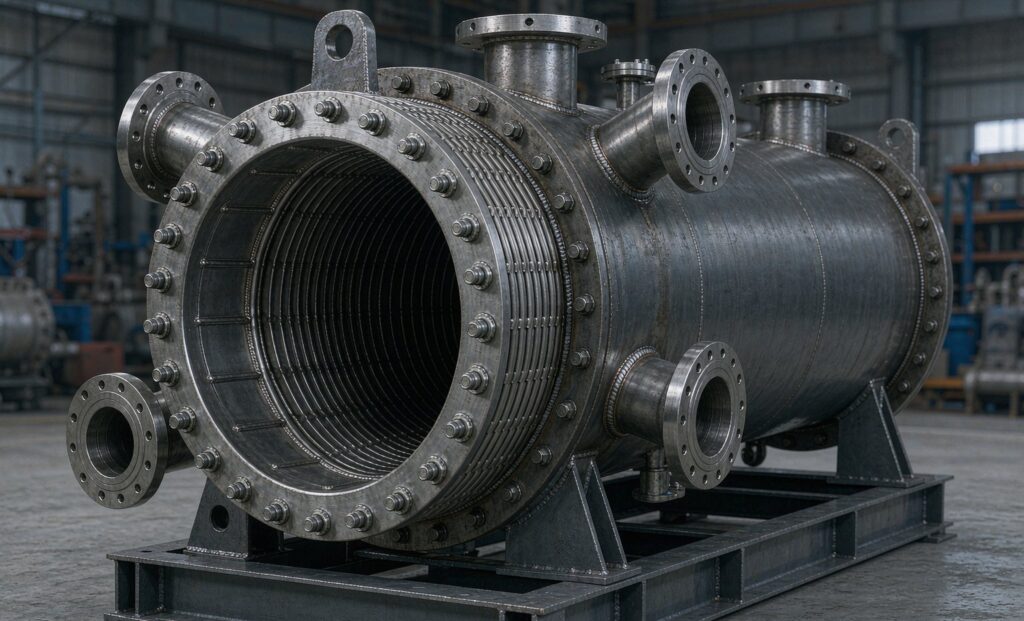
A plate and shell heat exchanger is a welded hybrid: a stack of circular corrugated plates, welded to each other at the perimeter to form alternating channels, enclosed in a cylindrical pressure shell with nozzles on the shell side. The plates do the heat transfer work of a gasketed plate pack, but there are no gaskets in the fluid path and the whole stack is held inside a round vessel that takes the pressure — so it behaves like a shell and tube unit in service while keeping most of the thermal density of a plate exchanger.
The design exists because two familiar options each give up something important at the edges of their range. A gasketed plate exchanger is compact and reaches a 1 K approach, but its elastomer gaskets limit it to about 180–200 °C, cap the pressure at 1.6–2.5 MPa, and can leak or blow out. A shell and tube exchanger handles any temperature and pressure, tolerates fouling, and can be mechanically cleaned, but it is large, needs 2–5 K of approach, and holds a lot of fluid. The welded plate heat exchanger sits between them: welded containment, no gaskets, 300 °C and 4 MPa practical limits, and an approach in the 1–2 K range.
Where It Sits Between the Familiar Designs
| Property | Gasketed plate | Brazed plate | Plate and shell | Shell and tube |
|---|---|---|---|---|
| Max temperature | ~180 °C (gasket limited) | ~200 °C (braze limited) | ~300–400 °C | No practical limit |
| Max pressure | 1.6–2.5 MPa | 3.0–4.5 MPa | 2.5–4.0 MPa | 10 MPa+ routine |
| Approach achievable | 0.5–1.5 K | 0.5–1.5 K | 1–2 K | 2–5 K |
| Gaskets in fluid path | Yes | None (brazed) | None (welded) | No (flanged joints only) |
| Mechanical cleaning | Full dismantle | Not possible | Chemical only | Tube side routine |
| Fouling tolerance | Low | Very low | Moderate | High |
| Footprint per kW | Very small | Very small | Small | Large |
| Capacity ceiling per unit | ~3 MW | ~2 MW | ~10 MW | 50 MW+ |
| Fluid inventory | Low | Very low | Low | High |
| Repairable | Yes, re-gasket | No, replace | Limited, specialist weld repair | Yes, re-tube |
The row that decides most projects is the fourth. Where a gasketed unit is excluded because the fluid is a hydrocarbon, a toxic refrigerant, or anything that must not escape, the plate and shell keeps the plate geometry legal. Where a brazed unit is excluded because it cannot be cleaned or because the duty exceeds the braze alloy’s temperature limit, the plate and shell takes over. Both of those exclusions appear at exactly the duties where buyers are already spending real money, which is why the type has a steady niche rather than a mass market.
Five Duties Where It Genuinely Wins
1. Ammonia and CO2 refrigeration at high pressure. An NH3 system runs 1.5–2.5 MPa on the high side; a transcritical CO2 gas cooler runs 8–12 MPa, which is beyond a plate and shell too, but subcritical CO2 condensers and economisers at 3–5 MPa are squarely in range. A welded plate stack eliminates the gasket as a leak path on a fluid that must not leak, and it does so in a fraction of the floor area of a shell and tube unit. Our guide to ammonia refrigeration heat exchanger selection works through the same comparison for that refrigerant specifically.
2. District heating substations with high primary pressure. Primary network pressures in a modern district heating scheme routinely reach 1.6–2.5 MPa with 120–140 °C supply. A gasketed plate is at its limit; a welded plate stack in a shell is comfortable, and the 1 K approach matters because it determines the return temperature the network sees and therefore the capacity of the whole line.
3. Steam-to-water conversion with a high duty. Saturated steam at 10 bar and 180 °C is at the edge of gasket capability and beyond most brazed units. A plate and shell condenser handles it with a close approach, which is what allows a condensate return temperature low enough to avoid flash loss.
4. Oil cooling and hydraulic circuits where the oil-side is clean. On a clean hydraulic or lube oil circuit at 2–3 MPa, the welded stack gives plate-level efficiency without the gasket swelling problem that ends most gasketed units in oil service.
5. Heat pump condensers above 90 °C. High-temperature industrial heat pumps delivering 90–120 °C water push gaskets to their limit and push brazed units past it. This is the fastest-growing application for the type, and it connects directly to the economics in our industrial heat pump payback analysis.
Where It Does Not Win
Honesty matters more than a specification sheet here. Three cases should send you elsewhere.
- Fouling service. The plate channels are 2–4 mm. Any stream carrying fibres, crystals, polymer, or suspended solids above a few tens of mg/L will block it, and because the stack is welded you cannot open it to rod the channels out. Chemical cleaning only works on deposits that dissolve.
- Very large duties. Above roughly 10 MW per unit the shell diameter needed for the plate stack stops being competitive with a conventional bundle, and multiple shells in parallel become the better answer.
- Any duty where in-situ inspection is a regulatory requirement. If your inspection regime demands visual access to the heat transfer surface, a removable bundle is the only design that satisfies it. A welded plate stack can be inspected only by cutting it open.
One further caution: a plate and shell unit is not repairable in the field. A tube in a shell and tube exchanger can be plugged; a plate pack cannot. Treat the unit as a long-life consumable and select for the full duty plus margin rather than trimming the surface area to win the order.
What to Put in the Specification
- Duty and approach. kW, all four temperatures, and the required approach at the limiting end — stated at the design point, not as a range.
- Design pressure and temperature per side, with the test pressure and the code you are designing to.
- Allowable pressure drop per side at design flow. On a plate geometry, the difference between 30 kPa and 80 kPa changes the plate count materially.
- Fluid data including concentration for glycols and brines, and the minimum operating temperature that sets viscosity.
- Materials for plates, shell and nozzles specified separately. 316L plates with a carbon steel shell is a common and cost-effective combination; titanium plates with a carbon steel shell is common in seawater-adjacent duty.
- Connection standard — flange facing, size, and orientation. Plate and shell units have nozzles on the shell and on the end plate, and the layout is fixed at manufacture.
- Certification. D1/D2 or the equivalent pressure vessel class for your jurisdiction, with material certificates and third-party inspection if required.
- Cleaning provisions. Chemical cleaning connections on both sides are worth specifying at order; retrofitting them is a shutdown job.
Materials and Construction Notes
Plates are almost always 316L stainless, in 0.5–0.8 mm thickness, pressed with a herringbone or chevron pattern. Titanium and 254 SMO are available where chloride levels rule out 316L — above roughly 200 mg/L chloride, titanium is the safer choice and the cost premium is smaller than the consequence of a pinhole in a welded stack. The shell is carbon steel with an epoxy or rubber lining where the shell-side fluid is aggressive, or stainless where the whole unit is specified in one alloy.
Two construction details are worth asking about directly. First, the plate-to-plate weld: laser or TIG, and is it a full penetration weld with a documented procedure? Second, the plate-to-shell connection at the end plate — this is the joint that sees the largest thermal gradient in the unit and it is where a marginal design fails. A supplier who cannot describe both in a drawing should not be selected for a high-temperature duty.
Zhenggong manufactures plate and shell units alongside gasketed, brazed and shell and tube exchangers at its 35,000 m² facility in Shandong, and holds D1/D2 pressure vessel certification together with ISO 9001 and ISO 14001. Design is to TEMA, ASME Section VIII Div.1 or EN 13445 depending on destination, with material traceability to EN 10204 3.1 as standard.
Cost and Lead Time Reality
Comparing purchase price alone misleads on this type. A plate and shell unit typically costs 1.2–1.8 times a gasketed plate of the same duty, and 0.8–1.2 times a shell and tube of equivalent surface area — but it occupies perhaps a quarter of the shell and tube’s floor area, which in a plant room with a fixed footprint is often the deciding factor.
| Cost element | Gasketed plate | Plate and shell | Shell and tube |
|---|---|---|---|
| Capital, same duty | 1.0 (reference) | 1.2–1.8× | 0.9–1.3× |
| Gasket renewal, 5-yr cycle | Recurring, 8–15% of capital | None | None (joint gaskets only) |
| Pumping energy | Low | Low | Higher — larger flow passages, lower velocity |
| Installation | Light, no foundation | Moderate | Heavy, may need foundation and lifting plan |
| End of life | Re-gasket and reuse | Replace | Re-tube and reuse |
Lead time is normally 6–10 weeks for a welded plate stack against 4–6 weeks for a gasketed unit, because the plate welding and the shell fabrication are sequential. Build that into the project programme rather than discovering it at the purchase order.
Deciding Between the Three
A short decision path covers most cases. If the fluid must not leak and the pressure is above 1.6 MPa, the gasketed plate is out. If the duty is above 200 °C, the brazed unit is out. If the stream fouls, the welded plate stack is out and you are back to a bundle. Everything that survives those three filters is a plate and shell application, and it will usually be the smallest and most efficient option available.
For the broader head-to-head — including where a conventional bundle still beats every plate geometry on maintainability — our comparison of shell and tube versus plate heat exchangers sets out the same criteria from the tubular side. And for the gasket failure modes that drive buyers away from the gasketed design in the first place, the gasket failure diagnosis guide is a useful reality check on service life expectations.
If the duty sits in the range described here, the fastest route to a firm answer is a thermal design against your actual conditions. Zhenggong’s engineering team will confirm whether a welded plate stack or a conventional bundle is the better commercial choice for your duty — including the cases where the answer is the cheaper option. Browse the product range or send your duty, pressures and fluid data for a quotation.