
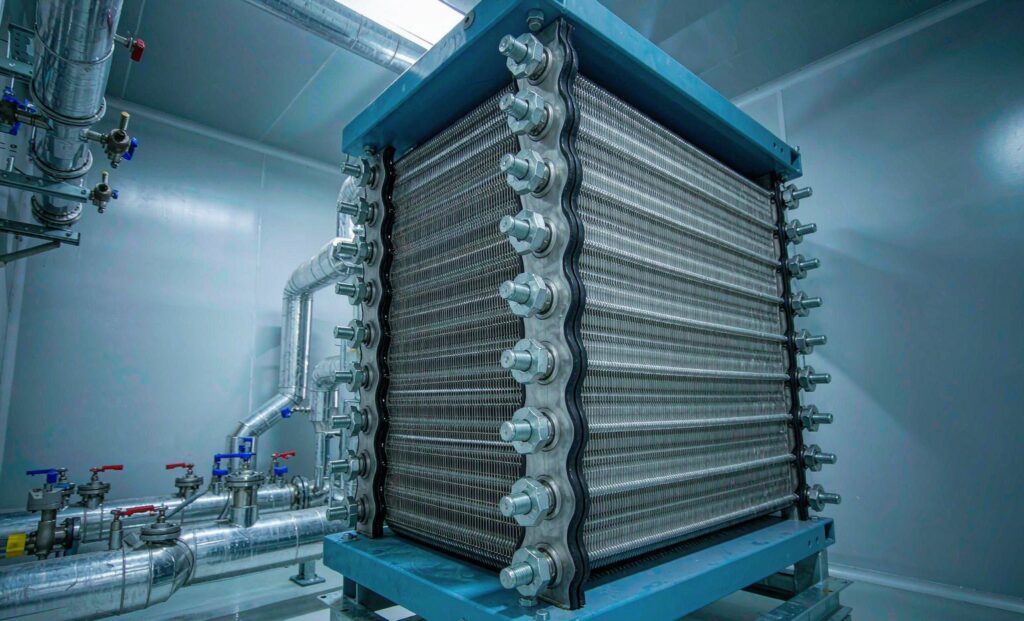
Why Ammonia Rewrites the Heat Exchanger Rules
An ammonia refrigeration heat exchanger is selected under constraints that simply do not apply to an R-134a or R-32 system. Ammonia is the most efficient common refrigerant, has zero global warming potential and costs a fraction of a synthetic HFC per kilogram — which is why industrial cold storage, food processing, breweries and ice plants keep returning to it. It is also toxic, which means the refrigerant charge in the plant becomes a safety and regulatory number rather than an engineering detail.
The plate versus shell and tube comparison also runs the other way for ammonia. In most duties a shell and tube exchanger holds the larger charge, and every kilogram of ammonia held in the plant counts against the room classification, the leak detection specification and the ventilation design. Selecting an ammonia refrigeration heat exchanger is therefore a question of duty, charge volume, materials and cleanability at the same time.
Where Heat Exchangers Sit in an Ammonia Plant
An industrial ammonia system contains several distinct heat transfer duties, and each one is a different selection problem.
| Duty | Function | Typical construction | Main engineering concern |
|---|---|---|---|
| Evaporator | Liquid ammonia boils, absorbing heat from a secondary fluid or the room | Gasketed or semi-welded plate, shell and tube, air cooler coil | Refrigerant distribution between channels, freeze protection at low evaporating temperature |
| Condenser | Ammonia vapour condenses and rejects heat to water or air | Shell and tube, evaporative condenser, plate | Condensing pressure, water quality on the cooling side, non-condensable venting |
| Subcooler | Liquid ammonia is cooled below condensing temperature | Plate or shell and tube | Liquid hold-up and flash gas removal |
| Oil cooler | Compressor lubricant is cooled, often with thermosiphon circulation | Shell and tube or plate | Oil viscosity at low temperature, cross-contamination with refrigerant |
| Desuperheater and economizer | Recovers high-grade heat or improves cycle efficiency | Shell and tube, plate | Pressure drop and two-phase distribution |
The distinction matters in procurement because the same plate family behaves completely differently as a direct-expansion evaporator, a pumped-liquid evaporator, a flooded evaporator or a condenser. Confirm the heat transfer role and the fluid path, not just the physical size.
Plate or Shell and Tube for Ammonia?
Gasketed and semi-welded plate exchangers have taken a large share of ammonia refrigeration duty from shell and tube units, mostly on charge volume and footprint. The trade-off is real, though, and it shows up in pressure rating and cleanability.
| Factor | Gasketed or semi-welded plate | Shell and tube |
|---|---|---|
| Heat transfer coefficient | High; corrugations force turbulence at modest velocity | Lower at the same velocity; baffles do the work instead |
| Ammonia charge | Typically a fraction of a comparable shell and tube unit | Large internal volume, large charge |
| Pressure rating | Medium, commonly up to about 25 bar | High; the shell tolerates much higher design pressure |
| Cleanability | Gasketed units open up for inspection and plate cleaning; semi-welded pairs are chemically cleaned only | Tube bundle removable in U-tube and floating head designs, hydrojettable |
| Footprint | Compact, and capacity can be changed by adding plates | Larger, fixed capacity |
| Best fit | Clean streams, charge-sensitive plant rooms, close approach temperatures | Dirty streams, high pressure, mechanical cleaning required |
For a large industrial plant the answer is usually a mix: plates for the charge-sensitive, clean duties, and shell and tube where the fluid is dirty, the pressure is high, or the maintenance team intends to clean tubes mechanically.
Material Selection: Where Ammonia Is Unusual
Two constraints dominate. First, ammonia attacks copper and copper alloys, so brass and copper-bearing materials are excluded from the refrigerant circuit — that rules out copper-brazed plate exchangers for ammonia duty. Second, ammonia is a chloride-free but strongly alkaline refrigerant that can cause stress corrosion cracking in some stainless grades under the wrong conditions, and it is highly permeable, so elastomer choice matters as much as metal choice.
- Plates and tubes — 316L stainless steel covers most ammonia evaporator and condenser duty. Titanium is used where the cooling side is seawater or brackish water, and nickel alloys are reserved for high temperature or high pressure ammonia heat pump duty.
- Brazed and welded plate units — because copper braze filler is not acceptable, ammonia service requires a nickel-brazed or fusion-bonded (100 per cent stainless, no filler metal) plate exchanger. These have no gaskets at all, so there is no elastomer to degrade, but they cannot be opened for cleaning.
- Gaskets — EPDM handles low temperature ammonia duty but degrades with prolonged exposure; HNBR and other ammonia-rated elastomers are specified where the gaskets see refrigerant directly. Viton-type fluorocarbons are used where temperature and chemical resistance both matter. Anchor the choice to the compound datasheet, not the trade name.
- Secondary side — glycol, brine and cooling water circuits are usually the real corrosion problem in a cold store, especially where washdown chemicals, salt and dissimilar metals meet. Review the secondary side as carefully as the refrigerant side.
If you are comparing plate constructions for a refrigerant duty, our guide to brazed versus gasketed plate heat exchangers covers where each construction belongs, including the welded and fusion-bonded options used where copper braze is not permitted.
Ammonia Charge Reduction: The Number That Drives the Design
The charge in the plant is what triggers machinery room classification, leak detection, ventilation rates and emergency shutdown requirements under most national ammonia safety codes. It is also the number that insurers and safety auditors ask about first. This is why charge reduction has become the strongest argument for plate exchangers in ammonia refrigeration, and why the internal volume of a proposed exchanger belongs in the technical comparison alongside the duty.
Three practical levers reduce charge:
- Choose the exchanger type with the lowest internal volume for the duty — a plate unit holds a small fraction of the refrigerant a shell and tube exchanger of the same capacity holds.
- Keep pipework runs short and liquid lines tight. Poorly routed suction and liquid headers routinely hold more ammonia than the exchangers themselves.
- Consider a secondary refrigerant loop — carbon dioxide or a glycol and brine circuit — that confines the ammonia to the machine room and eliminates large charged circuits in occupied areas.
Cleanability and Inspection in a Cold Store
Ammonia evaporators in food plants operate in a washdown environment with frost, oil carry-over from the compressor and secondary-side fouling all in play at once. Decide the cleaning method before the exchanger type, because a welded or brazed plate unit that cannot be opened is a poor choice in a duty that will need mechanical cleaning.
- Gasketed plate: open the frame, inspect every plate, replace individual gaskets. Best access, highest gasket count.
- Semi-welded plate: one side chemically cleaned only; the other side opens for plate cleaning.
- Shell and tube: pull the bundle, hydrojet the tubes, inspect the shell side. Best where the fluid is genuinely dirty.
- Air cooler coils: fin spacing determines frost hold-up and defrost interval — tight fins give more surface but block faster.
Specification Checklist for an Ammonia Heat Exchanger
- State the heat transfer role — evaporator, condenser, subcooler, oil cooler, economizer — not just the duty in kW.
- Give the pressure and temperature envelope, including the pressure that controls the design rather than the normal operating point.
- Give the evaporating and condensing conditions with the circulation method: direct expansion, pumped liquid or flooded.
- Specify materials for plates or tubes, frames, gaskets, fasteners and welds separately, and say whether copper-bearing materials are prohibited.
- State the ammonia charge you are prepared to accept and the code basis for it.
- State the cleaning method and the access you have at the installation point.
- Ask for plate or tube material certificates, weld procedures, non-destructive testing records and a hydrostatic test report with the offer.
- Ask for the predicted duty at the fouled condition, not only at clean conditions.
The Short Version
For ammonia refrigeration, the exchanger is selected on four numbers: duty, charge volume, pressure rating and cleanability. Plates win on charge and footprint; shell and tube wins on pressure, dirt and mechanical cleaning; and the material specification has to exclude copper and confirm the gasket compound. Write all four constraints into the enquiry and the offers you get back will be comparable.
Zhenggong Cooling and Heating Equipment Co., Ltd manufactures shell and tube, plate and air-cooled heat exchangers at a 35,000 m² facility in Shandong, China, and holds D1/D2 pressure vessel certification alongside ISO 9001 and ISO 14001. Send the duty, the refrigerant conditions and the materials you need excluded, and we will return a selection with the charge volume and the pressure envelope stated. Contact us through the contact page for a quotation, see the brazed and fusion bonded plate heat exchanger range for copper-free refrigerant duty, or check the certification page for the pressure vessel documentation supplied with each unit.
Last updated: October 2026.
Source: TEMA Standards and industrial refrigeration practice for ammonia (R-717) systems.