
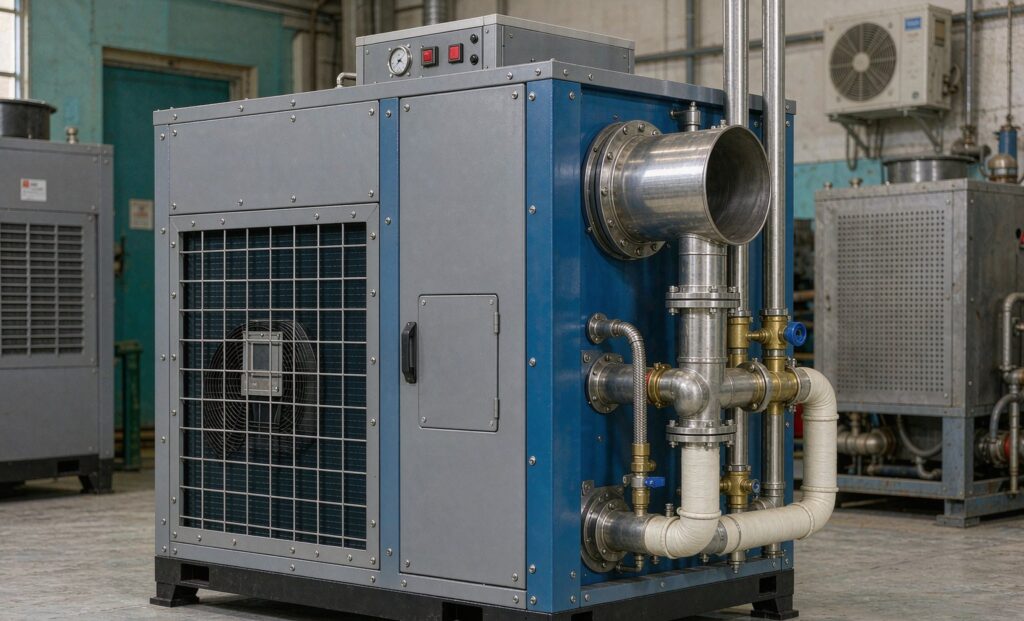
An industrial heat pump payback period is rarely the number a supplier puts on the first page of a proposal — it is the number a finance director recomputes from your own duty, your own energy tariffs and your own operating hours. Get those three inputs right and most process-heat projects in the 60–95 °C band land between 18 months and five years. Get them wrong and the same machine looks either like a bargain or a liability. This guide shows how to model the figure properly, and which costs the simple payback formula quietly leaves out.
What Actually Drives the Industrial Heat Pump Payback Period
Four variables decide the result. Everything else is detail.
- Thermal duty. The useful heat delivered, in kW. Model one load at a time — a plant-wide average cannot be verified and cannot be approved.
- Annual running hours. A plant that runs 6,000 hours a year multiplies every saving; a batch process that runs 1,500 hours multiplies the payback instead.
- The real coefficient of performance (COP). Not the catalogue number at nominal conditions, but the COP at your actual source temperature and your actual delivery temperature.
- The price gap. The difference between what you pay for fuel today and what you pay per kWh of electricity tomorrow. This gap — not the absolute price of either energy — is what funds the investment.
When the delivered heat price of gas rises above roughly 0.35 currency units per kWh, an electric heat pump at a realistic COP overtakes a gas boiler on running cost. That crossover is the whole investment case in one sentence.
How to Calculate the Payback in Five Steps
- Isolate the duty. Choose a single hot-water or steam load with a defined flow, temperature rise and annual hours. Write it down as kW, °C and h/year.
- Price the heat you buy today. Take your actual fuel invoice, the boiler efficiency (typically 80–90 % for a modern gas boiler, lower for oil) and convert to a cost per useful kWh.
- Price the same heat on a heat pump. Divide the annual useful heat by the honest COP, then multiply by your all-in electricity tariff. Add the demand charge for the extra electrical load.
- Subtract to get annual saving. Fuel cost today minus heat-pump running cost. This is the numerator you will divide the capital cost by.
- Divide capital cost by annual saving. Use an installed capital figure — machine, pipework, electrical, controls, commissioning — not a machine price.
Worked Example: A 500 kW Process Heat Duty
Take a hot-water duty of 500 kW running 6,000 hours a year at 70 °C output, currently served by a gas boiler. Annual useful heat is 3,000,000 kWh. At a boiler efficiency of 85 % and a fuel price equivalent to about 0.080 per kWh of fuel, the delivered heat costs roughly 0.094 per useful kWh, or about 282,000 a year.
The same 3,000,000 kWh on a heat pump with a COP of 3.5 draws about 857,000 kWh of electricity. At an industrial tariff equivalent to 0.11 per kWh, that is about 94,000, plus a demand charge of perhaps 15,000. Total running cost lands near 109,000.
| Parameter | Gas boiler | Industrial heat pump |
|---|---|---|
| Useful heat delivered | 3,000,000 kWh/y | 3,000,000 kWh/y |
| Efficiency basis | 85 % thermal | COP 3.5 |
| Annual energy purchased | ~3,530,000 kWh fuel | ~857,000 kWh electricity |
| Annual running cost (indicative) | ~282,000 | ~109,000 |
| Annual saving | ~173,000 | |
| Installed cost | assume 400,000 | |
| Simple payback | ~28 months | |
The figures are illustrative and move with local tariffs, but the shape is what matters: the saving is large enough that even a doubling of installed cost still clears a five-year hurdle.
The Four Costs a Simple Payback Leaves Out
Simple payback is capital divided by annual saving. Three of the four omitted items make the project worse; one makes it better.
- Electrical connection and demand charges. Moving heat from fuel to electricity raises your connected load. New switchgear, cable, a transformer upgrade and monthly kVA charges all belong in the model.
- Security deposit. Many utilities recalculate the deposit against the higher bill, which ties up working capital.
- Power factor penalties. A large compressor pulls the power factor down. An automatic power-factor correction panel is part of the project cost — and part of the saving.
- Accelerated depreciation. In many jurisdictions energy-saving equipment qualifies for faster write-down, which pulls cash benefit forward and improves the true return. This is the one omission that works in the project’s favour.
Where the Numbers Get Thin — and How to Fix Them
A heat pump payback stretches out when any of four conditions is true: low annual running hours, an unusually cheap fossil fuel, a low COP because the source is cold or the delivery temperature is high, or an expensive electricity tariff. The engineering answer is usually to raise the COP rather than to abandon the idea.
Every 10 °C you remove from the delivery temperature, or add to the source temperature, improves the COP and shortens the payback. That is why the best industrial heat pump projects are almost always paired with heat recovery: instead of drawing from ambient air, they draw from warm wastewater, cooling water or exhaust gas that the plant already owns. Our guide to waste heat recovery economics covers how to find and quantify those sources.
Where a full conversion does not yet pay, a hybrid design often does. The heat pump carries the base load at high COP and a smaller boiler trims the peaks. For a like-for-like running-cost comparison of the two technologies, see heat pump versus gas boiler.
The Choice That Sets the COP: Air-Source or Water-Source
Before the payback calculation is final, decide where the heat comes from, because that single decision moves the COP more than any other. An air-source unit is the simplest to install — there is nothing to drill and nothing to licence — but its source temperature falls with the weather, so its COP is lowest exactly when the heat is most needed. A water-source unit draws from a river, a lake, a borehole, a sewer or an existing cooling-water loop, and holds a far steadier and usually higher source temperature through the year.
Which source suits which site
- Air source: lowest capital cost, no water rights, good where winter is mild and the duty is modest.
- Water source: higher and steadier COP, best where a warm water body or process loop already exists; needs a heat exchanger between the source and the refrigerant circuit to keep the water out of the machine.
- Waste-heat source: the highest COP of all, because the source is warm by definition; the only question is whether it is available every hour you need heat.
That last point is why the most bankable projects pair a heat pump with an existing waste stream. If your plant rejects warm water or air to atmosphere today, that rejected heat is the cheapest source you will ever be offered — and it is already inside your fence line.
Specifying the Equipment Behind the Payback
An industrial heat pump is a refrigeration circuit that happens to deliver heat, so its economics rest on the heat exchangers inside it — the evaporator that lifts heat from the source and the condenser that releases it to the process. Their approach temperatures set the COP; their pressure drop sets the compressor lift. Specify them properly and the payback model you built above survives contact with the real machine.
Zhenggong manufactures shell and tube, plate and air-cooled exchangers together with complete industrial heat pump units for process heating, and builds them under an ISO 9001 and ISO 14001 quality and environmental system with D1/D2 pressure vessel certification for the pressurised bodies. Design duties are matched to your source and sink temperatures rather than to a catalogue nominal point.
Next Step
Send us the duty, the source temperature, the delivery temperature and your annual running hours. We will return a payback model and a sized heat pump selection you can put in front of a finance committee. Request a heat pump assessment and we will come back with the numbers, not a brochure.