
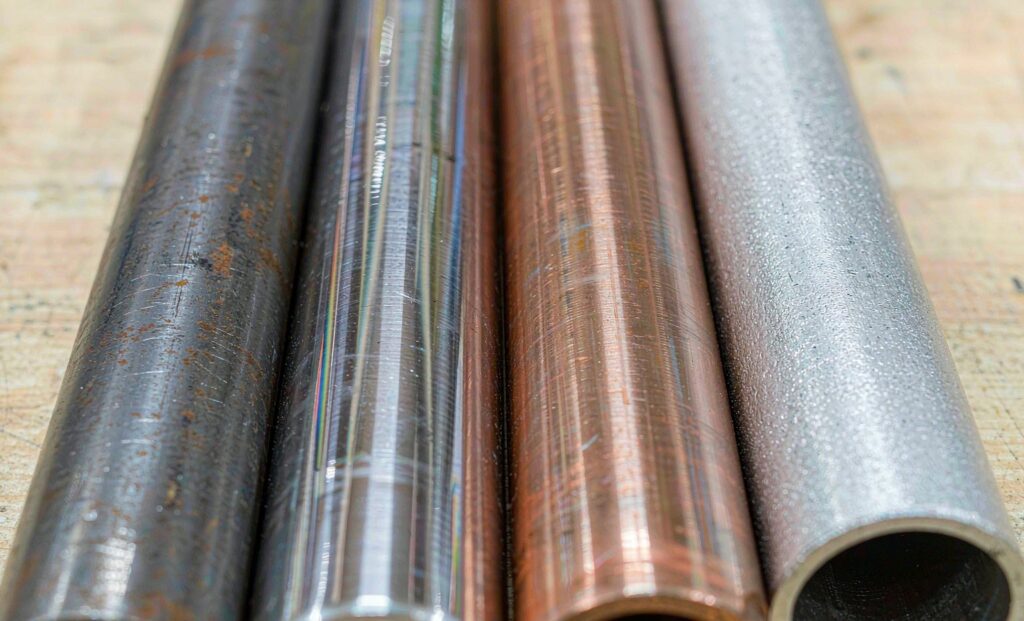
Why Tube Material Choice Outranks Almost Everything Else
When a shell and tube heat exchanger fails early, the cause is more often the tube material than the thermal design. A perfectly calculated unit in the wrong alloy will perforate within two or three years in a duty that a correctly specified one would survive for twenty. The material selection decision sits at the intersection of the process fluid, the cooling medium, the temperature, and the presence of chlorides — and it deserves more attention than it usually gets in a purchase enquiry.
This guide sets out the practical differences between the common tube materials, the specific conditions that rule each one in or out, and the selection questions you should be able to answer before specifying.
The Common Tube Materials and Where Each Belongs
Carbon Steel
Carbon steel is the default for non-corrosive duties: clean water, oil, and many process streams where the fluid is dry or inhibited. It has the highest thermal conductivity of the common tube materials and the lowest cost. Its weakness is corrosion in any aqueous service where dissolved oxygen is present, and its complete unsuitability for chloride-bearing water at temperature. Carbon steel tubes in a cooling water duty will generally need a corrosion allowance and a water treatment programme to reach a twenty-year life.
Stainless Steel 304 and 316 / 316L
304 stainless is a general-purpose austenitic grade suitable for clean water, many food duties and mildly corrosive process fluids. It is not suitable for chloride service at elevated temperature, where it is susceptible to chloride stress corrosion cracking — typically above about 60 °C depending on concentration. 316 and 316L add molybdenum, which improves resistance to pitting and to chlorides, and 316L is the workhorse grade for most industrial water and process duties.
The practical rule: if your cooling water has more than a few tens of ppm chloride and the tube wall runs hot, 304 is the wrong answer and 316L may also be marginal. This is the single most common material specification error we see.
Duplex and Super Duplex Stainless
Duplex grades offer roughly twice the yield strength of austenitic stainless and substantially better resistance to chloride stress corrosion cracking. Super duplex extends that further, into seawater and high-chloride process duties. Duplex is the natural choice where 316L is borderline: seawater cooling, high-chloride process water, and any duty running hot with chlorides present. It costs more per kilogram but allows a thinner wall thanks to the higher strength, which partially offsets the price difference.
Titanium
Titanium is essentially immune to seawater and chloride corrosion and is the standard choice for seawater-cooled and highly chlorinated duties. Its thermal conductivity is lower than carbon steel but higher than stainless, so thermal performance is not the barrier. Its limitation is cost and the fact that it is unsuitable in a few strongly reducing or dry chlorine environments.
Copper Alloys: Admiralty Brass, Cupro-Nickel
Admiralty brass has good thermal conductivity and reasonable resistance to fresh and brackish water. Cupro-nickel, particularly 90/10 and 70/30, handles seawater well and resists biofouling because copper ions inhibit marine growth. Both are unsuitable where ammonia or amines are present, which attack copper alloys aggressively, and cupro-nickel is increasingly avoided on environmental grounds where discharge of copper is regulated.
Comparing the Candidates
| Material | Best for | Avoid when | Relative cost |
|---|---|---|---|
| Carbon steel | Clean oil, dry gas, inhibited water | Oxygenated water, chlorides, marine duty | Lowest |
| Stainless 304 | Clean water, food, mild process fluids | Chlorides above ~60 °C | Low to moderate |
| Stainless 316/316L | Most industrial water and process duties | High chloride, hot seawater, reducing acids | Moderate |
| Duplex / super duplex | Seawater, high-chloride, hot process water | Very high temperature above ~300 °C | High |
| Titanium | Seawater, chlorinated water, aggressive brine | Strongly reducing environments, dry chlorine | High |
| Admiralty brass | Fresh and brackish cooling water | Ammonia or amine traces | Low to moderate |
| Cupro-nickel 90/10 | Seawater with biofouling risk | Ammonia present, copper discharge restricted | Moderate to high |
The Questions That Decide the Grade
- What is the chloride concentration of every stream, including the cooling water at its worst?
- What is the maximum tube wall metal temperature, not the bulk fluid temperature?
- Is dissolved oxygen present in any aqueous stream?
- Are there traces of ammonia, amines or sulphides anywhere in the process?
- Is the cooling water fresh, brackish, seawater, or treated closed-circuit?
- Will the unit ever be cleaned with a chemical that attacks the tube material?
- Are there welding or fabrication restrictions — is a duplex weld procedure available?
- What is the consequence of a tube failure: lost production, contamination, or a safety event?
The Selection Procedure That Works
Work from the corrosive stream outwards, not from the cost downwards. Identify which of the two streams is aggressive, decide the material for that side first, then choose the least expensive adequate material for the other. It is common and correct to have different tube and shell materials — a titanium tube bundle in a carbon steel shell is a normal and economic arrangement for a seawater-cooled unit.
Then check the assumption against three numbers: maximum chloride, maximum wall temperature and velocity. If the chosen material is only just inside its limit on any of them, move up one grade rather than rely on a margin. Verification of the material certificate against the specified grade is worth insisting on, particularly on duplex and titanium where substitution is difficult to detect visually. Our certification page sets out the material traceability we supply with each unit.
If the corrosive duty is severe enough that even super duplex is marginal, compare against a plate or air-cooled alternative before committing. Our guide to shell and tube versus plate heat exchangers covers the construction comparison, our air-cooled heat exchanger guide addresses duties where eliminating the cooling water solves the corrosion problem entirely, and our notes on heat exchanger tube failure and inspection intervals cover what to expect once the unit is in service.
Material Selection Is a Lifecycle Decision
The lowest purchase price almost never produces the lowest cost of ownership in a corrosive duty. A carbon steel bundle that is replaced every four years costs more than a duplex bundle that lasts twenty, and the difference is invisible in a capital comparison. Specify on the basis of the mechanism you expect, and price the replacement interval into the decision.
Zhenggong Cooling and Heating Equipment Co., Ltd manufactures shell and tube, plate and air-cooled heat exchangers at its 35,000 m² Shandong facility, with D1/D2 pressure vessel certification and ISO 9001 / ISO 14001 management systems. We supply bundles in carbon steel, stainless, duplex, titanium and copper alloys, and can advise on material selection for a specific fluid. Send us your stream compositions through the contact page for a recommendation, or browse our product range.
Last updated: October 2026.
Source: Nickel Institute and TEMA Standards, heat exchanger tube material guidance.