
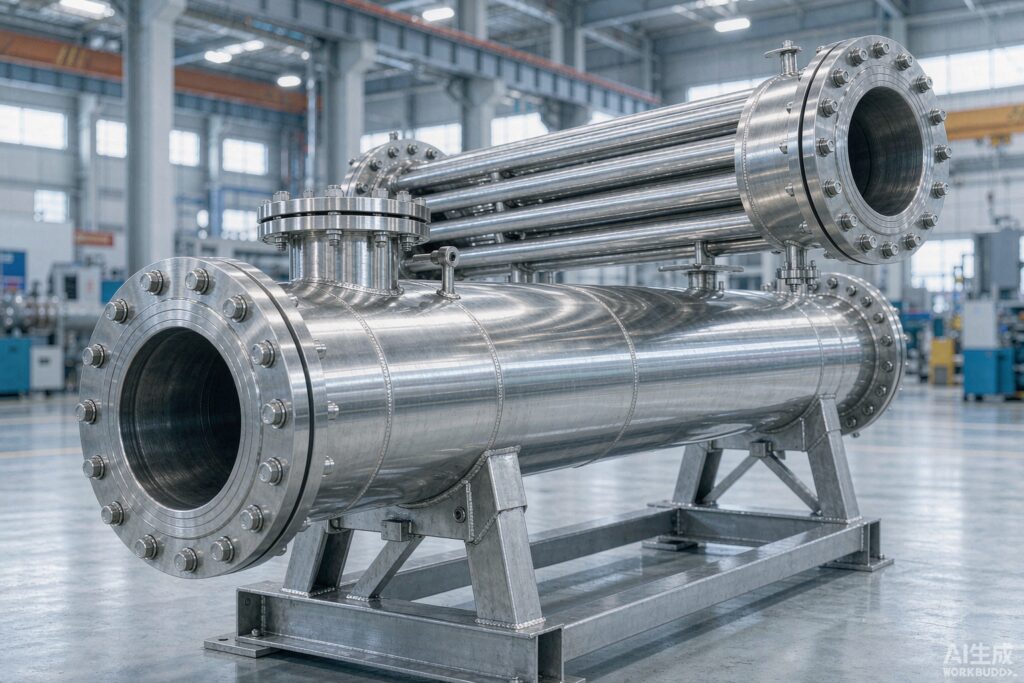
Choosing between a shell and tube heat exchanger and a plate heat exchanger is one of the most common decisions engineers face when designing or upgrading a thermal system. Both transfer heat efficiently — but they behave very differently in terms of cost, maintenance footprint, pressure tolerance, and long-term operating economics. This guide breaks down the practical trade-offs so you can match the right technology to your application.
Shell and Tube Heat Exchangers: Built for Heavy Duty
Shell and tube exchangers route one fluid through a bundle of tubes while a second fluid flows around them inside the shell. Their defining strengths are robustness and versatility:
- High pressure and temperature capability — well suited to steam, oil, and process applications where plate units would fail.
- Easy mechanical cleaning — the tube bundle can be pulled and re-tubed, which matters in fouling services.
- Long service life — a properly maintained shell and tube unit commonly runs for 20–30 years.
- D1/D2 pressure vessel compliance — regulated industries generally require certified pressure-vessel construction.
The trade-off is size: shell and tube exchangers need more floor space and typically hold a larger fluid volume than plate designs.
Plate Heat Exchangers: Compact and Highly Efficient
Plate exchangers stack corrugated metal plates that create turbulent flow in very narrow channels. This gives them exceptional heat transfer coefficients — often 3–5× higher than shell and tube — in a footprint that can be a fraction of the size. They excel in:
- HVAC and district heating/cooling with moderate pressures.
- Food, beverage, and pharmaceutical processing where gasketed plates can be opened for hygiene-critical cleaning.
- Heat pump and condenser duty where close temperature approach saves energy.
Limitations: gasketed plate units are capped at lower pressures and temperatures, and gaskets are a recurring maintenance item. Brazed and semi-welded variants push these limits higher at added cost.
Quick Selection Checklist
Use this short rule-of-thumb table before you specify:
| Requirement | Best choice |
|---|---|
| Pressure above ~25–30 bar | Shell and tube |
| Tight space, high efficiency | Plate |
| Fouling / dirty service | Shell and tube |
| Close temperature approach | Plate |
| Steam or thermal oil | Shell and tube |
| Fast maintenance access | Gasketed plate |
Why Certified Manufacturing Matters
Whatever geometry you choose, the fabricator’s qualifications drive reliability. Zhenggong Cooling and Heating Equipment manufactures both technologies at a 35,000 m² certified facility in Shandong, China, holding D1/D2 pressure vessel qualifications with ISO 9001 and ISO 14001 certified management systems — supporting custom sizing, material selection, and international compliance for export projects. For system design support and maintenance services, see our engineering services page.
Conclusion
There is no universal winner: shell and tube wins on pressure, fouling tolerance, and longevity; plate wins on efficiency, compactness, and cost per kW exchanged. When in doubt, share your duty points — flow rates, temperatures, pressures, and media — with a manufacturer who builds both. A supplier that can compare the two side by side against your real operating data will save you from the two classic mistakes: over-engineering a simple duty, or under-specifying a demanding one.