
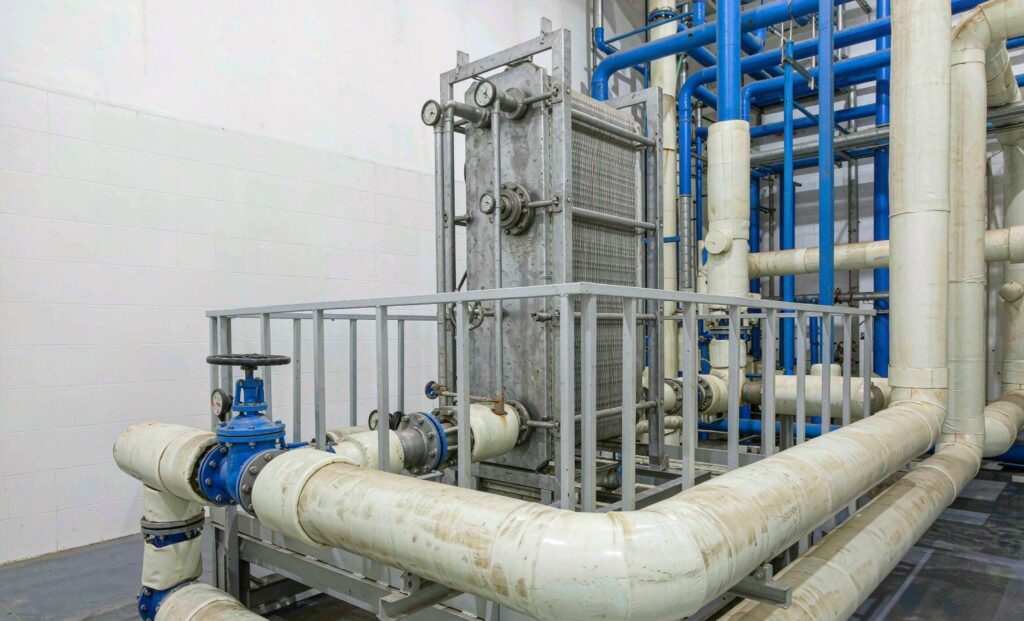
What District Heating Does to a Heat Exchanger Specification
District heating is not simply a large-scale version of a building heating system. It runs at higher network temperatures, at much larger pressure differentials, and with a seasonal load profile that swings from design capacity in January to almost nothing in July. Those three facts drive the heat exchanger selection in ways that a standard comfort-heating specification misses entirely.
This guide covers the selection criteria that matter for district heating substations: the temperature programme, the pressure rating split between network and building side, and the part-load behaviour that determines whether the unit actually performs in spring and autumn.
The Temperature Programme Is the Whole Design
District heating networks are defined by a temperature programme, typically quoted as supply and return temperatures at design conditions. A common European programme is 90/55 °C or 80/60 °C on the primary side, with a secondary side designed to 70/40 °C. The closer the primary return temperature can be driven towards the secondary inlet, the more heat the network can deliver for the same flow, and the lower the distribution losses.
That last point is where heat exchanger selection earns its keep. A well-matched unit will drive the primary return down to within a few degrees of the secondary return. A poorly matched unit leaves the primary return hot, which forces the network to circulate more water for the same duty and increases pumping energy across the whole system. The difference between a good and a mediocre approach temperature on a district heating substation is measured in megawatt-hours per year, not in the purchase price of the unit.
The Approach Temperature You Should Specify
State a maximum approach temperature, not just a duty. Something in the range of 2 to 5 °C at the cold end is achievable with a plate heat exchanger and is the number that determines whether the network return is actually low. A supplier who meets the duty but leaves a 12 °C approach has met the letter of the specification and missed the point of it.
Pressure Rating: Where the Split Matters
District heating substations sit between two systems that rarely share the same pressure class. The primary network may run at 16 bar or higher, particularly in tall buildings where the static head is significant. The secondary building circuit frequently runs lower, and local regulations may require a physical separation between them.
Where a direct connection is permitted, a single plate heat exchanger is used. Where indirect connection is required, the heat exchanger becomes the barrier between the two systems, and its design pressure must be equal to the higher of the two. This is not a place to economise, because a failure here floods a building with network water.
| Selection parameter | What to specify | Consequence of getting it wrong |
|---|---|---|
| Primary design pressure | The higher of network or building rating, with margin | Under-rated unit fails or cannot be certified |
| Maximum approach temperature | 2 to 5 °C at the cold end | High primary return raises network pumping cost permanently |
| Pressure drop allowance | Stated in kPa for both sides | Excessive drop requires larger pumps and more energy |
| Design temperature | Network supply plus margin | Gasket or plate material degrades prematurely |
| Turndown requirement | Minimum load as a percentage of design | Unit cannot control in summer; hunting and cycling |
| Fouling resistance | Network water is usually treated; still allow for it | Duty shortfall appears in the second or third season |
Why Part-Load Performance Decides the Real Cost
A district heating substation spends most of its operating hours well below design load. A unit optimised purely for the design point can be badly behaved at 20 per cent load, where velocity drops, flow distribution across the plates becomes uneven, and the control valve hunts. Specify the minimum turndown the site will see and ask what the approach temperature degrades to at that load. A unit that holds a reasonable approach at 30 per cent load is worth more than one with a marginally better design-point figure.
This is one reason plate heat exchangers dominate district heating substations: their narrow channels keep velocity up even at reduced flow, so the heat transfer coefficient does not collapse the way it does in a wide-gap shell and tube unit. The trade is a tighter pressure drop, which is why the pressure drop allowance has to be set with part load in mind rather than design flow alone.
A Selection Checklist for District Heating Substations
- Confirm whether the connection is direct or indirect, and what separation the local code requires.
- State the full temperature programme on both sides, not just the design duty.
- Specify the maximum approach temperature at the cold end.
- State the pressure drop allowance on each side as a hard limit in kPa.
- State the minimum turndown the station will operate at, and ask for the approach at that load.
- Confirm the design pressure is the higher of the two systems, with code margin.
- Specify a gasket material suited to the network water chemistry and temperature.
- Ask for the plate and gasket materials to be shown on the datasheet, not just the model number.
- Ask what the unit’s performance is after a realistic fouling allowance, not at clean conditions.
Materials and Longevity in Network Service
Network water is usually treated but not always perfectly. Where chlorides are present at temperature, 316L stainless plates are the baseline and higher-alloy grades are worth considering. Gasket choice is the more common weak point: EPDM is the standard for hot water, but if the network uses any oxygen scavenger or additive that is incompatible, the gasket life collapses. Ask your water treatment supplier for a compatibility statement and pass it to the exchanger manufacturer.
For a broader treatment of the alternatives, our guide to shell and tube versus plate heat exchangers sets out where each construction fits. If your site needs a heat pump rather than a direct network connection, our notes on industrial heat pump payback cover the economics. Our applications by industry pages include the HVAC and district energy duties we routinely supply.
The Short Version
District heating selection comes down to three numbers: the approach temperature at the cold end, the pressure rating of the higher of the two systems, and the minimum load the station will actually see. Get those three right and the unit will perform for its full service life. Get them wrong and you will pay for it in pumping energy every hour the network runs.
Zhenggong Cooling and Heating Equipment Co., Ltd manufactures gasketed and brazed plate heat exchangers, shell and tube units and air-cooled equipment at its 35,000 m² facility in Shandong, China, certified to D1/D2 pressure vessel standards and operating under ISO 9001 and ISO 14001. We supply district heating and HVAC substations worldwide. Contact us through our contact page with your temperature programme and pressure classes for a selection, or review our product range.
Last updated: October 2026.
Source: Euroheat & Power, district heating substation design guidance.