
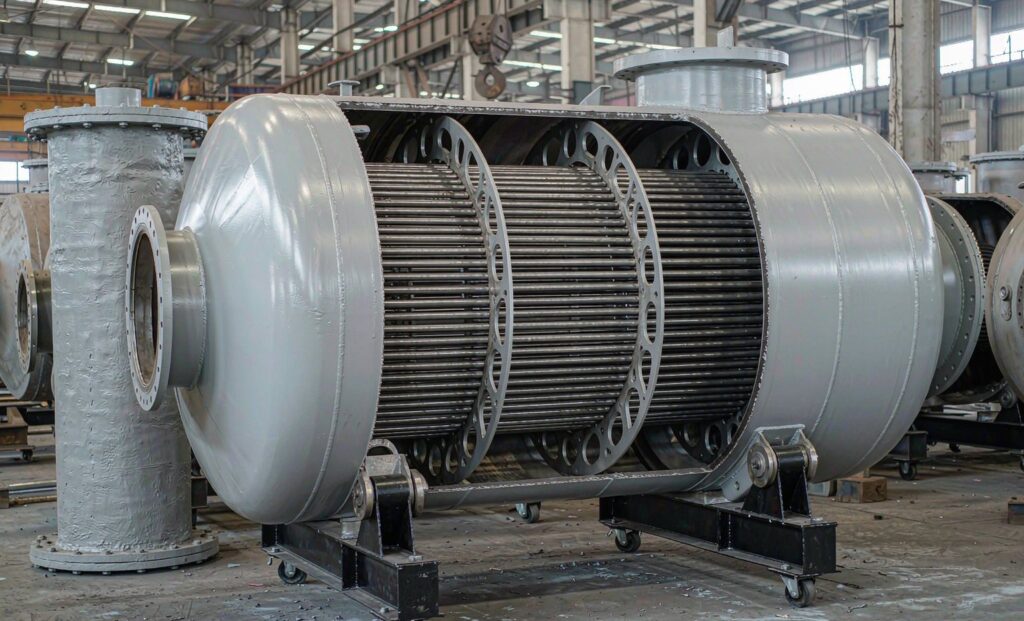
A GB/T 151 shell and tube heat exchanger is a unit designed and built to the Chinese national standard for heat exchangers, GB/T 151-2014, rather than to TEMA or ASME Section VIII. For a buyer outside China the distinction is not academic: it changes the material designations on the mill certificates, the non-destructive testing ratios, the documentation package and, occasionally, the tube-to-tubesheet joint that arrives on the dock. Most of the confusion in this trade comes from treating GB/T 151 as a translation of TEMA. It is not. It is a parallel standard with its own material system, its own allowable stress basis and its own inspection conventions, and it is the standard a very large share of the world’s shell and tube exchangers are actually built to.
This is what the standard covers, where it genuinely aligns with the Western codes and where it diverges, and what a purchaser should write into an enquiry so that the delivered unit is the one that was specified.
What GB/T 151 is, and what it is not
GB/T 151-2014 is a recommended national standard (the “T” in GB/T means recommended rather than mandatory) titled, in translation, Heat exchangers. It governs the design, fabrication, inspection and acceptance of shell and tube heat exchangers, and it replaced the earlier GB 151-1999. It is a product standard for a class of equipment, which is precisely how TEMA is used in North America, and it plays a similar role in Chinese procurement.
Three things it is not:
- It is not the pressure vessel code. The governing pressure vessel standard in China is the GB 150 series — GB 150.1 to 150.4 — which covers design, materials, fabrication and inspection of pressure vessels generally. GB/T 151 sits on top of that for the exchanger-specific rules: tubesheets, tube-to-tubesheet joints, bundles, expansion joints and the thermal design interface.
- It is not a substitute for the safety regulation. Fixed pressure vessels in China fall under the special equipment safety regime, TSG 21, which governs registration, periodic inspection and the qualification of the manufacturer. A unit can be built to GB/T 151 and still be non-compliant with TSG 21 if the fabricator lacks the licence for that category.
- It is not TEMA with Chinese labels. Some requirements are stricter, some looser, and several are simply organised differently. Assuming equivalence is how a buyer ends up with a bundle that meets the standard on paper and does not meet the project specification.
The document set a Chinese exchanger is actually built to
When a Chinese fabricator says a unit is “built to GB”, the useful question is which documents are in the design package. A complete one normally references:
- GB/T 151-2014 for the exchanger itself.
- GB 150.1–150.4 for the pressure boundary design rules, allowable stresses and weld details.
- GB/T 151’s referenced material standards — the plate, tube, forging and casting standards that give the actual chemistry and mechanical properties.
- TSG 21 for the manufacturing licence category and the statutory inspection regime.
- NB/T 47013 for non-destructive testing methods and acceptance levels, where NDT is required.
Ask for that list in writing at quotation stage. A fabricator who cannot produce it is not working to a controlled design package, whatever the cover page of the drawing says.
Materials: the designation system that confuses buyers
Chinese material designations do not map one-to-one onto ASTM or EN grades, and a “304 equivalent” on a quotation is a claim that needs checking against the certificate. The common pairings in exchanger construction are these, and they should be read as the nearest equivalent rather than an identity:
| Chinese designation | Nearest common equivalent | Where it appears | What to verify |
|---|---|---|---|
| Q245R | Pressure-vessel-quality carbon steel plate, comparable to A516 Gr.60/70 territory | Shells, channels, heads at moderate duty | Impact test requirement and plate thickness range on the certificate |
| Q345R | Higher-strength carbon steel plate, comparable to A516 Gr.70 territory | Shells and channels at higher pressure | Grade, impact energy, heat treatment condition |
| S30408 | 304 / 1.4301 | Tubes, shells, wetted parts | Actual Ni and Cr content, not just the grade name |
| S31603 | 316L / 1.4404 | Tubes and wetted parts in chloride or corrosive duty | Carbon content and intergranular corrosion test if welded |
| S32168 | 321 / 1.4541 | Tubes in high-temperature or thermal-cycling duty | Titanium stabilisation, and whether tube ends are annealed |
The single most common procurement failure here is accepting a grade name without the chemistry. S30408 and 304 are close; “304 equivalent” from a trader is not a material specification at all.
Tube-to-tubesheet joints: expanded, welded, or both
GB/T 151 recognises the same three joint families used elsewhere: roller-expanded, welded, and welded plus expanded. The choice is driven by pressure, temperature, thermal cycling and the consequence of leakage between the two sides.
- Expanded only. Adequate for moderate pressure and temperature where a small cross-leak is tolerable and the tubesheet is thick enough for the required ligament. Sensitive to tube-hole finish and to the expansion procedure.
- Welded only. Used where the joint must be leaktight and the duty is clean, but the weld is thin and a poor weld is a leak path that appears at first thermal cycle.
- Welded plus expanded. The default for critical duty: the weld seals, the expansion carries the mechanical load and relieves the weld of fatigue. Also the more expensive and the harder to repair.
Whichever is specified, the enquiry should state it explicitly. A fabricator left to choose will choose the cheapest joint that satisfies the standard, and that is usually not the one the process engineer assumed.
Baffles, bundle types and vibration
GB/T 151 covers the conventional baffle arrangements — single-segment, double-segment and the no-tubes-in-window variants — together with support plate spacing rules. The practical issue for a buyer is flow-induced vibration: a bundle designed to the standard’s minimum support spacing can still vibrate in service if the shell-side velocity is high, particularly in the inlet region and in a gas or vapour duty.
If the duty involves high shell-side velocity, state a maximum unsupported span or ask for a vibration check in the design report. This is the one area where “it complies with GB/T 151” and “it will survive ten years” can both be true statements about a unit that fails in year two.
Design pressure, temperature and allowable stress
Allowable stresses under the GB 150 basis are tabulated against material, thickness and temperature, and they are not identical to ASME Section II values even for a comparable grade. In practice the differences are modest, but they matter at the edges: thick-wall units, high-temperature service, and any duty where the design margin is thin.
Two rules follow for a purchaser. First, specify design pressure and design temperature as separate numbers for each side — shell and tube — rather than a single figure, because a Chinese quotation sheet will often carry one number for the whole unit unless told otherwise. Second, where the project is governed by ASME or PED, say so at enquiry stage. Some fabricators will build to a dual basis; a few will quietly build to GB and present the certificate as though it were equivalent.
Non-destructive testing and weld efficiency
GB/T 151 works with weld joint efficiency factors tied to the extent of radiography or ultrasonic testing, in the same logic as ASME. The trap is the default: a unit quoted without a stated NDT percentage typically carries the minimum the standard allows, which corresponds to a lower joint efficiency, which means a thicker wall for the same pressure — or, if the wall was sized on the assumption of full radiography, a unit that does not meet its design condition.
State the NDT method, the extent (for example full radiography of all longitudinal and circumferential seams, or spot radiography) and the acceptance level in the enquiry. Then check the radiographs against the seam list on delivery. A documentation package that contains reports for fewer seams than the unit has is the most common finding in a third-party inspection.
Hydrostatic testing
The hydrostatic test for a GB/T 151 unit follows the GB 150 basis: a test pressure normally derived as 1.25 times the design pressure, adjusted by the ratio of allowable stress at test temperature to that at design temperature, with the shell and tube sides tested separately where the design pressures differ. The test is witnessed and recorded, and the record belongs in the documentation package.
Ask for the test pressure calculation, not just the certificate. A certificate showing a test pressure that cannot be reproduced from the design data is a document problem that surfaces at the worst possible moment — during a client’s pre-commissioning audit.
Nameplate, documentation and third-party inspection
A compliant Chinese exchanger arrives with a nameplate carrying the design and test pressures, design temperature, material of each pressure part, capacity, weight, the standard referenced and the manufacturer’s licence details. The documentation package should contain the design calculation, the drawings, material certificates traceable to heat numbers, NDT reports, the hydrostatic test record, and where applicable the third-party inspection certificate.
For export projects, name the inspection body at enquiry stage — a recognised third party such as SGS, TÜV, Bureau Veritas or Intertek — and state whether witness points are required at material identification, at hydrotest and at final painting. Retrofitting an inspection requirement after fabrication is expensive; specifying it beforehand costs a line in the purchase order.
What to put in an enquiry
To get a unit that is both compliant and suitable, the enquiry should carry: duty data for each side (flow, inlet and outlet temperature, allowable pressure drop, fluid and its fouling tendency); design pressure and design temperature for shell and tube separately; the code basis, stated as GB/T 151 plus GB 150, or ASME VIII Div.1, or both; TEMA class if the buyer’s specification requires it; tube material and tube-to-tubesheet joint type; NDT extent and acceptance level; the third-party inspection requirement; and the documentation language.
Vague enquiries get a price against a generic design, and the gap between that and the specification is discovered at the FAT. One page of requirements prevents it.
Where GB/T 151 surprises foreign buyers
Four recurring surprises, in order of how often they cost money:
- Material certificates in Chinese with grade names that do not resolve. Ask for the chemistry and mechanicals in the certificate, in English, and check them against the grade rather than the grade against the name.
- Documentation thinner than expected. Design calculations and NDT coverage are sometimes partial unless the purchase order defines them.
- Painting and surface preparation to a Chinese standard rather than the project’s ISO 12944 class. If the site is coastal, specify the system.
- Nozzle and flange standards. Chinese flanges to the GB/T series are not interchangeable with ASME B16.5 even at the same nominal size and pressure class. If the unit must mate with imported pipework, specify the flange standard.
None of these is a defect in the standard. They are differences between standards that only become defects when nobody writes the requirement down.
Our shell and tube heat exchanger range is built to the GB/T 151 and GB 150 basis with material certificates and NDT records traceable to heat number, and the guide to TEMA shell and tube types sets out the classification a project specification usually asks for. The shell and tube overview covers bundle selection by duty. Send the duty data and the code basis and we will confirm the design route before quotation.
