
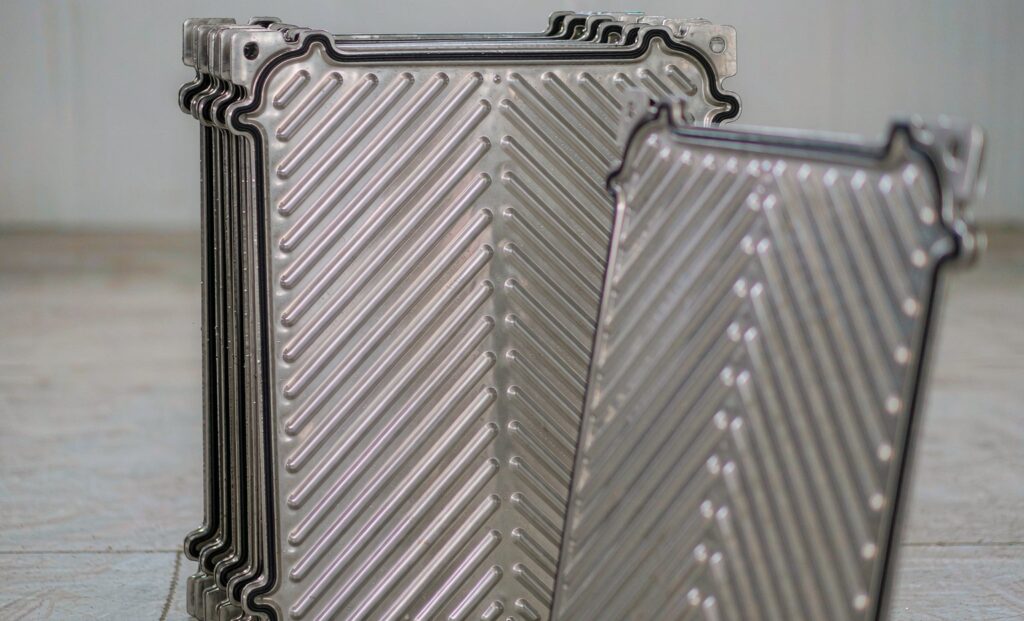
Alfa Laval plate heat exchanger plates replacement is a dimensional exercise before it is a purchasing one. The plate is a stamped pressing, not a machined part: its duty is set by the chevron angle, its thickness, the port configuration and the gasket groove, and every one of those has to match the frame it is going into and the plates it is going to sit next to. Order a plate that is dimensionally close and the pack will not close to its compression dimension, or it will close and leak at the first port. Neither failure is visible until the unit is assembled and pressurised.
This is what a replacement actually involves, the measurements that identify a plate without a part number, and the four decisions that determine whether the new pack performs like the original or merely fits.
What a plate replacement actually replaces
Three different jobs get called the same thing, and they have different answers.
- Re-gasketing. Plates reused, gaskets renewed. Correct when the plates are clean, flat and crack-free, and only the elastomer has aged. Cheapest, and the most common job on a well-maintained unit.
- Plate replacement. New plates, new gaskets, existing frame. Correct when plates are cracked, pitted through, deformed at the port rims, or when the duty has changed and the pack needs a different angle or count.
- Pack re-rating. New plates plus a changed plate count or chevron angle to move duty. This is an engineering change, not a spare-parts order, and it needs the original duty data — flow rates, inlet and outlet temperatures, pressure drop allowance and fluid properties.
Most enquiries describe the third job while asking for the price of the second. The distinction matters because a like-for-like plate is a catalogued part, while a re-rated pack is a thermal calculation that has to be redone.
The six measurements that identify a plate
Where the plate marking is unreadable or the unit has been re-plated before with non-original parts, these six numbers identify the plate family well enough to quote it. Take them with the plate flat on a bench, not in the frame.
| Measurement | How to take it | What it fixes |
|---|---|---|
| Plate height and width, outer | Steel rule across the full pressing | Identifies the frame size and therefore the plate family |
| Plate thickness | Micrometer on the flat land, not the corrugation | Sets the channel gap and the achievable compression |
| Port centre distance, horizontal and vertical | Centre to centre of the port holes | Distinguishes variants that share a footprint |
| Port diameter | Vernier inside the port ring | Flow area; some families offer more than one |
| Chevron angle | Read from the plate marking, or measure the corrugation pitch and depth | Sets the heat transfer and pressure drop balance |
| Gasket groove profile and gasket section | Section a scrap gasket; measure width and height | Determines whether the replacement gasket will seat |
Photograph each plate face as well. Two shots — one of the full plate, one of the port area and the marking — answer questions that six numbers cannot, particularly on older frames where the port ring is a different pressing.
Reading the plate marking
Original plates carry a marking pressed or inked onto the plate face: a model designation, a plate thickness code, sometimes a chevron angle letter and a production code. That marking is the fastest route to a correct replacement, and it is the first thing to photograph. Three cautions:
- A marking can be non-original. Plates from third-party suppliers are often marked to look familiar. If the marking does not resolve against the manufacturer’s own documentation, treat the plate as unidentified and measure it.
- The marking may not encode the angle. On several families the angle is a separate suffix. A plate quoted without stating its angle is quoted on the assumption that it matches what is already there.
- Gaskets are marked separately. A plate and its gasket are two parts with two identities. Replacing plates while reusing old gaskets is normal; replacing plates without recording the gasket material and section is how units end up with the wrong elastomer.
Plate thickness: 0.5, 0.6 and 0.8 mm, and what changes
Gasketed plates in general process and HVAC duty are commonly between about 0.4 mm and 1.0 mm thick, with 0.5 mm and 0.6 mm covering most duties and 0.8 mm appearing where pressure or corrosion allowance demands it. Thickness is not a quality upgrade — it is a trade:
- Thinner plate, same pressing: deeper effective channel, better heat transfer per unit area, lower cost per square metre. Less resistant to pressure, more sensitive to handling damage and to erosion at the port.
- Thicker plate: higher design pressure, better tolerance of thermal cycling and of a corrosive duty with a corrosion allowance, but fewer plates fit in a fixed frame length and the thermal performance per plate drops.
Fitting thicker plates into a frame dimensioned for thin ones reduces the plate count that will close, which reduces the surface area, which changes the duty. That is a legitimate engineering outcome, but it has to be calculated rather than discovered at commissioning.
Chevron angle and the duty trade-off
The corrugation angle is the single most consequential choice on a plate. Steep angles (often designated H) produce high turbulence, high heat transfer coefficients and high pressure drop. Shallow angles (L) produce the opposite. Mixed packs — alternating high and medium angle plates — are used to hit a duty in a frame that would otherwise be too small or too large.
The rule that matters in replacement: the angle pattern must be preserved. A pack built as alternating H and M plates performs differently if replaced with all-M plates, even at the same plate count and the same total area. If the original pattern cannot be established, the duty has to be recalculated rather than assumed.
Gasket material selection
The plate is usually stainless; the gasket is what fails. Four elastomers cover almost everything:
| Material | Typical temperature band | Good for | Do not use for |
|---|---|---|---|
| NBR | about −20 to +110 °C | Water, water-glycol, oils, general HVAC | Steam above its limit, strong oxidising chemicals, hot aromatic solvents |
| EPDM | about −25 to +150 °C | Hot water, steam, many aqueous chemicals, glycol | Mineral oils, hydrocarbons, fats |
| HNBR | about −20 to +140 °C | Oil and glycol at higher temperature than NBR allows | Strong acids, ketones |
| FKM | about −10 to +180 °C | Hydrocarbons, oils, aggressive chemicals | Hot water and steam, ammonia, low-temperature duty |
Two practical notes. EPDM and oil are incompatible, and a dairy or food duty switched from NBR to EPDM for temperature reasons will fail if any oil is present in the circuit. And a gasket chosen only by temperature band without regard to the fluid is how a pack lasts three months instead of five years.
Why a pack with mixed plates leaks
A plate pack is a stack of identical pressings compressed to a fixed dimension. Mixing plates from different pressings, different thicknesses or different angles breaks that stack in three ways:
- Uneven compression. Different thicknesses compress by different amounts at the same closing dimension, so the seals see different loads. The thinnest plate’s gasket leaks first.
- Port misalignment. Port rings from different families do not sit concentrically. A small offset creates a step that the gasket cannot seal across.
- Gasket groove mismatch. Groove profiles differ between generations. A gasket that fits the groove but not the neighbouring plate’s land will extrude at pressure.
This is why the honest answer to “can I add four plates I have in stock” is usually no, unless the provenance is known. Where plates must be mixed, they should at least be the same pressing, the same thickness and the same angle, and they should be placed contiguously rather than distributed through the pack.
Cleaning, re-gasketing or replacing: the decision
Fouling and failure look similar from outside: reduced duty, rising pressure drop, a temperature approach that will not close. The difference is found after opening the unit.
- Fouled but sound plates — clean in place with the correct chemical for the foulant, or remove and clean off-line. Scaling responds to acid; organic films and fats respond to caustic; both need the gasket material checked against the cleaning chemical first.
- Gaskets hard, cracked or swollen — plates are probably reusable. Replace gaskets, check plate flatness, reassemble.
- Pitting or through-cracks — replace. A cracked plate leaks between the two media, which is a contamination event, not just a loss of duty.
- Deformed port rims — replace. This is the common failure on units that have been over-compressed or assembled with grit in the port.
- Creep or stress-corrosion cracking in the corrugation — replace, and investigate chloride levels and the cleaning regime. New plates in the same service will do the same thing.
Compression, the closing dimension and torque
Plate packs are closed to a dimension, not to a torque, and the dimension is measured across the pack or between the frame’s reference marks. Torque figures exist as an assembly aid, but the acceptance criterion is the dimension. Over-compression is a real failure mode: it deforms the plate corrugations, crushes the gaskets into the grooves and shortens the life of both.
Close the pack diagonally and evenly, in several passes, checking the dimension on both sides as you go. A pack that closes unevenly will leak at the slack end no matter how much torque is applied afterwards.
Pressure testing and commissioning
After assembly, test each side separately at the specified test pressure with the other side open to atmosphere, so a leaking gasket is visible as a cross-leak rather than hidden. Then bring the unit into service slowly: a cold pack pressurised with hot fluid will move as the plates expand, and a sudden thermal shock on a freshly assembled pack is a common cause of a gasket that creeps out of its groove.
What to send with an enquiry
The plate marking photograph, the six measurements, the plate count currently fitted, the gasket material, the duty (flows, temperatures, pressure drop), and the fluid on each side. Add the frame’s serial or nameplate photograph. With those, a replacement can be quoted and cross-checked against the original duty; without them, the quote is a dimensional guess dressed as a part number.
On the standards side, gasketed plate-and-frame exchangers for petroleum and petrochemical service are covered by ISO 15547-1, which sets out the mechanical requirements, and that document is worth naming in an enquiry where the unit is going into a specification-driven project.
What “compatible” means, and what it does not
Aftermarket plates for a branded frame are described as compatible, pattern or equivalent. What that should mean is that the plate is dimensionally interchangeable — same footprint, thickness, port geometry, angle and groove — and that the gasket seats in the same groove. What it does not mean is that the plate carries the original manufacturer’s approval, and it does not mean the thermal duty has been verified unless the supplier states the calculation basis.
Alfa Laval is a trademark of Alfa Laval Corporate AB. Our plates are independent aftermarket parts supplied as dimensional replacements; we are not affiliated with, or authorised by, that company, and original parts remain available from it. For a critical duty where the warranty is tied to original components, that is the right route.
Our Alfa Laval gasket replacement range covers the elastomer side of the same job, the gasket material selection guide covers fluid compatibility in more detail, and our re-gasketing and plate replacement service covers units where the pack is beyond a bench repair. Send the marking photograph and the six measurements, and we will confirm the plate family before anything is pressed.
