
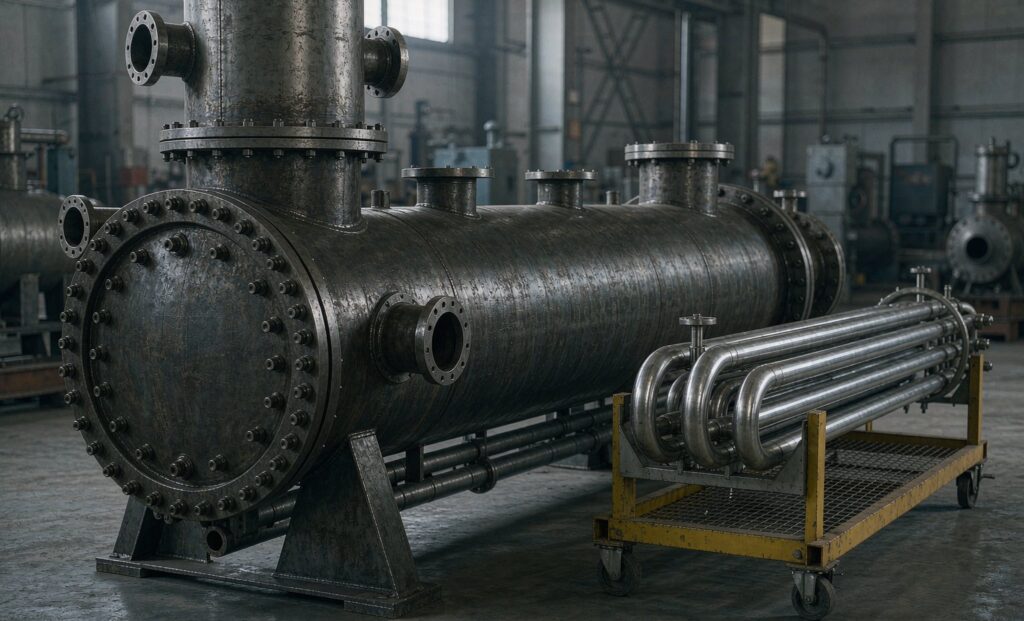
What the Three Letters On a TEMA Shell and Tube Heat Exchanger Actually Control
Most enquiries that reach us quote a duty, a material and a delivery date, and leave one decision entirely open: the TEMA shell and tube heat exchanger types. That decision is usually buried in a three-letter code in the corner of a datasheet — BEM, BEU, AES, AEW — and it is treated as a part number rather than an engineering choice. It is not. The TEMA designation describes how the unit comes apart, how it copes with thermal expansion, and therefore what it will cost to keep running for the next twenty years.
Two suppliers can quote the same duty, the same materials and the same surface area, and still differ by 30 to 40 per cent in price because one assumed a fixed tubesheet and the other assumed a floating head. Understanding the TEMA shell and tube heat exchanger types is how a buyer knows which of those two quotes is the right one, instead of simply paying for the cheaper mistake.
This guide decodes the designation, compares the configurations that matter in real procurement, and lists the questions that should be answered before the type is frozen on the drawing.
What the TEMA Designation System Is, and What It Is Not
The Tubular Exchanger Manufacturers Association has published a mechanical standard for shell and tube exchangers since 1941. The three-letter code is the short form of that standard: front head, shell type, rear head. A full specification adds shell diameter and tube length in inches, so AES 27-240 describes a floating-head unit with a 27 inch shell and 240 inch tubes.
Two things the code deliberately does not describe. First, it says nothing about the thermal design: you can build a badly undersurfaced exchanger inside a perfect AES frame, and a fouling allowance of zero will pass every clean-condition check no matter which letters are stamped on the nameplate. Second, it does not define materials, corrosion allowance, tube wall thickness or the tube-to-tubesheet joint. Those come from the specification you write, not from TEMA. The designation is a mechanical skeleton, and it constrains everything that gets built around it.
Letter One: The Front Head (Channel)
The first letter describes what is bolted or welded to the front of the shell, and therefore how you get at the tube ends.
- A — channel with a removable cover. The cover unbolts without touching the tube-side piping. This is the most common front head in process and utility service, and the one to ask for when tubes will ever be inspected, cleaned or plugged.
- B — bonnet with an integral cover. Cheaper, but the whole bonnet must come off, which means breaking the tube-side pipework. Sensible only when tube access is genuinely rare: clean condensate, lube oil, closed loop water.
- C and N — channel integral with the tubesheet. Used where pressure or hazardous fluids make a flanged joint unacceptable.
- D — a special high-pressure closure for very high design pressures, typically above Class 600.
If your tube-side fluid is cooling water, choose A almost every time. The small cost premium buys the ability to hydrojet the tubes in place.
Letter Two: The Shell Type
The second letter describes the shell-side flow path, which is really a pressure-drop decision.
- E — single-pass shell. The default. Fluid enters one end, crosses the bundle guided by transverse baffles, leaves the other end. Roughly four out of five industrial units are E-type.
- F — two-pass shell with a longitudinal baffle. Higher LMTD and fewer shells in series, but the baffle is difficult to seal and leakage erodes the performance you were chasing.
- G, H and J — split, double-split and divided flow. Chosen when shell-side pressure drop must be cut sharply: large gas flows, vacuum service, viscous fluids.
- X — pure crossflow with no longitudinal baffles. The lowest shell-side pressure drop available, at the cost of efficiency.
- K — kettle reboiler with an enlarged shell and a vapour space above the bundle. Standard for distillation column reboilers.
For ordinary liquid-to-liquid duty, E is correct and anything else needs a reason. If a supplier proposes an F-shell to make a temperature cross work, ask how the longitudinal baffle is sealed and what happens to performance once it leaks.
Letter Three: The Rear Head, Where the Real Money Is
The third letter decides whether the bundle can be pulled, and how the unit absorbs the difference in expansion between hot tubes and a cooler shell.
- Fixed tubesheet (L, M, N) — tubes welded or rolled into both tubesheets, which are bolted to the shell. Cheapest, no internal gaskets, and the maximum number of tubes for a given shell. The penalty is that the shell side cannot be mechanically cleaned, and differential expansion is locked into the metal. Above roughly 50 degrees C difference between shell and tube average temperatures, a fixed tubesheet design either needs an expansion joint in the shell or should not be used at all.
- U-tube (U) — tubes bent into a U and free to expand. No internal gasket and no expansion joint, and the bundle comes out for shell-side cleaning. The U-bend cannot be mechanically cleaned, so the tube-side fluid must be clean.
- Floating head (P, S, T) — one tubesheet is free to move inside a shell cover. Both sides can be mechanically cleaned and the bundle is removable. This is the standard answer for dirty service on both sides and for high tube-side pressure. It costs more, has an internal gasket to maintain, and takes more space.
BEM vs BEU vs AES vs AEW: The Comparison That Decides Most Projects
| Selection factor | BEM (fixed tubesheet) | BEU (U-tube) | AES (floating head) | AEW (packed floating head) |
|---|---|---|---|---|
| Shell-side mechanical cleaning | No | Yes, bundle removable | Yes, bundle removable | Yes, bundle removable |
| Tube-side mechanical cleaning | Yes, cover off | No, U-bend blocks access | Yes, cover off | Yes, cover off |
| Thermal expansion handled by | Expansion joint or nothing | Free-floating U-bend | Free-floating tubesheet | Packed sliding joint |
| Internal gasket in the pressure boundary | None | None | Yes, split ring | Yes, packing to atmosphere |
| Relative first cost | Lowest | Low to medium | Highest | Medium to high |
| Best fit | Clean fluids, small temperature difference, budget driven | Large temperature difference, clean tube side, fouling shell side | Fouling both sides, high pressure, critical service | Moderate pressure and temperature, both sides fouling |
A practical rule that covers most industrial enquiries: if both streams are clean and the temperature difference is small, take BEM. If the temperature difference is large but the tube-side fluid is clean, take BEU. If either stream needs mechanical cleaning and the other is dirty too, take AES and accept the cost.
TEMA Class R, C or B
The letters are only part of the specification. TEMA also defines three mechanical classes: R for refinery and related service, C for general commercial and process duty, and B for chemical process service. The class drives minimum tube wall thickness, corrosion allowance, tube-to-tubesheet joint requirements and the inspection regime. A C-class unit and an R-class unit can share the same AES designation and be very different pieces of equipment. Always state the class in the enquiry, because suppliers will otherwise assume the lightest one that meets the code.
Five Questions That Fix the TEMA Type
- Does the shell side need mechanical cleaning during its life? If yes, BEM is off the table immediately.
- Does the tube side also need mechanical cleaning? If yes, BEU is eliminated too, and you are looking at AES or AEW.
- How large is the differential expansion — what is the difference between the average shell metal temperature and the average tube metal temperature? Above roughly 50 degrees C, be careful with a plain fixed tubesheet.
- Is either side at high pressure? High tube-side pressure favours U-tube over floating head. High shell-side pressure makes a packed floating head less attractive.
- Is the service sour or otherwise restricted by a material specification? That determines post-weld heat treatment, hardness limits and joint qualification, and it should be written down before the type is chosen.
The Three Specification Mistakes That Cost the Most
Specifying BEM for a fouling service. A fixed tubesheet plus a real fouling allowance is a contradiction. The unit will meet the duty when clean, foul, and then there is no way to restore the shell side except chemical cleaning. If the fouling factor is high, the maintenance route decides the configuration.
Specifying BEU with cooling water on the tube side. Cooling water scales, and scale inside a U-bend cannot be removed mechanically. Specify BEU for cooling water only when water quality is tightly controlled and chemical cleaning is acceptable.
Treating an expansion joint as an accessory. If the design ends up as a fixed tubesheet with an expansion joint in the shell, the joint is a pressure boundary component. It needs its own design calculation, fatigue assessment and inspection protocol, and it will be the first thing a plant inspector asks about.
What to Put in the Enquiry
To get a comparable TEMA shell and tube heat exchanger proposal from two or three suppliers, give them the same starting point:
- Duty, both flow rates, all four terminal temperatures and the allowable pressure drop on each side.
- The TEMA class you want, and whether any part of the unit is subject to an external design code.
- Fouling resistance for each stream drawn from real operating experience, not the clean condition.
- The intended cleaning method and access space available at the installation point.
- Design pressure and design temperature separately for shell and tube sides.
- Whether the plant will ever run at part load, and the minimum turndown expected.
Once the mechanical configuration is agreed, the internals follow — and the single number that most often ruins an otherwise correct design is baffle geometry. Our notes on baffle spacing in shell and tube heat exchangers explain how to specify it. The stainless shell and tube heat exchanger range we build covers fixed tubesheet, U-tube and floating head configurations in carbon steel, stainless steel, duplex and titanium.
The Short Version
The TEMA designation is a mechanical decision with a thermal consequence attached. Decide first what needs cleaning and how big the differential expansion is; those two answers eliminate most of the catalogue before you look at price. Then state the TEMA class, the fouling resistances and the pressure-drop limits, and ask for the internals to be shown on the drawing so two proposals can be compared on equal terms.
Zhenggong Cooling and Heating Equipment Co., Ltd manufactures shell and tube, plate and air-cooled heat exchangers at a 35,000 m² facility in Shandong, China, and holds D1/D2 pressure vessel certification alongside ISO 9001 and ISO 14001. Send the duty, the cleaning requirement and the design conditions, and we will return a thermal design with the TEMA type and internals shown on the outline drawing. Reach us through the contact page for a quote, or see the certification page for the documentation issued with each unit.
Last updated: October 2026.
Source: TEMA Standards, Tubular Exchanger Manufacturers Association, 10th edition.