
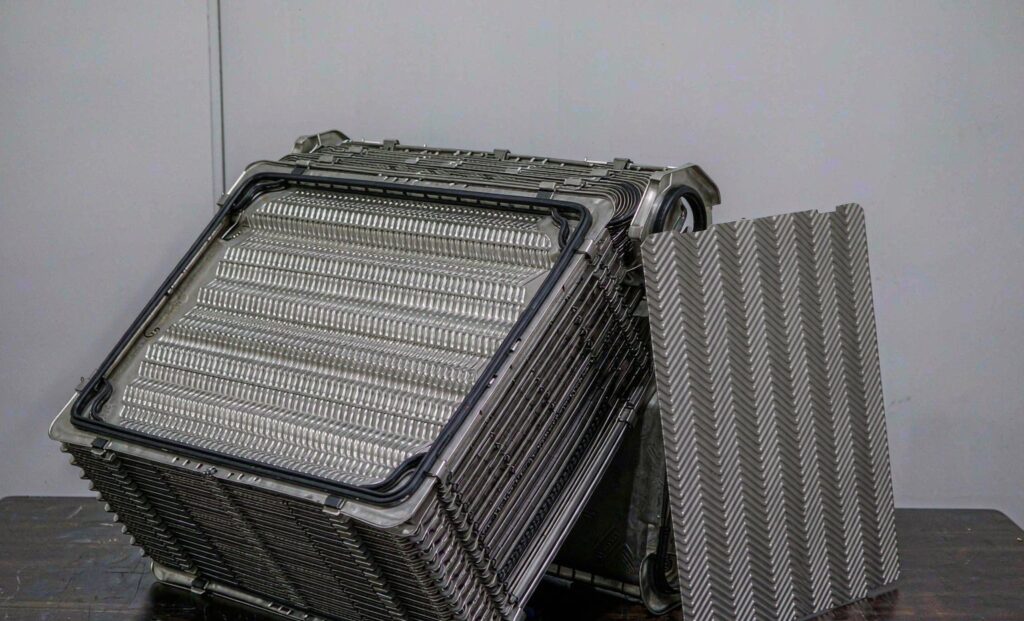
Schmidt packs turn up across European HVAC plant rooms, refrigeration systems and district heating substations, usually installed a decade or two ago and usually still carrying the original frame. When the pack finally needs replacing, the temptation is to order by model number and plate count from the nameplate. That works often enough to be dangerous: the same model designation has been built with more than one plate pattern over the years, and a pack that is 10 percent short on thermal length will show up as a duty shortfall long before it shows up as a leak.
A replacement pack is a legitimate engineering purchase. It just needs to be specified from the unit rather than from the label.
What the nameplate gives you
A Schmidt frame nameplate normally carries the model, the design pressure and temperature, a plate count and a year. Sometimes a serial that the manufacturer can trace, sometimes not, depending on how old the unit is and whether the plate has been rebuilt before.
What it does not give you is the plate pattern, the chevron angle, the actual plate thickness as built, or which gasket system was fitted. Those four things decide whether the new pack performs, and none of them are on the label. This is why a replacement quote built purely from the nameplate is a guess with a part number attached.
How to tell which plate you actually have
Before measuring anything, clean one plate properly and look at it. Most plate manufacturers mark the plate near the port or on the edge with a pattern code, a press mark or a date. On a Schmidt pack these marks are the fastest way to narrow the pattern family, and a photograph of the marking plus the nameplate saves a week of correspondence.
If the marking is illegible after years of service, geometry does the same job. Two plates from different families rarely share port centres, corrugation depth and plate thickness simultaneously.
The six measurements a plate supplier needs
- Overall plate length and width, measured on a cleaned plate that has been removed from the pack, not on the frame.
- Port centre distances — both axes — plus the port hole diameter. These fix alignment with the frame and are the first thing that goes wrong on a pattern-matched plate.
- Plate thickness. Commonly 0.4, 0.5 or 0.6 mm. The frame’s closing dimension assumes a specific thickness, so a substitution changes both duty and the assembly dimension.
- Chevron angle and corrugation depth. The plate’s thermal personality. A hard angle gives high heat transfer and high pressure drop; a soft angle the reverse. Two packs with the same plate count and different angles are not interchangeable.
- Gasket type and attachment. Clip-on, glued, or a two-piece arrangement. The groove profile differs, and a clip-on gasket will not sit in a glued groove.
- Material. 304, 316L, titanium, SMO, or a mixed pack where only the chloride side is upgraded.
A plate on a bench with a rule along both axes, photographed square-on, answers most of this in one image.
The dimension people forget: the A-measurement
Every frame has a closing dimension — the distance between the fixed and movable covers with the pack compressed. It is stamped on the frame or recorded in the manual, and it changes whenever plates are added, removed or re-gasketed. Assemble a new pack to a guessed dimension and the plates either leak at the gasket or get crushed at the port area.
Record the plate count and the closing dimension, tighten in the sequence and to the figure for that frame, in several passes, and log both numbers. The next maintenance interval starts from them. A pack that keeps needing “a bit more torque” is telling you the gaskets have had it.
Pattern-matched versus OEM plates
Pattern-matched plates are a normal engineering product, not a compromise, provided three things hold:
- Port geometry matches exactly. A few millimetres of offset creates a step the gasket cannot seal, or a restriction at the port that shows up as pressure drop.
- Plate thickness is the same, or declared. A 0.5 mm plate substituted for 0.4 mm changes the duty and the closing dimension at the same time.
- The thermal length is honest. More plates of a softer angle can match the duty without matching the pressure drop. Ask for both numbers, not one.
What does not transfer is the OEM’s warranty position on the frame. If the unit is under a service agreement, check before substituting.
Material selection, and the chloride trap
Most plate failures we see are chloride stress corrosion cracking in 304, not erosion. 304 is fine for clean, low-chloride loops and is the cheapest option. 316L covers most process water and food duties. Titanium is the correct answer for seawater, brine, and anything with chloride above roughly 200 ppm at temperature. SMO is the fallback where titanium itself is attacked.
Ammonia is a separate case: standard brazed units with copper filler cannot be used, and gasketed packs need gaskets that tolerate it. If the duty is ammonia refrigeration, say so at enquiry stage rather than at commissioning.
Gasket choice decides service life
NBR covers water, oils and most food duties to about 110 °C. EPDM is the default for hot water and steam-adjacent duties and handles higher temperatures. HNBR and HT-EPDM cover the upper range. The gasket is usually the first thing to fail, and the plate surface runs hotter than the bulk fluid, so specify with margin rather than to the nominal duty temperature.
The three ways a new pack fails in its first month
- Leak at the port area on first pressurisation. Almost always a gasket seating problem from assembling dry or from an incorrect closing dimension.
- Duty shortfall at design flow. Wrong chevron angle or a plate count carried over from a different pattern. It shows as an approach temperature that will not come down.
- Pressure drop above design. Plate count too high for the pattern, or a port restriction from a pattern-matched plate with slightly different geometry.
All three are visible in the first hour of commissioning if the right numbers are checked, and invisible if only “does it leak” is checked.
When replacing the pack is the wrong answer
If the frame is corroded at the gasket seat, the tie bars are stretched, or the plates are perforated by erosion in a specific band, a new pack buys a short interval rather than a solution. A shell and tube unit is often the more durable answer for dirty or high-pressure duties, and a brazed unit is frequently cheaper for a small clean duty.
Our brazed and gasketed plate range covers the alternative when the pack is beyond saving, the shell and tube range covers the duties a plate pack handles badly, and the service page covers re-gasketing and re-tubing. Send the nameplate photograph, the plate marking and the six measurements and we will come back with a pattern, a plate count and the expected pressure drop.
