
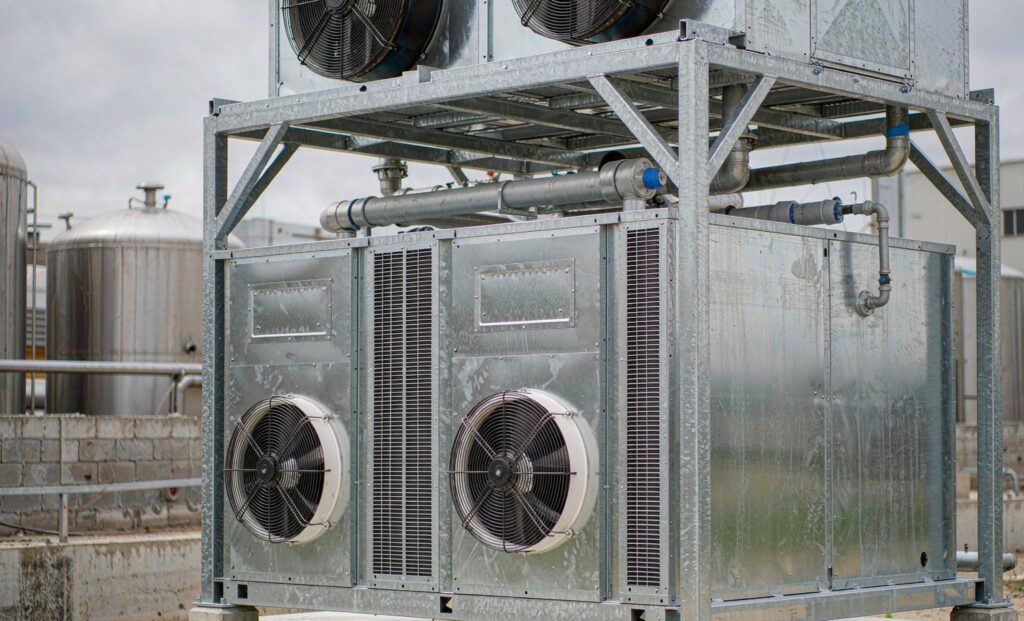
A chiller for a dairy or food plant is asked to do three jobs that an office cooling schedule never combines: hold a process temperature tightly, absorb a pulldown load after a washdown or a product change, and keep working in an environment that is wet, caustic and full of protein foam. Sizing on nameplate tonnage alone is how plants end up with a unit that holds duty in winter and trips on a 38 °C afternoon.
Separate the three loads before sizing anything
- Process load. Milk arriving at 30 to 35 °C and leaving at 4 °C, or a product stream held at a setpoint. This is a steady load and it sets the base capacity.
- Pulldown load. A warm tank, a room after defrost, or a batch that has to come down in a defined time. This is a transient load two to three times the steady figure, and it usually decides the compressor size.
- Cold store and hygiene load. Door openings, infiltration, lights, people, and the defrost cycle. Small individually, material in aggregate.
A unit sized only on the process load will short-cycle on pulldown and run at part load the rest of the day. Both are inefficient and both shorten compressor life.
Air cooled: the right answer, with conditions
An air cooled screw chiller removes the cooling tower, the water treatment and the make-up water from the plant, which for a food site is a hygiene and maintenance win. The cost is that capacity depends on ambient air, and the condenser coil becomes a fouling surface in a dusty yard or next to a dairy’s own exhaust.
Design the unit for the ambient it will actually see, not the ambient in the catalogue. A chiller rated at 35 °C that is asked to work at 42 °C in summer loses a meaningful share of its capacity and gains a high-pressure trip risk. Ask for the derate curve at your design ambient and at your altitude.
The inputs a chiller supplier actually needs
- Required duty in kW, and the pulldown requirement with its time limit.
- Heat transfer fluid: water, or glycol at what percentage. A 30 % propylene glycol loop costs efficiency but buys freeze protection that a dairy usually wants.
- Flow rate and the entering and leaving temperatures on both sides.
- Design ambient dry bulb, and whether the unit sits in a plant room or outdoors.
- Electrical supply, and whether the site needs a soft starter or VFD.
- Redundancy requirement: duty only, or duty and standby.
Eight numbers get a real selection. Without them a supplier is quoting a box.
Part load is where the energy is
A dairy chiller runs at full load for a few hours a day at most. The rest of the time it modulates, and the part-load behaviour decides the annual bill far more than the full-load kW does.
- Slide valve or VFD on the screw compressor — a screw unloaded by slide valve loses efficiency faster than one driven by a VFD at part load.
- Floating head pressure — letting the condensing pressure follow ambient instead of holding a fixed setpoint is usually the single largest saving on an air cooled unit.
- EC condenser fans — fan power is a real share of the total at low ambient, and EC fans track it down.
- Multiple compressors or circuits — two smaller circuits beat one large one at 40 % load, and they give you redundancy for free.
Washdown, food safety and the enclosure
This is where a standard HVAC chiller fails an audit. A dairy washdown involves hot water, caustic and acid detergents, and a hose aimed at everything at waist height. Specify:
- A corrosion-resistant frame and an enclosure rated for wet cleaning rather than weatherproof only.
- Coil coating or a coil material that survives caustic overspray; bare aluminium fin stock does not.
- Drain pans that empty completely and can be cleaned, not pans that hold a biofilm.
- Electrical enclosures positioned and sealed so they can be hosed around, not into.
- Guards that come off without tools for cleaning, because guards that are hard to remove get removed permanently.
If the plant runs HACCP, the chiller is part of the hazard analysis as soon as it cools a product contact stream. Document the refrigerant, the glycol type (food grade propylene, not ethylene), and the cleaning procedure.
Commissioning checks worth insisting on
- Record superheat and subcooling at full load and at 50 % load, not just at start-up.
- Verify glycol concentration with a refractometer against the design figure.
- Log the approach temperature on the evaporator and the condenser at design flow. A high approach on day one is a fouled or undersized exchanger, and it will only get worse.
- Check oil level and differential oil pressure after the first 48 hours, then again after two weeks.
Sizing it properly
Our air cooled screw chiller page carries the model range with capacities at standard conditions, and the glycol chiller page covers the low-temperature duties. The sizing tools will get you to an indicative duty and area in a few minutes, and the engineering services page covers the site survey if the plant layout is still open. Send the duty, the fluid and the design ambient and we will come back with a selection and a derate curve rather than a headline tonnage.
