
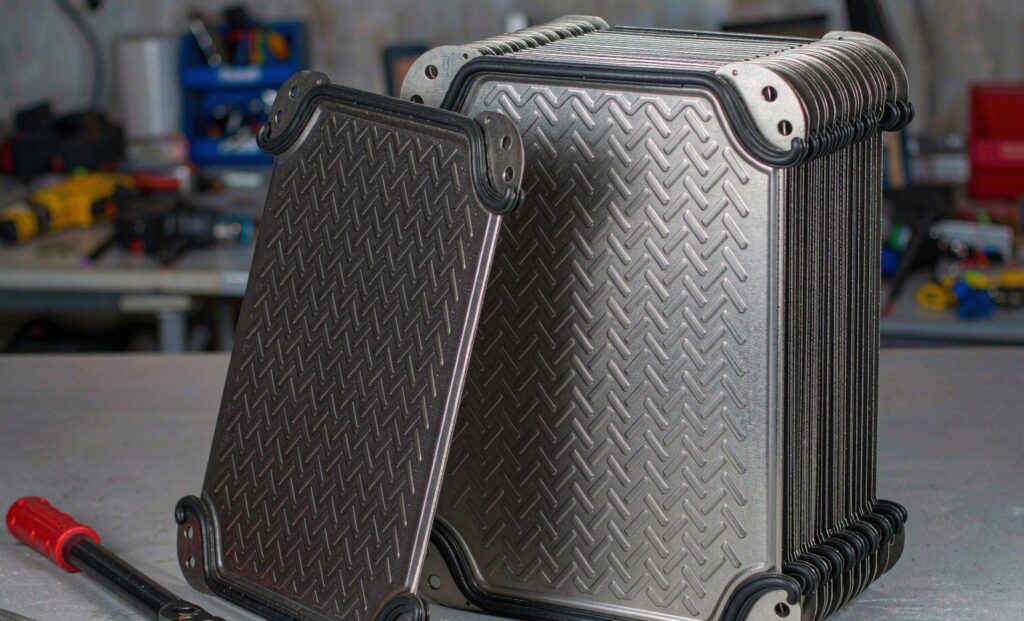
A Hisaka plate pack is replaced for one of two reasons: the plates are perforated or eroded through, or the gaskets have reached the end of their life and re-gasketing no longer holds. In both cases the replacement only performs if the new plates reproduce the original geometry. “A plate for a Hisaka” is not a specification, and a pack that is close in size but wrong in pattern will either lose duty or raise pressure drop past what the pump can deliver.
What the nameplate tells you, and what it does not
The nameplate gives you the model, the design pressure and temperature, the plate count and usually the year of build. It does not give you the plate pattern, the chevron angle, the plate thickness as built, or the gasket type fitted. Hisaka has produced several plate families over the years, and a model number that looks familiar may have been built with more than one plate variant.
That is why a replacement quote should be driven by measurements from the actual unit, not by the model number alone.
The six measurements a plate supplier needs
- Plate length and width overall, measured on a cleaned plate removed from the pack.
- Port centre distances — horizontal and vertical — and the port hole diameter. These fix alignment with the frame and are the first thing that goes wrong on a pattern-matched plate.
- Plate thickness. Commonly 0.4, 0.5 or 0.6 mm. Thinner plates transfer better and foul faster; the frame’s closing dimension assumes a specific thickness.
- Chevron angle and corrugation depth. This is the plate’s thermal personality: a hard angle gives high heat transfer and high pressure drop, a soft angle the reverse.
- Gasket type. Clip-on, glued, or a two-piece arrangement. The groove profile differs and a clip-on gasket will not sit in a glued groove.
- Material. 304, 316L, titanium, SMO, or a mixed pack where only the hot side is upgraded.
A photograph of the plate on a bench with a rule along both axes, plus the nameplate, is usually enough to identify the pattern.
The dimension people forget: the A-measurement
Every frame has a closing dimension — the distance between the fixed and movable covers with the pack compressed. It is stamped on the frame or recorded in the manual, and it changes when plates are added, removed or re-gasketed. If the new pack is assembled to a guessed dimension, the plates will either leak at the gasket or be crushed.
Record the plate count, tighten to the marked dimension, and log it. The next maintenance interval starts from that number, and a pack that keeps needing “a bit more torque” is telling you the gaskets are done.
Pattern-matched versus OEM plates
Pattern-matched plates are a normal engineering product, not a compromise, provided three things hold:
- Port geometry matches exactly. A few millimetres of offset creates a step that the gasket cannot seal, or a flow restriction at the port.
- Plate thickness is the same or declared. A 0.5 mm plate substituted for 0.4 mm changes both the duty and the closing dimension.
- The thermal length is honest. More plates of a softer angle can match the duty but will not match the pressure drop. Ask for both numbers.
What does not transfer is the OEM’s warranty position on the frame. If the unit is under a service agreement, check before substituting.
Material selection, and the chloride trap
Most plate failures we see are chloride stress corrosion cracking in 304, not erosion. 304 is fine for clean, low-chloride loops and is the cheapest option; 316L covers most process water and food duties; titanium is the correct answer for seawater, brine and anything with chloride above roughly 200 ppm at temperature. SMO is the fallback where titanium is attacked.
Ammonia is a separate case: standard brazed plate units with copper filler cannot be used, and gasketed packs need gaskets that tolerate it. If the duty is refrigeration with ammonia, say so at enquiry stage.
Gasket choice decides service life
NBR covers water, oils and most food duties to about 110 °C. EPDM is the default for hot water and steam-adjacent duties and handles higher temperatures. HNBR and HT-EPDM cover the upper range. The gasket is usually the first thing to fail, and the temperature at the plate surface is higher than the bulk fluid temperature, so specify with margin.
Assembly and verification
Tighten in the sequence and to the dimension given for the frame, in several passes, with the plates free to centre themselves. Then:
- Pressure test at the design pressure with the correct test fluid, and hold it.
- Check the approach temperature at the design flow — a pack with the wrong pattern shows up here long before it shows up as a leak.
- Log the pressure drop on both sides. If it is materially above the design figure, the pattern or the plate count is wrong.
When replacement is the wrong answer
If the frame is corroded at the gasket seat, the tie bars are stretched, or the plates are perforated by erosion in a specific band, a new pack buys a short interval. A shell and tube unit is sometimes the more durable answer for dirty or high-pressure duties, and a brazed unit is often cheaper for a small clean duty.
Our brazed and gasketed plate range covers the alternative if the pack is beyond saving, the shell and tube range covers the duties a plate pack handles badly, and the service page covers re-gasketing and re-tubing. Send the nameplate photo and the six measurements and we will come back with a plate pattern, a plate count and the expected pressure drop.
