
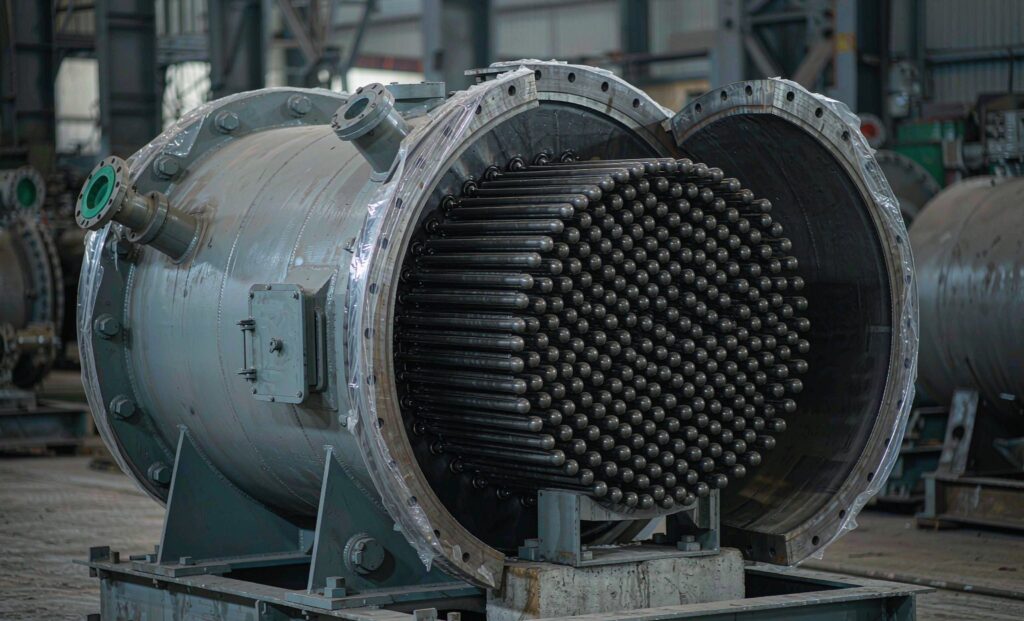
Most confusion around TEMA vs ASME heat exchanger procurement comes from treating two different kinds of document as if they competed. They do not. ASME Section VIII Division 1 is a legal construction code with a stamp attached; TEMA is a voluntary industry specification written by manufacturers and adopted by contract. One makes the vessel lawful to install. The other makes it a usable piece of equipment. A purchase order that names only one of them leaves half the machine undefined.
Two different jobs: legal code and engineering specification
ASME VIII-1 governs the pressure boundary — shells, heads, flanges, nozzles, welds, material traceability and the hydrotest. It is adopted into law by most US states and by many other jurisdictions, and compliance is proven by a U-stamp and a U-1A manufacturer data report signed by an Authorized Inspector.
TEMA — the Tubular Exchanger Manufacturers Association standards — governs the mechanical detail that ASME deliberately leaves out: baffle spacing and thickness, tube pitch and layout, tie rods and spacers, impingement protection, tube-to-tubesheet joint practice, shell and tube minimum wall thicknesses, tolerances and vibration limits.
| Document | Status | Governs | Stamped? |
|---|---|---|---|
| ASME VIII-1 | Legal code | Pressure boundary, welds, test | Yes, U-stamp |
| TEMA | Voluntary spec | Internals, thicknesses, tolerances | No stamp exists |
| API 660 | Voluntary spec | Refinery additions on top of both | No |
| PED / EN 13445 | EU law | Pressure equipment placed on the EU market | CE marking |
| TSG 21 / GB/T 151 | China regulation | Chinese pressure vessel construction | Licence plus inspection |
What ASME VIII-1 actually covers
The code is a minimum safety standard for pressure containment. It tells you how thick the shell must be for a given design pressure and material, how much joint efficiency to credit to a weld, what corrosion allowance to add, how to reinforce a nozzle opening and how to conduct the hydrotest. It does not tell you whether the exchanger will perform.
Two details catch buyers out. First, VIII-1 carries an exemption for heat exchanger tubes — UG-16(b) — which allows a tube wall thinner than the general minimum because the shell protects it from external damage. That exemption does not remove the pressure calculation; it only removes the arbitrary minimum. Second, the code says nothing about baffle cut, tube pitch, bundle vibration or impingement plates. A U-stamped exchanger with a badly chosen baffle spacing is fully legal and will still fail in service.
What TEMA adds
TEMA classifies exchangers into three mechanical duty levels, and the class you name changes wall thickness, corrosion allowance, tolerances and documentation.
| Class | Duty | Typical service | Cost effect |
|---|---|---|---|
| R | Heavy | Refinery, petrochemical, high pressure | Highest |
| C | Commercial | HVAC, chilled water, general industry | Lowest |
| B | Moderate | Chemical process, general industrial | Middle |
Class R is the default that most reputable fabricators will apply when the purchase order says nothing, because it is the safest assumption and protects the manufacturer. It is also frequently more exchanger than an HVAC plant needs, and the buyer pays for the extra wall thickness and the heavier flanges. If cost matters and the service is benign, specify Class C explicitly.
Beyond the class, TEMA fixes the three-letter nomenclature that tells a fabricator exactly what to build — BEM, BEU, AES and the rest — covering shell type, head type and rear-end type. The TEMA shell and tube type guide walks through how those letters map to real maintenance and thermal-expansion behaviour.
What a U-stamp does and does not mean
It means the vessel was designed and built to VIII-1, inspected by an Authorized Inspector, and is documented well enough to be registered in the jurisdiction where it is installed. In most US states, a heat exchanger without a U-stamp cannot legally be placed in service.
It does not mean:
- that the thermal duty has been met — that is a separate performance guarantee;
- that the internals follow TEMA — the code is silent on them;
- that the exchanger suits European or Chinese jurisdiction — those need their own marking or licence;
- that the material selection is right for the process — the code accepts the material you specify.
The EU and Chinese equivalents
Europe runs on the Pressure Equipment Directive, 2014/68/EU, with EN 13445 as the harmonised design code (ASME VIII-1 is also acceptable as a design basis under PED, with additional assessments). The classification depends on pressure and volume — a large exchanger at high pressure lands in a higher category, which brings a notified body into the inspection chain and a CE mark on the nameplate.
China runs TSG 21 as the regulation with GB/T 151 as the heat exchanger standard. Manufacturing is licensed by class; D1 and D2 are the categories that cover most shell and tube exchangers, and each vessel ships with a supervision inspection certificate. That certificate is not an ASME U-stamp and not a CE mark, and the three are not interchangeable — a point worth stating plainly because quotations from different regions often blur it.
Zhenggong holds a Chinese D1/D2 pressure vessel manufacturing licence together with ISO 9001 and ISO 14001 certification, and builds to TEMA practice as standard. A U-stamp or a CE/PED marking is a separate certification and is not implied by D1/D2 — if your project requires either, it has to be stated in the enquiry so the correct route, inspection body and cost are built into the offer rather than discovered at dispatch. The certification page sets out what is held, and the D1/D2 buyer verification guide explains what the paperwork should contain.
Writing the specification so nobody argues later
Almost every dispute about codes traces back to an RFQ that named a standard without naming a class, an edition or a jurisdiction. Fix that with a short, explicit block:
- Design code and edition — for example ASME VIII-1, 2023 edition, with the U-stamp and an Authorized Inspector witness of the hydrotest.
- TEMA class — R, C or B, stated, not implied by silence.
- Supplementary standard — API 660 for refinery service, or the client specification that overrides it.
- Jurisdiction of installation — the country and, for the US, the state, because local adoption and registration requirements differ.
- Design conditions — pressure and temperature for both sides, separately, with the corrosion allowance stated in millimetres rather than left to the fabricator.
- Material specification — grade and product form, including tube standard, not just “stainless”.
- Non-destructive examination — radiographic extent per butt weld, dye penetrant on tube-to-tubesheet joints, and who witnesses it.
- Documentation — U-1A, material certificates to EN 10204 3.1, welding procedures and qualifications, hydrotest record, and the drawing set in the agreed format.
- Third-party inspection — named agency, notice period and the hold points they attend.
The grey areas buyers fall into
“TEMA compliant” without a class
There is no TEMA stamp and no TEMA certificate. Compliance is verified by the purchaser’s inspector against the purchase order. A supplier claiming TEMA compliance without naming a class has told you nothing measurable.
A U-stamp on a machine that does not fit
Buyers sometimes assume the stamped item is the better item. It is the more thoroughly inspected one. If the baffle spacing produces a 40% pressure drop over budget, the stamp does not help the pump.
Assuming D1/D2 satisfies an ASME or PED requirement
It does not. Each marking answers to a different regulator. Sending a Chinese D1/D2 vessel into an EU project without a PED assessment is a compliance failure that surfaces at installation, when the fix is expensive.
Paying for Class R in a Class C application
Heavy-duty internals on a clean chilled water duty add cost without adding life. The reverse error — Class C internals in a fouling hydrocarbon service — costs a bundle within two years.
Which one governs your order
Both, in sequence. The legal code decides whether the vessel may be installed and operated. The industry specification decides whether it performs and how long it lasts. Name the code, its edition, the TEMA class, the supplementary standard and the jurisdiction in the RFQ, and the two documents stop competing and start doing their separate jobs.
For shell and tube work the practical starting point is the stainless steel shell and tube heat exchanger range; for a project that also needs the thermal duty fixed before the mechanical detail, the engineering service covers selection and re-rating. If the code question is still open, send the design conditions and the destination country to our engineering team and we will tell you which marking the project actually needs before a quotation is issued — that conversation is cheaper than a re-certification, and it usually takes one exchange.
