
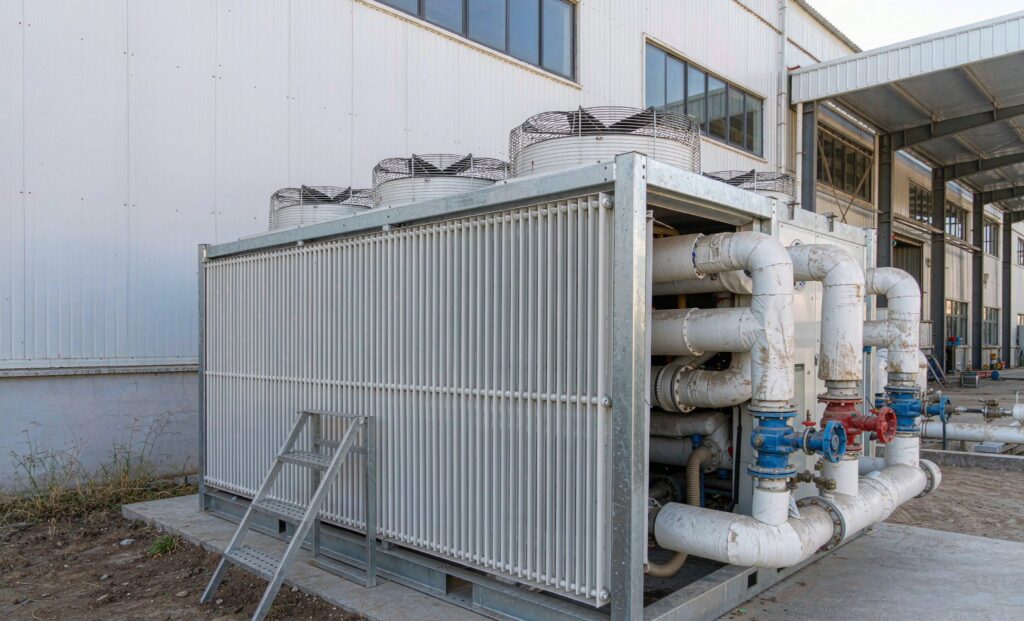
What an Air Cooled Screw Chiller Does in a Battery Plant
Specifying an air cooled screw chiller for a battery plant is not the same job as specifying one for an office block. A lithium-ion cell factory has four or five separate cooling duties that peak at different times, a dry room that cannot tolerate a water leak above a ceiling, and a dust problem that will quietly halve the capacity of a condenser coil within two years. The chiller itself is usually the simplest part of the decision. What decides whether the plant runs at nameplate is the heat exchanger behind it — the condenser coil rejecting to ambient, the evaporator passing glycol to the process, and the oil cooler nobody sizes until the first high-pressure trip.
This guide covers the load side first, because an air cooled screw chiller that is 30 % oversized costs more to run every hour of its life and one that is undersized cannot be fixed by adding refrigerant. It then works through the three heat exchangers, the ambient derating that catches overseas buyers, and the specification data a supplier needs to quote a machine that will actually hold ±1 °C at the process.
Where the Heat Actually Comes From
Cell manufacturing is a sequence of thermal processes, not a single cooling load. The table below is representative of a 5 GWh/year line producing prismatic cells; the proportions shift with chemistry, cell format and whether the plant buys coated electrode or coats in-house, but the shape of the load is consistent.
| Process step | Cooling duty | Temperature | Share of load |
|---|---|---|---|
| Coating and drying | Web cooling after the oven; solvent recovery condensers | 15–25 °C chilled water | 10–15 % |
| Calendering | Roll and bearing cooling under high nip pressure | 20–25 °C, tight tolerance | 5–10 % |
| Formation | First-charge heat from every cell in the rack | 25 ±2 °C ambient or tray | 25–35 % |
| Aging and grading | 48–72 h soak at elevated temperature; room cooling | 38–45 °C controlled | 10–20 % |
| Dry room and HVAC | Dehumidification reheating and space cooling | 20–25 °C, −40 °C dew point | 25–40 % |
| Utilities and test benches | Cyclers, leak test, electrolyte chillers | −10 to +25 °C | 5–10 % |
Two things follow from that table. First, the load is dominated by formation and dry-room HVAC, so a chiller sized on total connected load will be heavily oversized at night and in winter — part-load efficiency matters more than the nominal COP on the datasheet. Second, the temperature levels are different: a single 7/12 °C chilled water loop serving everything forces the formation trays and the dry room to be overcooled or re-heated, which is where a lot of the wasted energy in a new plant sits.
Why Air-Cooled Screw and Not Scroll or Water-Cooled
The three options are not interchangeable, and the choice is usually made on site constraints rather than thermodynamics.
- Air-cooled screw — one machine to about 1.5 MW, multiple compressors or a single screw with slide valve, no cooling tower, no water treatment, no plume. Best where water is scarce or expensive, where the plant has roof or yard space, and where a 24/7 load profile justifies a machine that holds efficiency at 50 % load.
- Air-cooled scroll — modular, cheap to buy, efficient in small blocks, but a bank of 30 scrolls has 30 sets of contactors and a much larger footprint per kW. Sensible below roughly 300 kW per machine.
- Water-cooled screw with a cooling tower — 25–35 % lower condensing temperature in a hot climate and therefore lower power per kW of cooling, but it brings water treatment, blowdown, legionella management and a tower that must sit away from the dry room’s air intakes.
For a battery plant in a hot, dry or water-constrained region — Saudi Arabia, North Africa, parts of India and inland China — the air-cooled screw is usually the default, and the design effort goes into making the condenser coil survive the dust and the ambient rather than into the compressor selection.
Sizing: Four Numbers That Decide the Machine
1. Peak block load, not connected load
Add the simultaneous peaks, apply a diversity factor to the processes that never run together (coating and formation usually do; aging and formation rarely peak at once), then add 10–15 % margin. A margin above 20 % is not a margin, it is a part-load efficiency problem: a screw chiller at 30 % load with a fixed-speed compressor cycles and loses 20–30 % of its efficiency, which is exactly the operating point a battery plant sits at overnight.
2. Leaving water temperature and the true ΔT
Formation and test benches want 20–25 °C; coating web cooling wants 15 °C; electrolyte and leak-test circuits sometimes want 5 °C or lower. Each temperature level should have its own circuit or its own machine. A single 7/12 °C loop with three-way mixing valves at every branch is the most common design mistake in a new cell plant, and it costs 8–15 % of chiller power indefinitely.
3. Glycol concentration
Any circuit that can see below 5 °C, or that sits in an unheated space through a winter, needs glycol. Propylene glycol at 30 % gives freeze protection to about −13 °C and costs 3–5 % in heat transfer; at 40 % it protects to about −21 °C and costs 8–12 %. Size the evaporator and the pump for the glycol, not for water, and specify the concentration on the order. A chiller selected for water and commissioned with 40 % glycol will not reach its rated capacity, and the supplier is entitled to say so.
4. Ambient design condition
Air-cooled capacity is quoted at a reference ambient — usually 35 °C — and falls as ambient rises. A machine quoted for 35 °C and installed where the summer design is 46 °C will deliver roughly 15 % less capacity at 10 % more power, and the plant discovers it in July. Give the supplier the actual summer design dry-bulb, the altitude, and whether the unit sits in a yard with a wall behind it. Recirculation from a nearby wall or from the unit’s own discharge can add 4–6 K to the entering air temperature without showing up on any drawing.
| Ambient dry-bulb | Relative capacity | Relative power | Practical note |
|---|---|---|---|
| 25 °C | 108–112 % | 92–95 % | Spring and autumn operation in most climates |
| 35 °C | 100 % (reference) | 100 % | Where most catalogue data is quoted |
| 43 °C | 90–93 % | 105–108 % | Gulf summer; specify the real number |
| 46 °C | 84–88 % | 110–115 % | Add coil area or accept the shortfall |
The Condenser Coil: Where Battery Plants Break Chillers
A cell plant produces carbon black from electrode slitting and dusting, solvent-laden exhaust from coating, and general workshop dust. All of it ends up on the condenser fins. This is the single most common reason an air cooled chiller underperforms two summers after commissioning, and it is entirely predictable at the specification stage.
Fin pitch, and why 2.1 mm is wrong here
Standard air-cooled condensers use 2.1 mm fin pitch because it gives the most surface per unit volume. On a battery plant, specify 2.8–3.2 mm, accept the 8–12 % loss of coil surface, and gain a coil that can actually be cleaned. A 2.1 mm coil in a carbon-black environment blinds in one season and cannot be recovered by air lancing alone.
Cleaning access and the fouling penalty
Every 1 K rise in condensing temperature costs roughly 2–3 % in compressor power. A coil that has lost 30 % of its airflow raises condensing temperature by 5–8 K, which is a 12–20 % power penalty hiding in the electricity bill. Design for access: removable fan decks or hinged panels, coil faces reachable from both sides, and a pressure-gauge tapping across the coil so the maintenance team can measure the blockage instead of guessing.
Materials in a solvent environment
Epoxy-coated or cathodic-dip-coated aluminium fins are worth specifying where the plant handles NMP or where the unit sits near a solvent recovery stack. Copper tube with coated aluminium fin is the normal choice; bare aluminium fin in a solvent-laden atmosphere corrodes from the fin edge inward and loses bond contact with the tube, which shows up as a capacity loss that no amount of cleaning recovers.
The Evaporator and the Glycol Loop
For process cooling, a stainless brazed plate evaporator or a shell and tube evaporator is used rather than the copper-tube-in-shell arrangement of a comfort chiller. Three rules govern the selection.
- Velocity floor. Keep the glycol side above 0.8 m/s in the channels to avoid fouling and to keep the heat transfer coefficient up; above 1.5 m/s the pressure drop starts to cost more pump power than it saves in compressor power.
- Freeze protection is a control function, not a glycol function. Glycol buys time, it does not replace a low-pressure cutout, a flow switch interlock and a frost-stat on the leaving water. Most evaporator freezes in battery plants happen on a single-circuit test bench at 3 a.m., not on the main loop.
- Water quality. The process side sees deionised water, electrolyte traces and cleaning chemicals. 316L is the minimum; where chloride from electrolyte handling is possible, titanium plates are the cheap insurance. Copper alloys are the wrong choice on any circuit that can see electrolyte.
The Oil Cooler Nobody Sizes
A screw compressor rejects a meaningful share of its input power into the lubricant, and that heat has to leave the machine. On an air-cooled package the oil cooler is usually a separate coil section in the same air stream, and its performance is coupled to the condenser: when the condenser coil is blocked, the oil runs hotter, viscosity falls, the compressor’s internal leakage rises and capacity drops further. Specify the oil cooler as a thermostatically controlled circuit with its own coil section, and check that the package can hold oil temperature at 46 °C ambient with a dirty condenser — suppliers rarely volunteer that case.
Free Cooling and Heat Recovery in a Plant That Runs 24/7
Two opportunities are routinely missed in cell plants, and both sit on the heat exchanger side rather than the compressor side.
Free cooling is viable wherever the process wants 15 °C or more and winter ambient drops below about 5 °C. A dry cooler and a plate heat exchanger in the loop can carry the load with the compressors off for 2,000–4,000 hours a year in a temperate climate. It pays back in two to four years and it also reduces compressor run hours, which extends overhaul intervals.
Heat recovery from the condenser serves the dry room’s reheat load, which in a cell plant is large and continuous. Desuperheating recovers only 10–20 % of the rejected heat; a full condenser heat recovery circuit can deliver 50–70 % at 45–55 °C, which is enough to preheat dehumidifier regeneration air or wash water. The economics depend entirely on whether there is a year-round sink for that heat — in a dry room there usually is.
Specification Checklist
- Peak and minimum block load in kW, with the diversity basis stated.
- Leaving and return water temperatures for each circuit, not one blended figure.
- Glycol type and concentration, and whether the evaporator is rated for it.
- Summer design dry-bulb, altitude, and the unit’s installed position relative to walls.
- Required capacity at that ambient, not at 35 °C.
- Condenser fin pitch and coating, with the cleaning method and access agreed.
- Evaporator and oil cooler materials, and the chloride exposure in each circuit.
- Part-load performance at 25, 50, 75 and 100 % load, with the control method (slide valve, VFD, multiple compressors).
- Sound pressure at the nearest occupied boundary, at the actual distance.
- Refrigerant, charge, and the leak-detection and ventilation requirements of the local code.
- Electrical data: full-load amps, starting method, harmonics if VFD-driven.
- Documentation: GA drawing, P&ID, performance curves, pressure test certificates, and the material certificates for the pressure-containing parts.
Zhenggong Cooling and Heating Equipment Co., Ltd builds air-cooled screw chiller packages and the shell and tube, plate and dry-cooler heat exchangers inside them, under D1/D2 pressure vessel certification and ISO 9001 / ISO 14001. Units are rated against the customer’s ambient and glycol conditions rather than a catalogue reference point.
Maintenance Calendar That Keeps the Rating
| Interval | Task | What it protects |
|---|---|---|
| Monthly | Record suction and discharge pressures, condensing temperature, approach | Detects coil fouling before it costs 10 % of the power bill |
| Quarterly | Clean condenser coil; check fan blades and motor current | Airflow and condensing temperature |
| Quarterly | Glycol concentration and pH by refractometer | Freeze protection and corrosion inhibition |
| 6-monthly | Oil analysis; check oil cooler approach | Compressor life; catches a blocked oil cooler early |
| Annual | Evaporator approach and flow verification; pressure test | Confirms the machine still meets its rated duty |
If your project needs a chiller sized for a real ambient and a real glycol loop, send the load table, the temperatures and the site conditions. Ask our engineers for a selection, or start from the air-cooled screw chiller and air-cooled glycol chiller pages. For the process side, the application index lists the circuits these machines usually feed, and how a screw chiller works covers the compressor side in more detail.
