
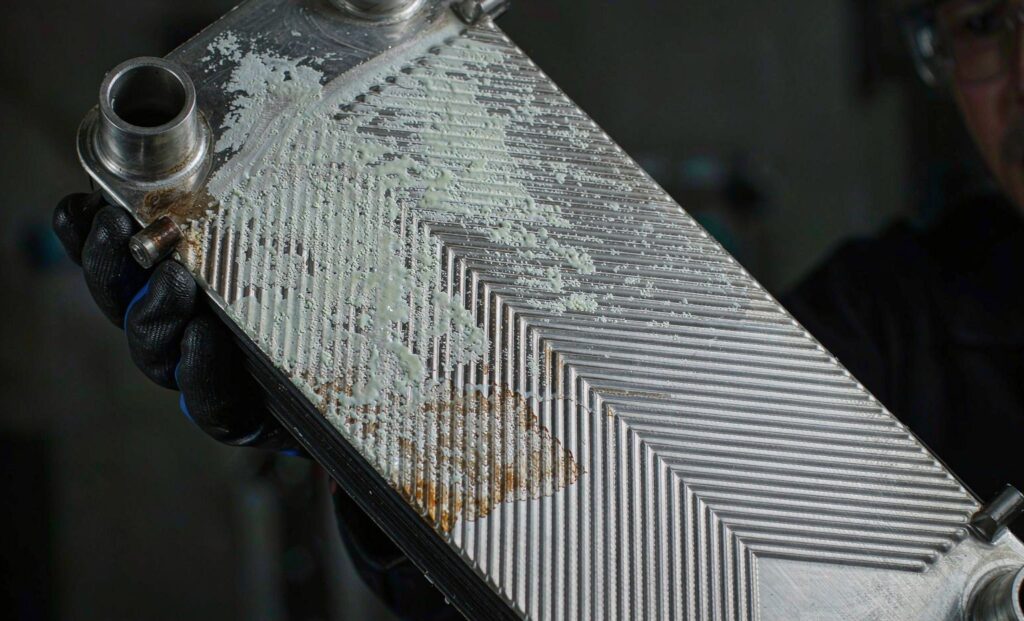
The Right Plate Heat Exchanger Fouling Cleaning Method Starts With the Foulant
Most plate heat exchanger fouling cleaning method failures are not failures of technique. They are failures of diagnosis: a unit is descaled with acid, comes back 20 % better, and is written off as “not what it was” — when the deposit was an organic biofilm that acid never touched. The chemistry that dissolves calcium carbonate does nothing to a protein film, and the caustic that strips a fat layer will not shift ten years of hard scale. Choosing the method before identifying the foulant is the single most expensive habit in heat exchanger maintenance.
This guide is the selection side of the job: how to read the operating signature to work out what is on the plates, how to confirm the foulant with what is in the plant room, which of the five cleaning methods fits which deposit, and the parameters — concentration, temperature, velocity, dwell — that decide whether a clean restores the duty or quietly damages the pack. Our step-by-step plate heat exchanger cleaning procedure covers the physical sequence; this article covers deciding what to do to it.
Read the Symptoms Before You Open Anything
Two measurements, taken against a clean baseline, separate a fouling problem from a mechanical one. Without a baseline you are guessing, so if the plant has none, establish it on the first clean and post it on the frame.
| Signature | ΔP behaviour | ΔT / duty behaviour | Likely cause |
|---|---|---|---|
| Classic fouling | Rises 30–100 % over baseline | Approach temperature widens; duty falls | Deposit on the plates, both sides or one |
| Blocked channel | Rises sharply, often with flow loss | Duty falls disproportionately in one pass | Debris bridging a port; hard scale at the inlet |
| Air or gas in the loop | Unstable, fluctuates | Duty wanders; temperature hunting | Venting, pump suction, dissolved gas release |
| Plate deformation | Falls below baseline | Duty well below design with clean plates | Over-tightening past the A dimension; thermal excursion |
| Internal leak | Roughly normal | Contamination, not a thermal symptom | Perforation or cracked plate — cleaning will not help |
The distinction between the first two rows and the last three matters: cleaning solves the first two and wastes a shutdown on the rest. A unit with ΔP below baseline and poor duty is not fouled; it has flattened corrugations, and no chemical will restore contact points that have lost their preload.
Identify the Foulant With What You Already Have
You do not need a laboratory to get 90 % of the way. Five field tests, in this order, will classify almost every deposit found in an industrial plate pack.
- Look at the colour and texture. White or cream and brittle: carbonate scale. Rust-brown and friable: iron oxide. Black or dark grey and slimy: biofilm or carbon. Brown and waxy: oil or grease. Grey and granular: suspended solids, silt or sand.
- Drop a fragment into dilute acid. A few millilitres of 5 % citric or vinegar: vigorous fizzing means carbonate. Nothing means sulphate scale, silicate, organic or oxide.
- Heat a fragment on a metal sheet. A deposit that chars and smells organic is biological or hydrocarbon. One that glows and leaves ash is inorganic.
- Wipe with a solvent. Grease dissolves in a hydrocarbon solvent; biofilm does not; polymer coatings swell but stay attached.
- Check both circuits separately. The heating or cooling side and the process side foul differently. A plate pack that fouls only on the cooling-water side is a water-treatment problem, not a heat exchanger problem.
Two foulants are worth naming because they are misdiagnosed more than any others. Iron oxide from an unprotected carbon-steel loop looks like scale and behaves differently: acid removes it but leaves the plate surface active, and it returns within months unless the loop is treated. Silica and aluminium silicate scale does not respond to citric or nitric acid at practical concentrations and needs a chelating or alkaline route — trying to descale it with acid wastes a day and removes nothing.
The Method Matrix: Five Ways to Clean a Plate Pack
| Method | Best for | Limits |
|---|---|---|
| Recirculating chemical clean (CIP) | Scale, oxide, biofilm, light oil; units that cannot be opened | Needs a pump, a tank and a vent; will not shift hard scale bridging a port |
| Open, soak and brush | Heavy or layered deposits; grooved and gasketed plates | Labour-intensive; every opening risks gasket and groove damage |
| High-pressure water jet | Soft deposits, silt, biofilm mats | Cannot be used on the assembled pack; 30–50 bar at the plate, never close-in, or the plate deforms |
| Ultrasonic bath | Small plates, instrument-grade packs, blind channels | Plate must be removed; bath size limits it to small frames |
| Thermal (hot water or steam) | Fat, wax and sugar deposits that melt | Temperature ceiling set by the gasket, not the plate |
CIP is the default for a reason: it reaches the corrugation valleys and the port throats that a brush cannot, it needs no gasket disturbance, and it can be run overnight. It fails on one specific case — a channel already bridged by hard deposit, where the chemical cannot circulate past the blockage. If the flow rate during cleaning is well below the design flow and will not come up, stop and open the unit; more chemical will not fix a hydraulic problem.
Chemical Parameters That Actually Matter
Concentration is the number everyone argues about and the least important of the four. Temperature, dwell time and flow velocity decide the result; concentration only sets the driving force.
| Agent | Typical strength | Temperature | Notes |
|---|---|---|---|
| Nitric acid | 1–2 % | Ambient to 60 °C | Best general descaler for stainless; passivates as it cleans |
| Citric acid | 3–5 % | 40–60 °C | Gentler, safer to handle, slower on thick scale |
| Sulphamic acid | 5–10 % | Ambient to 50 °C | Good on carbonate and iron oxide; less aggressive to the passive layer |
| Caustic soda | 1–2 % | 60–80 °C | Fats, proteins, biofilm; must be followed by an acid step |
| Chelant (EDTA type) | 3–8 % | 50–70 °C, alkaline | Silica, sulphate scale, mixed deposits; slow, expensive, effective |
These are working ranges, not universal limits. Gasket elastomer, plate alloy and the chemical supplier’s corrosion data all set a ceiling, and the manufacturer’s stated maximum wins over any table in an article. Two rules are not negotiable: never hydrochloric acid on stainless steel, because chloride causes pitting and stress-corrosion cracking that shows up weeks later as a pinhole; and never hydrofluoric acid or fluoride-bearing cleaners on titanium plates, which attack the metal directly.
The temperature ceiling is the gasket, not the plate
EPDM comfortably handles 60 °C cleaning solution and will tolerate short excursions higher; NBR is less tolerant of hot caustic; FKM resists chemicals but swells in some solvents. Exceed the gasket’s limit and it takes a compression set — it stays compressed when the pack is released, loses sealing force, and leaks on the next hot cycle. A clean that costs a gasket set is not a cheap clean. Keep chemical cleaning at or below 60 °C unless the gasket supplier confirms otherwise in writing.
What Not to Put in a Plate Pack
- Hypochlorite and chlorine-based biocides. Effective on biofilm, aggressive on 304 and 316 stainless, and the residue keeps working after the clean. If a biocide is unavoidable, keep free chlorine low, keep the temperature down, and rinse immediately and thoroughly.
- Strong mineral acids on stainless. Hydrochloric, and sulphuric at strength, both cause chloride or general attack in the crevices at the gasket groove.
- Ammonia on brazed units. Copper-brazed plate packs are attacked at the braze fillet; ammonia cleaning belongs to gasketed units only.
- Abrasive pads, wire brushes and scrapers. They remove the passive layer and scratch the gasket groove. Nylon brushes only, and never a screwdriver to lift a gasket.
- Mixing acid and caustic without an intermediate rinse. Neutralisation in the pack generates heat and salt in exactly the narrowest part of the channel.
CIP in Practice: Velocity, Direction, Temperature
A CIP clean that underperforms is almost always a flow problem. Chemical circulating at 0.3 m/s is in laminar flow in the corrugation and only touches the top of the deposit; the same solution at 1.2–1.5 m/s is turbulent and reaches the whole surface.
- Flush first with water, in reverse. 1.2–1.5 times the normal design flow for 20–30 minutes, backwards through the unit. This removes loose solids before they consume the chemical, and it is the step most often skipped.
- Circulate the cleaning solution at design flow or above. Not less. If the pump cannot reach it, split the pack or accept a longer dwell.
- Reverse the direction every 20–30 minutes. Flow reversal is what clears the dead zones at the port throats and behind the gasket line.
- Watch the solution, not the clock. Cleaning is finished when the pH and conductivity stop changing, gas evolution stops, and the ΔP across the pack falls and holds. Typical dwell is one to four hours; a deposit that has not shifted in four hours will not shift in eight.
- Neutralise, then rinse to neutral. Circulate 1–2 % sodium carbonate or bicarbonate for 15–30 minutes, then rinse until the outlet reads pH 6.5–7.5 with no foam. Residual acid sits in the gasket groove and pits the plate from the edge inward.
- Passivate if the acid step was aggressive. A dilute nitric rinse, or the supplier’s passivating product, restores the chromium oxide layer before the unit goes back into service.
Do not clean a plate pack by filling it and leaving it static overnight, unless the deposit is light and the supplier has confirmed the chemistry is safe at that dwell. Static soak concentrates attack at the gasket line and at the contact points, which is precisely where the plate is thinnest in service.
Proving the Clean Worked
A clean is only finished when the numbers say so. Record, before and after:
- ΔP across each circuit at a stated flow. Recovery to within 10 % of the clean baseline is a good result; a pack that stays 40 % above baseline was not cleaned, it was rinsed.
- Approach temperature — the difference between the leaving secondary temperature and the entering primary temperature. This is the most sensitive single indicator of plate condition.
- Overall heat transfer coefficient, back-calculated from duty, area and log mean temperature difference. A recovery to 90 % of the original UA is realistic; 100 % rarely happens on a pack more than a few years old.
- Photographs of the plates if the unit was opened, and the cleaning solution volume and pH record. These are what turn the next diagnosis from an argument into a five-minute decision.
When Cleaning Stops Working
There is a point where the pack will not come back, and continuing to clean it is the expensive way to delay a replacement. The decision is usually clear once the unit is open.
| Finding | Verdict | Reason |
|---|---|---|
| Channel bridged by hard deposit that will not dissolve or dislodge | Replace the affected plates | The flow area is gone; no chemistry reaches it |
| Pinholes visible after cleaning | Replace, and review the alloy | Pitting has perforated the sheet; the next leak is cross-contamination |
| Corrugations flattened, plates polished at contact points | Replace the pack | Contact load is lost; duty and pressure rating both fall |
| Gasket hard, cracked, or permanently deformed | Replace the gaskets | Compression set cannot be reversed by cleaning or by tighter clamping |
| Groove corroded or scored | Replace the plate | A new gasket cannot seal against a damaged groove |
| Duty recovers for a few weeks then falls again | Fix the cause, not the pack | The deposit is being generated upstream; cleaning is treating a symptom |
The last row is the one that costs the most money over a decade. A unit that needs cleaning every six weeks is telling you about untreated cooling water, a failed softener, an open loop pulling in silt, or a process stream carrying solids. Each clean costs a shutdown and a chemical charge; the fix is usually a filter, a dosing regime or a closed loop, and it pays for itself in one season.
Prevention That Cuts Cleaning Frequency
Fouling rate on a plate pack is largely a function of four things, all of which are controllable at the system level rather than the exchanger.
- Water treatment. Keep cooling water within its scaling threshold for the temperature it actually reaches. A plate pack is more sensitive than a shell and tube unit because the channel is 2–4 mm wide and the wall temperature is closer to the bulk temperature.
- Filtration. A strainer or automatic filter upstream of the narrowest channel removes the debris that bridges ports. Mesh size should be smaller than the channel gap; for most plate packs that means 1 mm or finer.
- Velocity. Keep the design velocity above 0.5 m/s on the fouling-prone side. Below that, deposition accelerates faster than any treatment programme can compensate.
- A ΔP trigger, not a calendar. Clean at 30–50 % above baseline ΔP. Cleaning on a fixed annual date cleans clean units and leaves dirty ones running.
Zhenggong Cooling and Heating Equipment Co., Ltd supplies gasketed and brazed plate heat exchangers with plate and gasket materials selected against the cleaning chemistry as well as the process fluid, and manufactures under D1/D2 pressure vessel certification with ISO 9001 and ISO 14001. If a pack has reached the end of its cleaning life, our engineers can quote a matched replacement from the nameplate or a single plate.
Tell us the deposit, the cleaning chemicals already tried, and the ΔP and approach figures before and after — that is usually enough to identify the foulant and recommend a route. Send the details to our engineering team, or compare plate against tubular construction in shell and tube vs plate heat exchangers if the fouling duty is chronic enough to justify changing the type. The product range covers both.
