
Why APV Plate Heat Exchanger Plates Replacement Is a Plate Problem, Not a Gasket Problem
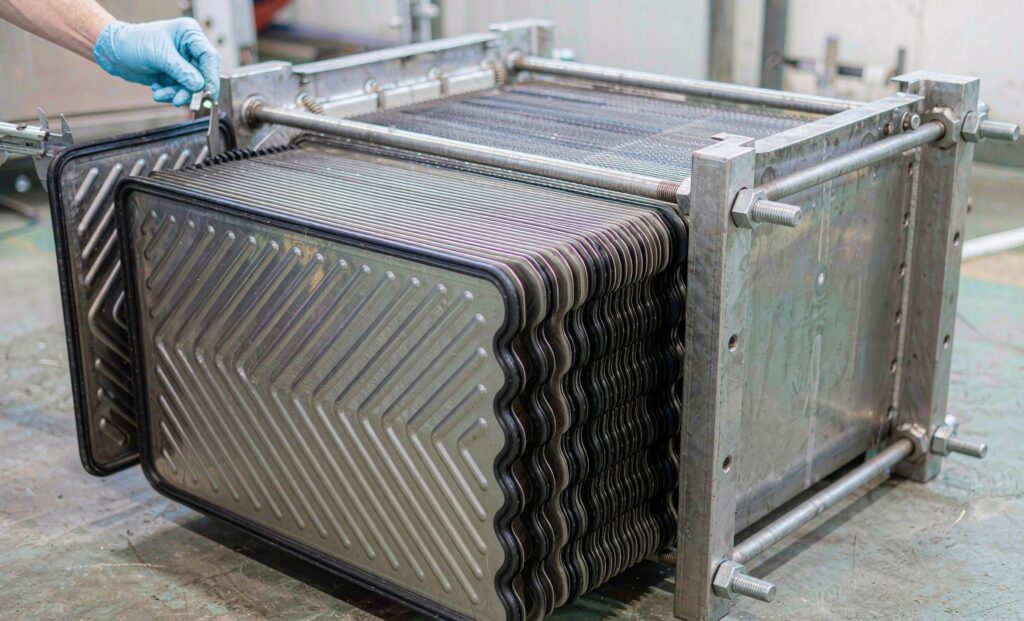
APV plate heat exchanger plates replacement is the job that gets ordered late and specified badly. The unit starts weeping, someone assumes gaskets, a gasket set arrives, the pack is rebuilt, and three weeks later the same unit is leaking again — because the plate was the problem and nobody measured it. A gasketed plate heat exchanger is a stack of pressed metal sheets clamped between two frames. The gaskets seal the perimeter of each plate; the plate itself carries the pressure load through its contact points and separates two fluids across a sheet of stainless steel 0.5–0.8 mm thick. When that sheet is perforated, cracked or flattened, no gasket will save the unit.
This guide covers the plate side of the job: how to establish that plates rather than gaskets have failed, what a replacement plate must match beyond its outline dimensions, how to identify an APV plate pattern when the nameplate is unreadable, when a full pack is the honest answer rather than a set of six plates, and what actually causes the leak that appears a week after a rebuild. It applies to APV gasketed units — the M-series, N-series, T-series, H-series and Quad-Drive frames — and with the model references changed, to most gasketed plate packs in industrial service.
APV is a registered trademark of SPX Flow, Inc. Zhenggong Cooling and Heating Equipment Co., Ltd is an independent heat exchanger manufacturer and is not affiliated with, authorised by or endorsed by SPX Flow. Model names are used here only to describe the equipment being serviced.
Six Plate Failure Modes That Force a Replacement
Plates fail in a small number of recognisable ways, and each one points at a different root cause. Diagnosing the mode before ordering matters, because replacing a chloride-pitted 316L plate with an identical 316L plate simply restarts the clock.
| Failure mode | What you see | Usual root cause | What to change on the order |
|---|---|---|---|
| Pinhole perforation | Cross-contamination between circuits; dye test shows a single point | Chloride pitting under deposits, or acid cleaning left in the channel | Review alloy (316L to titanium or 254SMO), fix the cleaning regime, add a deposit-control interval |
| Port-area crack | Leak at the corner port, often after a pressure surge | Fatigue from pressure cycling; plate unsupported between gasket and port | Check the system for water hammer and pump start/stop; consider a thicker plate |
| Corrugation flattening | Duty falls, ΔP falls, unit seals but underperforms | Over-tightening past the “A” dimension; repeated re-clamping to stop a leak | Full pack, not partial; record and enforce the A dimension |
| Erosion at the inlet | Polished, thinned metal in the port throat | Velocity above 2.5 m/s on a solids-bearing stream, or sand and scale carried through | Upstream strainer, plate with reinforced port, or a different exchanger type |
| Groove damage | Gasket will not seat; repeated leaks in one channel | Gasket removed with a screwdriver or scraper | Replace the plate; the groove cannot be repaired reliably |
| Stress-corrosion cracking | Fine branching cracks near gasket grooves and contact points | Chlorides plus residual tensile stress plus temperature | Alloy change and a chloride audit of both circuits, including cleaning chemicals |
A plate that has been in service for a decade has also lost wall thickness to general corrosion. If a caliper reading away from the contact points is more than about 10 % below nominal, the plate has no remaining margin and should not go back in, even if it passes a hydrostatic test today.
What a Replacement Plate Must Match
A plate is a dimensioned part. It fits an existing frame only when every one of the following agrees with the plate coming out. A supplier that quotes from a photograph of the nameplate alone is quoting a guess.
| Feature | Why it matters | How to establish it |
|---|---|---|
| Outline and corner radii | Hanger notch and guide slots locate the plate on the carrier bar | Caliper or steel rule on a cleaned plate |
| Port pitch | Centre-to-centre distance must line up with frame connections | Measure horizontal and vertical pitch, not the port diameter |
| Port bore | Sets flow area and how the port gasket seats | Measure; note whether the bore is lined |
| Corrugation depth and chevron angle | Sets the heat transfer coefficient and the pressure drop; identical outlines with different corrugation are different products | Photograph the pattern square-on with a scale; note the angle class |
| Plate thickness | Changes compressed pack length and the contact-point load path | Micrometer away from contact points and gasket |
| Gasket groove profile | Clip-on, glued and insert gaskets each need a different groove | Photograph a cross-section of the groove edge |
| Handing and position | Left and right plates alternate; turning and transition plates differ from channel plates | Mark every plate as it comes out, in order |
Thickness is the dimension that quietly breaks frames
Commercially available plates for the same pattern run from roughly 0.4 mm to 1.0 mm. If a replacement is pressed 0.1 mm thicker than the original, a 120-plate pack grows by 12 mm. That does not sound like much until you find the tie bolts have no travel left and the pressure plate cannot reach the A dimension. The unit then either will not seal or gets over-tightened to force it, which flattens corrugations and produces the exact underperformance the re-plate was meant to cure. Establish the installed thickness first, and specify it explicitly on the purchase order.
APV Plate Pattern Identification: Four Routes, Ranked
The nameplate is the fastest route and the first one to try. Photograph it before touching anything, even if it looks legible in the plant room — paint, corrosion and a phone torch at the wrong angle defeat more identification attempts than missing plates do.
| Route | What you need | Reliability | When to use it |
|---|---|---|---|
| Nameplate and serial | Clear photo of the frame plate nameplate | High | Nameplate intact; manufacturer or an experienced supplier can trace the pattern |
| Plate marking | Pattern code embossed near a port or corner | High | Any single plate still carries its code |
| Dimensional match | One cleaned plate, caliper, tape, scale | High | Nameplate gone, painted over or belonging to a re-badged unit |
| Sample plate | The failed plate itself, shipped or couriered | Highest | Disputed pattern, multi-pass unit, or a first order with a new supplier |
Whichever route you take, the same eight measurements travel with it: overall length and width, corner radii, hanger notch position, horizontal port pitch, vertical port pitch, port bore, plate thickness, and the gasket attachment method. Add photographs of the corrugation from both faces, an edge view, and the groove profile. That package can be answered by any competent supplier within a day, and it is worth assembling once, calmly, rather than at the start of an unplanned outage.
Full Pack or Partial Replacement?
Plants usually ask for the minimum: replace the four plates that failed the dye test. That is sometimes correct and often not.
- Partial replacement is defensible when the failure is isolated and recent — a handling dent, a single pinhole from a known contamination event, damage during a previous rebuild — and the rest of the pack measures within tolerance.
- A full pack is the honest answer when plates are 10–15 years old, when several channels have failed within a short period, when corrugations have flattened from years of over-tightening, or when the alloy is being upgraded. Plates in a pack age together and are clamped together; a pack with mixed remaining life fails in sequence.
- Never mix thicknesses in one pack. Different thicknesses load the contact points unevenly, and the thin plates carry more than their share of the clamping force.
- If part of a pack is renewed, put the new plates where the duty is most aggressive — usually the hot inlet or the chloride-bearing side — and keep the flow distribution symmetric across the pass arrangement.
There is a middle path used in food and pharmaceutical plants: renew the pack, keep the serviceable old plates as spares, tagged by pattern and thickness. It costs one pack and removes the next outage’s lead time.
Recalculating Duty When the Plate Count Changes
Plates are added in pairs to preserve the pass arrangement, and each pair adds one channel. Area goes up, so does pressure drop — both scale roughly with the number of channels, but not identically, because the velocity in each channel falls as channels are added for the same total flow. The correct sequence is to fix the permitted pressure drop and the flow limits first, then choose the count.
A unit re-plated with the right pattern but 8 % more plates will usually deliver slightly more duty at slightly lower ΔP. A unit re-plated with the wrong chevron angle — a high-θ plate where the original was low-θ — delivers more heat transfer and a pressure drop the pump cannot meet, and the plant discovers it at commissioning. If the original duty was already tight against the pump curve, ask for a thermal rating at the actual flows before accepting a pattern substitution.
The Rebuild Sequence, in Order
- Isolate, depressurise and cool below 40 °C. Cool at no more than 10 °C per minute and vent at no more than 10 bar per minute. A pack opened hot and pressurised distorts plates.
- Measure and record the A dimension between frame plate and pressure plate, cold, before a bolt moves. This is the assembly target and the only reliable check at the end.
- Count and mark. Number every plate in sequence, note orientation, and identify turning and transition plates. Photograph the pack from both ends.
- Clean the plates before measuring anything. Deposits distort every dimension and hide pinholes. Use the chemistry appropriate to the foulant, never hydrochloric acid on stainless.
- Inspect each plate: hold it to a light for pinholes, check the port throats for erosion, run a fingernail along gasket grooves, and caliper the thickness away from contact points.
- Lay out the new pack on a clean, soft surface in the recorded sequence, checking handing as you go. Plates laid the wrong way round seal perfectly and deliver the wrong duty.
- Fit gaskets — clip-on seated fully into the groove, glued with the specified adhesive and allowed to cure. Keep the plate face free of adhesive; a smear on a gasket face is a leak path.
- Close the pack evenly and tighten diagonally in stages until the measured A dimension is reached. Tighten to dimension, never to a torque figure borrowed from another machine.
- Pressure test both circuits separately at 1.3 times the maximum allowable working pressure, hold for at least 30 minutes, and record the result.
What Leaks After a Rebuild Actually Mean
A unit that leaks on the first hot cycle after a plate change is nearly always telling you one of five things, and the location of the leak identifies which.
| Leak location | Most likely cause | Action |
|---|---|---|
| External, at a gasket perimeter | Gasket not fully seated, or wrong groove profile | Depressurise, reseat, verify groove is undamaged |
| External, at the port area | Pack under-tightened, or port gasket ring displaced during assembly | Re-measure A dimension; check port ring seating |
| Internal, between circuits | Perforated plate, cracked plate, or a plate installed reversed so a blind port is open | Dye test each channel; re-check the sequence against the record |
| External, in one channel only | Two adjacent plates both damaged, or a flattened corrugation with no contact load | Replace the pair, not one plate |
| Leak appears after 1–3 weeks | Gasket compression set from over-tightening, or adhesive failure on a glued gasket | Check A dimension; a pack crushed past A cannot recover |
Documentation to Keep With the Unit
Every re-plate is an opportunity to make the next one cheaper. Keep, on the frame or in the maintenance file: the nameplate photograph, the plate pattern code, the installed plate count, the pass arrangement, the plate thickness, the gasket elastomer and attachment method, the measured A dimension, the tightening sequence used, and the pressure test record. A plant that holds this data can order a matched pack in a day from any qualified supplier; a plant without it pays for a site survey every time.
Zhenggong Cooling and Heating Equipment Co., Ltd manufactures gasketed plate heat exchangers and replacement plate packs to an installed pattern, and holds D1/D2 pressure vessel certification with ISO 9001 and ISO 14001 for the vessels and packs it builds. Plate packs are hydrostatically tested before dispatch and supplied with material traceability to the mill certificate.
Frequently Asked Questions
Can I fit plates from a different supplier into an APV frame?
Yes, if the plate is made to the same pattern, thickness, port geometry and groove profile. The frame is not the constraint; the pressed pattern is. Plates that fit the frame but carry a different chevron angle will start up at the wrong duty, and the mismatch usually shows up as a capacity shortfall or a pump that no longer reaches design flow rather than as an obvious fault.
Do plates and gaskets have to be replaced together?
Not always, but new plates in an old pack sit unevenly, and old gaskets on new plates have usually taken a compression set that no longer matches the new geometry. On a pack older than about eight years, replacing both is the cheaper decision once labour and a second outage are counted.
How long should a plate pack last?
Five to fifteen years is the normal range, driven far more by water chemistry, cleaning practice and clamping discipline than by hours run. Packs that are cleaned on a ΔP trigger and always closed to the recorded A dimension sit at the top of that range.
Can a pinhole be repaired?
A single pinhole can be plugged as an emergency measure to finish a campaign, but the repair creates a dead zone with different flow and a stress concentration. It is a stopgap, not a repair, and the plate should be replaced at the next shutdown.
If you are holding a failed plate and cannot read the nameplate, send a photograph of both faces, the groove edge and the port with a caliper across the plate, plus the fluids, temperatures and pressures on each side. Our engineers will identify the pattern and quote a matched pack. Request a plate pack quotation or review the full heat exchanger range; the gasket side of the same job is covered in our guide to Alfa Laval heat exchanger gaskets replacement.
