
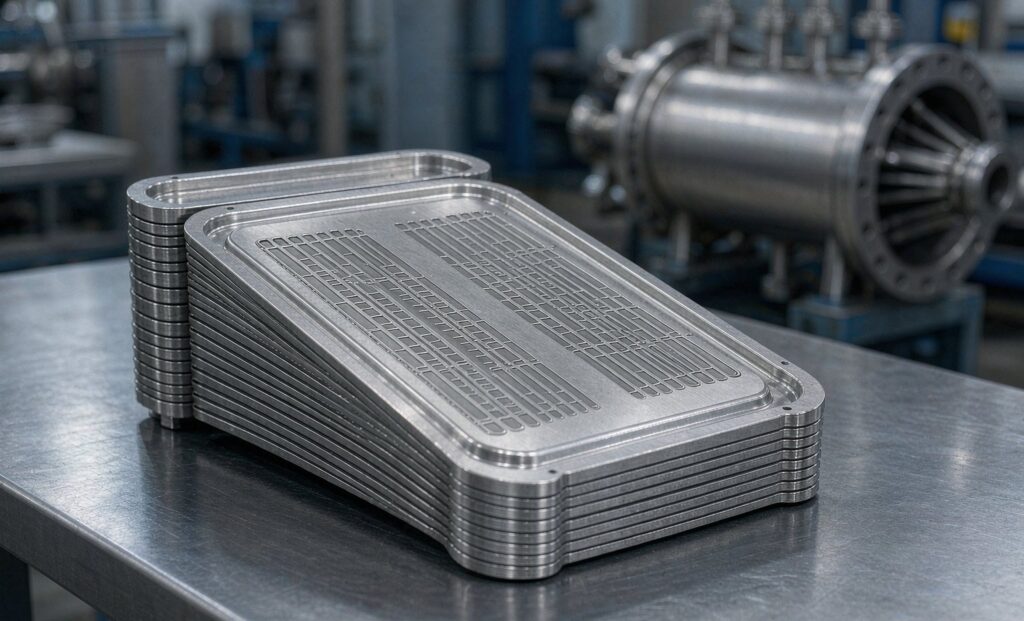
What a Printed Circuit Heat Exchanger Actually Is
A printed circuit heat exchanger is a solid block of metal with flow channels etched into flat plates, stacked and diffusion bonded until the stack becomes one continuous piece of material. The name comes from the manufacturing route: the channels are chemically milled the same way a printed circuit board is made, typically 1.5 to 2 mm wide with a semicircular cross-section, then the plates are pressed and heated under vacuum until the grain structure crosses the original interfaces. There are no gaskets, no tube-to-tubesheet joints, no brazing filler and no shell.
That construction produces three properties no conventional exchanger can match at the same time: very high pressure capability, very high temperature capability, and an extremely small footprint. It also produces two hard penalties — a cost per square metre of surface that is several times a shell and tube unit, and a channel geometry that cannot be mechanically cleaned.
Those four facts decide almost every real selection. This guide is written for the buyer or process engineer who has been quoted a PCHE and needs to know whether the premium is doing useful work or whether a shell and tube, welded plate or air cooled unit would do the same job for a fraction of the money.
How the Construction Sets the Limits
Because the plates are bonded across their entire surface rather than welded at a seam, the pressure boundary is the material itself. A diffusion bonded block in 316L stainless routinely carries 400 to 600 bar design pressure, and with nickel alloys such as Alloy 617 or 625 the same block will run at 800 to 900 °C. A gasketed plate exchanger is limited to roughly 25 bar and 180 °C by its elastomer; a shell and tube unit is limited by wall thickness and flange rating, which in practice means a much heavier and larger vessel for the same duty.
The channel size is what buys the surface density. A PCHE packs 200 to 1000 m² of surface into a cubic metre, against 50 to 200 m²/m³ for a shell and tube bundle. Overall heat transfer coefficients for water-to-water duty land in the 2000 to 4000 W/m²·K range because the hydraulic diameter is small and the flow is always turbulent at modest velocity. In practice a PCHE delivering the same duty as a shell and tube exchanger comes out four to six times smaller and lighter — and in cryogenic and offshore service, weight reductions above 70% have been documented.
Why the small channel is also the weakness
Pressure drop scales roughly with the inverse of hydraulic diameter, and every bend in an etched channel behaves like a short radius elbow. A PCHE is therefore a poor choice for a high volumetric flow at low pressure — the pumping penalty can exceed the value of the extra efficiency. It is a good choice when the stream is already at high pressure, because the absolute pressure drop is a small fraction of the available head.
The same geometry plugs. A 2 mm channel will not pass scale, weld slag, gasket fragments or polymer carry-over, and once a channel is blocked there is no rod, brush or jet that can reach it. Every PCHE installation needs a strainer at the inlet, sized so the aperture is roughly one third of the smallest channel dimension — in practice 200 to 320 micron — and that strainer needs a differential pressure transmitter and a cleaning schedule of its own.
PCHE vs Shell and Tube vs Plate: The Honest Comparison
The table below is the one worth taking to a selection meeting. Figures are typical ranges for commercially available equipment, not guarantees; every duty still needs its own thermal and mechanical design.
| Parameter | Printed circuit (PCHE) | Shell and tube | Gasketed plate | Welded / plate-and-shell |
|---|---|---|---|---|
| Practical design pressure | 400–600 bar, higher in alloy | Up to ~300 bar, thickness-driven | ~25 bar, gasket-limited | ~100 bar depending on type |
| Practical design temperature | −196 °C to 900 °C by alloy | −100 °C to 600 °C | −30 °C to 180 °C | Up to ~400 °C |
| Surface density (m²/m³) | 200–1000 | 50–200 | 150–250 | 100–200 |
| U-value, water/water (W/m²·K) | 2000–4000 | 800–1500 | 3000–5000 | 1500–3000 |
| Approach temperature | Down to 2–3 °C | 5–10 °C typical | 1–2 °C | 3–5 °C |
| Fouling tolerance | Poor — no mechanical cleaning | Good — bundle removable | Moderate — plates open out | Moderate — chemically cleanable |
| Field repair | None; block is replaced | Retubing is routine | Gaskets and plates replaced | Limited |
| Capital cost, same duty | Highest | Moderate, most predictable | Low | Moderate to high |
| Lead time | Long — few qualified fabricators | Short | Short, often stocked | Medium |
| Typical service | LNG, sCO₂, hydrogen, offshore, nuclear | Refinery, steam, general process | HVAC, chiller, food, district heat | Ammonia, aggressive clean fluids |
Read the first two rows together. A PCHE is not a better heat exchanger in general; it is the only heat exchanger that fits when pressure and temperature are both extreme and space is not negotiable. The moment one of those constraints relaxes, the economics move sharply against it.
Where the Printed Circuit Premium Is Justified
Four situations repeatedly justify the cost in real projects.
- Offshore and subsea. Deck space and topside weight are priced in structural steel. A unit one fifth the weight of the shell and tube alternative pays for itself in the support structure alone, and the absence of gaskets removes a leak path that would otherwise need fire detection and isolation.
- Cryogenic and LNG service. The etched block tolerates the thermal shock of a −160 °C stream and holds a 2 to 3 °C approach, which matters when the cold end of a liquefaction train is where the exergy loss lives. Our guide to cryogenic heat exchangers for LNG sets out the alternative vapouriser arrangements for buyers who do not need PCHE-class hardware.
- Supercritical CO₂ and high-pressure hydrogen. At 250 bar and above, the wall thickness a shell and tube unit needs destroys its own economics, and hydrogen embrittlement at joints favours a bonded block over a weld.
- Clean, high-value process streams. If the fluid is already filtered to a few microns — a closed-loop demineralised water circuit, a refrigerant, a pure gas — the fouling objection disappears and the compactness is free.
Where a PCHE Is the Wrong Purchase
Be equally clear about the other side, because a fabricator who only sells PCHEs will not tell you this.
- Any stream that fouls, scales or carries solids. Cooling water, river water, flue gas, crystallising solutions, slurries and polymerising monomers are all disqualifying. You cannot clean a blocked 2 mm channel, and replacement means replacing the whole block.
- Large volumetric flow at low pressure. The pressure drop penalty is unacceptable; a shell and tube unit with a large shell-side cross-flow area will do the job with a fraction of the fan or pump power.
- Budget-constrained projects with conventional duty. For 80 to 90% of refinery, chemical, HVAC and general industrial duty, a shell and tube exchanger is cheaper, more serviceable and thermally adequate.
- Sites without filtration discipline. A PCHE installed upstream of a strainer that nobody cleans is a scheduled failure, not a heat exchanger.
Specification Data a Fabricator Needs Before Quoting
Whether the answer turns out to be a PCHE or a conventional unit, the same data package decides it. Send these and a competent fabricator can tell you within a day which construction your duty genuinely needs.
- Fluid name, composition and phase on both sides, including any trace components that could deposit.
- Mass or volumetric flow, inlet and outlet temperatures, and allowable pressure drop on each side — stated separately, not as a total.
- Design pressure and design temperature for both sides, plus the governing code and any third-party inspection requirement.
- Corrosion allowance, material preference and any restriction on dissimilar metal joints.
- Available plot space, maximum weight, and nozzle orientation — the constraint that most often triggers a compact solution.
- Fouling resistance assumed in the thermal design, and the cleaning method the plant actually intends to use.
- Filtration available upstream, in microns, and who owns the strainer.
The Realistic Alternatives Worth Pricing
For most duties that are quoted as PCHE candidates, three alternatives deserve a price alongside it.
Shell and tube remains the default for a reason: predictable cost, removable bundle, retubing as a standard workshop operation, and no upper limit problem below 300 bar. A stainless steel shell and tube heat exchanger in 316L will handle a great many duties that are casually described as high pressure, and our TEMA type guide explains how the BEM, BEU and AES arrangements change cleanability and thermal performance.
Welded plate and plate-and-shell sit between the two. They keep most of the plate exchanger’s efficiency and approach temperature, remove the gasket temperature limit, and stay chemically cleanable. They are usually the correct answer for ammonia plant intercoolers and for aggressive but clean refrigerants. Our comparison of plate and shell versus gasketed plate and shell and tube covers where that line falls.
Air cooled is the answer when the constraint is water rather than pressure. A finned tube air cooled unit removes the cooling water circuit entirely, at the cost of footprint and fan power.
What to Ask a Supplier Before You Sign
Three questions separate a competent PCHE supplier from a trader with a catalogue. Ask which diffusion bonding cycle they use and what bond quality test they perform on a coupon from the same load. Ask what the maximum channel blockage they will accept at hydrotest, and how the channels are inspected. Ask what happens if the unit fouls in year four — whether they will chemically clean it in place, and at what price.
If the answers are vague, the duty probably does not need a PCHE, and a conventional exchanger from a fabricator who will still be there in ten years is the better commercial decision. Zhenggong manufactures shell and tube, plate and air cooled heat exchangers under D1/D2 pressure vessel certification and ISO 9001 and ISO 14001 — the certification and inspection page lists the codes and the third-party inspection scope, which is what a buyer’s QA department will ask for first.
Frequently Asked Questions
Can a printed circuit heat exchanger be repaired if it leaks internally?
Generally no. The block is a single bonded piece of metal, so an internal leak between channel passes cannot be cut out and re-welded. The unit is replaced. This is why the filtration and water chemistry requirements in the specification matter more than the thermal margin.
Is a PCHE more efficient than a shell and tube exchanger?
Per unit of surface, yes — the small hydraulic diameter gives a higher heat transfer coefficient and a closer approach temperature. Per unit of capital spent on a conventional duty, usually not. Efficiency only translates into money when it removes a compressor stage, shrinks a structural frame, or recovers exergy at a cryogenic cold end.
What pressure drop should be allowed in the thermal design?
State it explicitly per side and check it against the pump or compressor curve. A common mistake is to give the fabricator a single combined allowance, which lets the design drift into a channel geometry that meets the duty but consumes far more pumping power than the plant can absorb.
Next Step
If you are holding a PCHE quotation and are not certain the premium is earned, send the duty to our engineers. We will size a shell and tube and a welded plate alternative against the same process conditions and tell you plainly if neither will fit — in which case a specialist compact exchanger fabricator is the right call, not us. Start with the engineering service scope or send the data sheet through the contact form for a quotation.
