
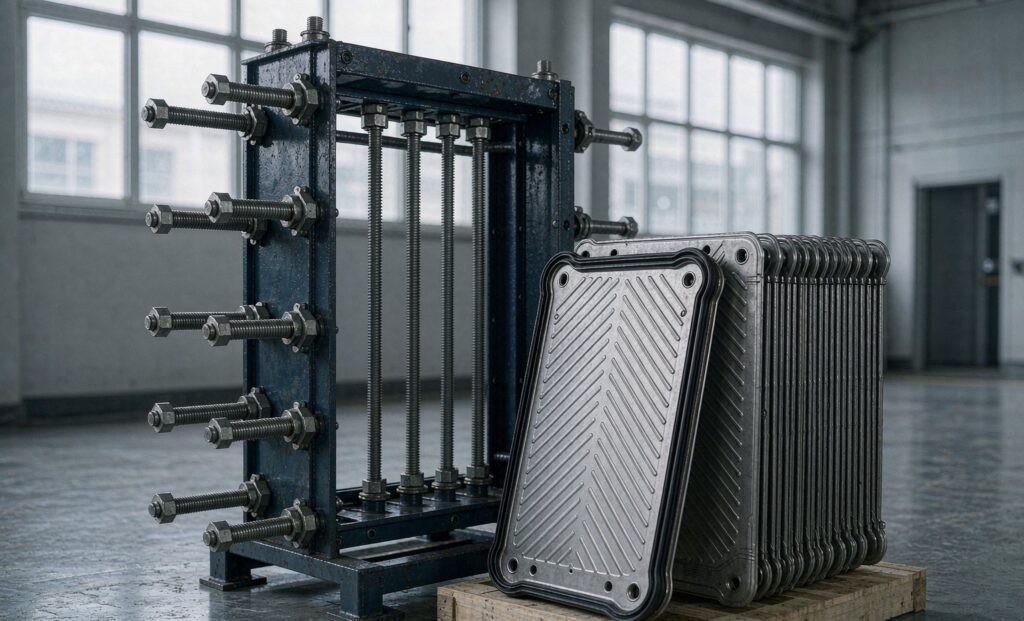
Why a Funke Plate Pack Is Not a Generic Spare Part
Funke Wärmeaustauscher Apparatebau, the German plate heat exchanger maker based in Hann. Münden, has been part of GEA Heat Exchangers since 2011 and has traded under the Kelvion name since 2014. That corporate history creates a specific problem for anyone planning Funke plate heat exchanger plates replacement: the frame nameplate says Funke, the current spare parts catalogue says Kelvion, and the drawings in your maintenance file use yet another plate code. Three vocabularies, one machine.
The second problem is geometry. A gasketed plate heat exchanger frame is a clamp. It will accept any plate that fits its bars, ports and tie-bolt envelope — which is why so many units in the field have been rebuilt at some point with plates that are close but not identical to the original. If you order a replacement plate on the model number alone, you are trusting that nobody has been in there before you.
- Plates are matched on geometry, not on model number. The frame model tells you the envelope; the plate tells you the duty.
- Gasket attachment differs between build generations. A clip-on gasket will not stay in a glued groove, and a glued gasket will not seat in a barbed one.
- Plate thickness is a pressure rating, not a preference. A 0.5 mm plate does not substitute for a 0.6 mm plate in the same frame at the same design pressure.
Step 1: Read the Nameplate Before You Touch Anything
Photograph the nameplate first, in daylight, with the frame clean. You need the type designation, serial number, year of manufacture, design pressure and temperature on both sides, test pressure, connection sizes, plate count and — where it is stamped — the installed surface area. When a unit has been re-plated, the nameplate is frequently the only record of what it was originally built to do, and it is often the only place the original plate thickness appears.
Two thirds of the replacement enquiries that go wrong start with a nameplate that was read from a photograph taken at an angle, in a dark plant room, with the frame painted over. Wire-brush the plate, photograph it square-on, and write the numbers down rather than trusting the image.
The plate edge stamp carries more information than the frame
Almost every plate carries a stamped or etched code on its edge or in the corner of the chevron field. On Funke plates this is typically a short alphanumeric string that encodes the plate pattern and, in some series, the thickness and material. Note it exactly, including any suffix letters — a suffix often distinguishes a blind plate, a pass divider or a plate with a different port arrangement. Do not “clean it up” into what you think the code should be.
Step 2: Measure the Plate — Seven Dimensions That Identify It
Replacement plates are identified by measurement, and there is no shortcut. Take the measurements on a single flat plate removed from the pack, on a bench, not inside the frame. Record them on a sheet that travels with the order.
| Dimension | How to measure | Tolerance that matters |
|---|---|---|
| Vertical port centres | Steel rule across the two port centres on one side | ±1 mm |
| Horizontal port centres | Steel rule across the two port centres top to bottom | ±1 mm |
| Plate height and width | Rule on a flat plate, edge to edge | ±1 mm |
| Port hole diameter | Vernier across the port ring | ±0.2 mm |
| Plate thickness | Micrometer on the flat land, three points | ±0.02 mm |
| Corrugation depth | Depth gauge across the chevron field | ±0.1 mm |
| Gasket groove width | Vernier in the groove, away from a port | ±0.2 mm |
Add two qualitative notes that a drawing cannot carry: the chevron angle (shallow, steep or mixed within the same plate) and whether the plate has a full peripheral gasket groove or a partial one with a separate ring around each port. Mixed-angle plates are common in duties that need a high heat transfer coefficient without an excessive pressure drop, and they cannot be replaced by single-angle plates without recalculating the duty.
Step 3: Thickness Decides Replace or Reuse
Standard gasketed plates are 0.5 mm; heavier gauges at 0.6 mm and 0.7 mm are used where the design pressure or the port velocity demands it. Erosion is worst at the port ring, where the flow accelerates into the channel, and corrosion is worst wherever the medium stagnates — under a gasket, in a dead corner, or in the last channel before a blind plate. Measure at the port ring first, not in the middle of the field where the plate looks healthy.
A working rule: below 80 percent of nominal thickness, replace. Between 80 and 90 percent, the plate is still serviceable but should not go back into a high-pressure pass, and it should not be paired against a new plate at a high differential pressure. The reason is not heat transfer — the wall resistance of a 0.5 mm stainless plate is a small fraction of the overall resistance in almost every duty — it is mechanical. The plate has to carry the full differential pressure across its corrugation, and a thinned plate at the port is where a pinhole starts.
If the only symptom is a falling approach temperature and a rising pressure drop with no external leak, you do not have a plate problem. You have fouling. Clean it first and re-measure before you spend money on plates. The diagnostic sequence is set out in our guide to identifying the foulant before choosing a cleaning method.
What Usually Fails: Plate, Gasket or the Whole Pack
Rebuilding a pack that did not need rebuilding is expensive and introduces new leak paths. Use the symptom to decide what actually gets replaced.
| Symptom | Most likely cause | What to replace |
|---|---|---|
| Weep at the plate edge, worse when hot | Gasket hardened or crept | Gaskets on the affected section |
| Cross-contamination between circuits | Cracked plate or failed port ring gasket | The plate, plus inspect its two neighbours |
| Pressure drop up, approach temperature down | Fouling or scaling | Nothing — clean and re-test |
| Leak returns in the same place after rebuild | Distorted plate or out-of-flat frame plate | Plate, then check frame flatness |
| Leak at the frame plate, not the pack | Corroded frame groove or cracked liner | Frame repair, not plates |
Gasket Attachment: Glued, Clip-On and the Trap in Between
Funke frames span both generations of gasket technology. Earlier units used gaskets bonded into a plain dovetail groove with adhesive. Later units use clip-on gaskets retained by barbs moulded into the groove, fitted dry with no adhesive at all.
The distinction is visible without dismantling anything: look into the groove. An undercut with a visible lip or a series of small barbs takes a clip-on gasket. A smooth dovetail with no undercut takes a glued gasket. Ordering the wrong type is the single most common wrong-part failure in this market, and it usually shows up as gaskets that lift out of the groove during closing.
Fitting practice differs accordingly. Glued gaskets need the groove cleaned back to bare metal — solvent, then a mechanical clean, then adhesive applied in a thin even film and allowed to tack before the gasket is pressed in. Clip-on gaskets need the groove clean and dry; any residual adhesive or oil stops the barbs engaging and the gasket will walk out under thermal cycling.
Mixing Old and New Plates: Keep New Plates Together
Partial replacement is normal, and it is where rebuilds go wrong. Three rules keep it safe.
- Group the new plates. Do not distribute new plates through the pack. A block of new plates behaves as a block; a scatter of new plates creates local differences in channel width and flow distribution.
- Put new plates in the hottest or most aggressive duty. If one side runs at 90 °C and the other at 30 °C, the new plates go where the old ones failed.
- Do not exceed roughly 20 percent old plates in a rebuilt pack if those plates are more than about ten years old or have been through more than three regasket cycles. This is a rule of thumb, not a standard — but a pack of mixed-age plates with mixed remaining life will leak again within a season, in a different place, and you will have paid twice.
Rebuild Sequence and the Number That Matters
The commissioning datum is the pack length, usually marked as dimension A on the frame or the drawing. Torque is a means to an end; pack length is the end. Record A before you open the frame, with the unit at ambient temperature and fully drained.
- Isolate, lock out, drain both circuits and break the vacuum. Confirm zero pressure on both sides.
- Measure and record the pack length at four points around the frame. If they disagree by more than a couple of millimetres, the pack is already unevenly compressed and the frame should be checked.
- Mark the plate order and orientation before removal — a pass divider or blind plate in the wrong position changes the entire flow arrangement.
- Clean the frame plates and the tie bolts. Inspect the frame groove for corrosion pitting.
- Inspect every plate against a light source. A pinhole shows as a bright point. Hold the plate at an angle to catch the corrugation shadows.
- Count the plates and confirm against the drawing before reassembly. An extra plate changes the channel count and the duty.
- Alternate plates correctly — the pack is a stack of mirrored pairs, and one plate flipped the wrong way creates a blocked channel that looks like fouling.
- Close in three stages, diagonally, alternating sides, until the pack reaches dimension A — never beyond it.
- Pressure test each side separately with the opposite side open to atmosphere, so a cross-leak shows as a level change rather than hiding inside a pressurised circuit.
Torque figures copied from a forum are worse than useless. They depend on bolt lubrication, thread condition and frame stiffness. If you must record a torque, record it as an observation at the point where A was reached, not as an instruction for next time.
Pressure Test and the First Day of Operation
Hydrotest at 1.3 times design pressure, or at the figure your local code and the original nameplate require, holding for at least 30 minutes. Then run the unit and watch the approach temperature for the first day. A rebuilt pack that reaches design duty within a few hours and holds it overnight is sound. One that starts well and drifts has a gasket that is not seated, a plate in the wrong orientation, or air still trapped in the circuit.
Cross-Referencing Another Brand Without Guesswork
“Equivalent to Funke type …” is a claim, not a specification. Any quotation built only on a model number, without the seven measurements above, is a guess with a price attached. The defensible cross-reference matches plate geometry, corrugation angle, gasket groove profile, plate thickness and material grade, and then re-checks the thermal duty and pressure drop at your flow rates. If the replacement plate has a different chevron angle, the duty will shift even though the plate drops straight into the frame.
Where an OEM plate is unavailable or its lead time is prohibitive, an independent manufacturer working from measured dimensions can supply a functionally equivalent pack — but the frame rating must be re-checked against the new plate thickness, and the duty should be recalculated rather than assumed. For brand-specific workflows on other makes, our notes on APV plate replacement and plate-pack rebuilding follow the same measurement-first sequence.
What a Replacement Order Should Contain
- Frame nameplate photograph, square-on and legible, plus the serial number typed out.
- Plate edge code, photographed and transcribed exactly.
- The seven-dimension measurement sheet, signed and dated.
- Plate count, and how many are to be replaced versus reused.
- Nominal and measured thickness, with the measurement points marked.
- Gasket elastomer and attachment type — glued or clip-on.
- Both media, with concentrations, and design pressure and temperature per side.
- Required certification: material certificate to EN 10204 3.1, dimensional report, and a pressure-retaining declaration where the frame is being re-rated.
Plates ship in a crate, on edge, with interleaved protection. A plate that arrives flat-stacked and strapped will arrive with bent ports, and a bent port will not seal no matter how carefully it is fitted.
Lead Time, Certificates and the Honest Trade-Off
Replacement plates typically run three to six weeks from drawing approval; gaskets are faster. The trade-off is straightforward: an OEM plate carries the original pattern and requires no recalculation, while an independent plate pack can be faster and cheaper but shifts the verification work onto you or your supplier. Either way, ask for the material certificate and the dimensional report, and check that the pressure-retaining parts carry the documentation your insurer or inspector expects. Zhenggong manufactures gasketed and welded plate heat exchangers under D1/D2 pressure vessel certification and ISO 9001 and ISO 14001 — see the certification and quality documentation for what is issued with each unit.
One last point that saves arguments later: photograph the assembled pack, from two angles, before the covers go back on. When the unit leaks in eighteen months, that photograph is the only evidence of what was actually inside it.
Next Step
If you have the nameplate photograph and the measurement sheet, we can quote a replacement plate pack against them — including a duty re-check at your flow rates and a gasket recommendation for both media. Send the details through the engineering enquiry form, or browse the gasketed plate heat exchanger range if the frame itself is being replaced rather than repaired.
