
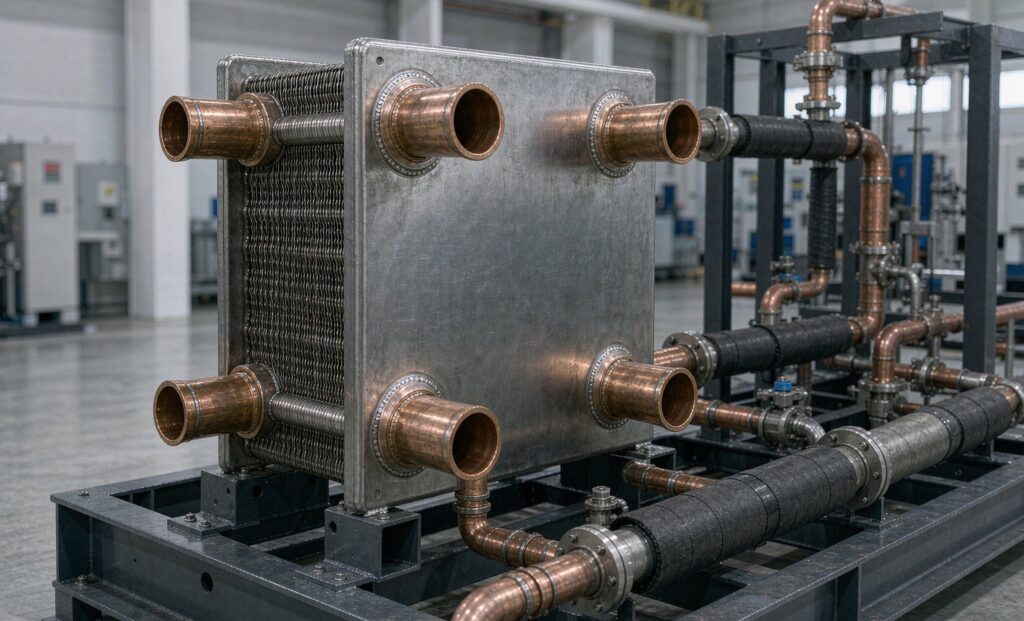
What a brazed plate heat exchanger actually is
A brazed plate heat exchanger (BPHE) is a pack of thin corrugated stainless steel plates joined permanently in a vacuum furnace using copper or nickel filler. The corrugation pattern creates two interleaved channel networks, so the two fluids — for example refrigerant and water, or primary and secondary circuits — pass on alternating sides of every plate and exchange heat through the thin stainless wall. There are no gaskets, no frame and no bolts. The result is a unit that is 60–80% smaller and lighter than a shell and tube exchanger of the same duty, with refrigerant-side volumes low enough to cut total system charge substantially.
Because the construction is sealed for life, the selection decision is front-loaded: get the fluid compatibility, pressure class and brazing material right at specification time, because there is no opening the unit later. That is exactly what this guide walks through.
Brazed vs gasketed plate heat exchanger: the core differences
The comparison below is the one engineers actually need. A gasketed unit can be opened, cleaned, regasketed and even extended with more plates; a brazed unit cannot. In exchange, the brazed unit wins on pressure, temperature, compactness and zero gasket maintenance.
| Factor | Brazed plate (BPHE) | Gasketed plate (GPHE) |
|---|---|---|
| Maximum working pressure | 30–45 bar standard; up to 100+ bar special designs | Typically up to 25 bar |
| Temperature range | −195 °C to 225 °C (copper); higher with nickel | ≈ −30 °C to 200 °C, gasket-dependent |
| Maintenance | None — chemical CIP cleaning only | Full mechanical cleaning, gasket replacement |
| Capacity flexibility | Fixed at manufacture | Plates can be added or removed |
| Fouling tolerance | Low — needs clean fluids | Good — handles fibrous and viscous media |
| Leak risk mode | Internal (plate failure) — rare | External (gasket aging) — expected over life |
| Footprint and weight | Smallest available per kW | Larger due to frame and bolts |
| Typical capex | Lowest per kW transferred | Higher initial, serviceable long-term |
Neither design is universally better. The question is which failure and maintenance mode fits the plant around it. If you are weighing plate technology against shell and tube as well, our comparison of shell and tube vs plate heat exchangers covers that axis in detail.
Where BPHEs dominate: heat pump and refrigeration circuits
The refrigeration circuit is the natural home of the brazed plate heat exchanger. Compact, high-pressure and gasket-free matches what an OEM needs:
Brazed plate heat exchanger as a heat pump evaporator and condenser
In a heat pump, the BPHE usually serves as the refrigerant-to-water condenser on the hot side and often as the evaporator on the source side. Plate geometry gives excellent heat transfer coefficients with refrigerant phase change, which keeps approach temperatures tight — directly improving COP. Low refrigerant hold-up volume reduces charge, which matters for F-gas compliance and for flammable refrigerants such as propane (R290), where charge limits are strict.
Refrigeration evaporator, economizer and subcooler duties
Compact chillers use BPHEs as evaporators with full flood or DX operation; economizers and subcoolers use the same plate format for small duties. Copper-brazed units handle all common HFC and HFO refrigerants. For transcritical CO₂ (R744) systems, high-pressure models with reinforced plate packs and nickel or steel brazing handle gas-cooler pressures well above 90 bar — always verify the rated design pressure against your high-side trip pressure.
Why ammonia is the exception
Standard copper-brazed units are chemically incompatible with ammonia (R717): ammonia attacks copper. Ammonia systems therefore use semi-welded or fully welded plate designs, or gasketed units with compatible plate and gasket materials. If your project is industrial refrigeration with NH₃, specify accordingly and put the material compatibility in the RFQ.
When the gasketed design is the better answer
- Fouling or particulate-laden fluids. Rivers, process slurries and untreated water need mechanical cleaning — read our plate heat exchanger cleaning and descaling guide for what that maintenance actually involves.
- Capacity that will grow. A gasketed frame can accept extra plates; a brazed block is fixed forever.
- Ammonia or aggressive chemistry. Semi-welded and gasketed units with titanium or Hastelloy plates survive what copper brazing cannot.
- Hygienic duties. Food, dairy and pharmaceutical plants need openable units for inspection and CIP validation.
BPHE selection checklist
- Define thermal duty, both sides’ temperatures and flows, and allowed pressure drop.
- Name the refrigerant and state design pressure and temperature on the high side — not just operating values.
- Choose brazing material: copper for standard HVAC/R duties, nickel where ammonia traces, chlorides or aggressive media rule copper out.
- Confirm connection types and sizes (solder, threaded, flanged) and mounting orientation.
- Verify the plate material (316 stainless standard) suits both circuits, and add a strainer on any suspect water side.
- Require helium leak testing and burst/pressure documentation from the manufacturer.
- Plan for CIP access: isolation valves and a chemical flush path extend BPHE life indefinitely in hard-water districts.
How brazed plate heat exchangers are made and tested
Understanding the manufacturing process explains both the strengths and the limits of the format. Plates are stamped from 316 stainless coil, stacked in alternating orientation, and loaded into a vacuum furnace with filler metal foil placed at every contact point. Under high vacuum and temperatures above 1,000 °C the filler melts, wets the plate intersections and re-solidifies as a rigid, hermetic core. Because the furnace atmosphere is evacuated, there is no oxidation inside the joints — which is why a well-made BPHE can hold refrigerant for decades without measurable leakage.
Two tests separate serious manufacturers from the rest. The first is helium leak testing of every unit: helium’s small molecule finds pinholes that air testing misses, and a leak rate ceiling on the order of 10⁻⁵ mbar·L/s should be quoted as standard, not as an option. The second is pressure and burst documentation: the rated design pressure must cover the worst case your system can generate, including hot-gas defrost and pump-off scenarios, not just steady-state operation. Ask for both certificates with the shipment.
Installation and water quality: protecting the block you cannot open
Since mechanical cleaning is impossible, the water side is where BPHEs live or die. Three inexpensive habits prevent most field failures:
- Strainer on the water inlet. A 40–60 mesh strainer catches scale flakes, weld beads and gasket debris from upstream pipework before they clog the narrow channels.
- Water treatment proportionate to the district. Hard-water sites need softening or a chemical program; closed loops need an inhibitor charge at commissioning and periodic top-up. Open cooling-tower circuits feeding a BPHE directly are the classic misuse — insert a plate or shell and tube exchanger to isolate the block from the open water.
- Correct flow direction for phase change. Refrigerant connections are directional by design: evaporators usually work best counter-flow with the refrigerant inlet at the bottom; condensers want refrigerant in at the top. Reversing them costs capacity and, in evaporators, risks poor oil return.
Where fouling still builds — hard water, long unattended seasons — periodic chemical cleaning in place (CIP) with citric acid or suitable descalers, followed by thorough rinsing, restores performance. Follow the manufacturer’s concentration and temperature limits so the stainless passivation layer is never attacked.
Quality credentials worth demanding from the factory
A BPHE is a pressure component, so the manufacturing floor matters as much as the thermal rating. Zhenggong Cooling and Heating Equipment Co., Ltd manufactures brazed and fusion-bonded plate heat exchangers at its facility in Shandong, China, under D1/D2 pressure vessel certification and ISO 9001 and ISO 14001 quality systems, and exports worldwide for OEM and project buyers. Our brazed and fusion bonded plate heat exchanger page lists construction options, pressure classes and connection standards, and the wider product range covers the shell and tube and air-cooled equipment that often sits in the same plant room.
Get a selection confirmed by a thermal engineer
Send your duty — refrigerant, capacities, temperatures and design pressures — and Zhenggong’s engineers will return a brazed plate selection with thermal performance data, pressure-drop figures and lead time. For quotes, custom designs and export documentation, contact the engineering team.