
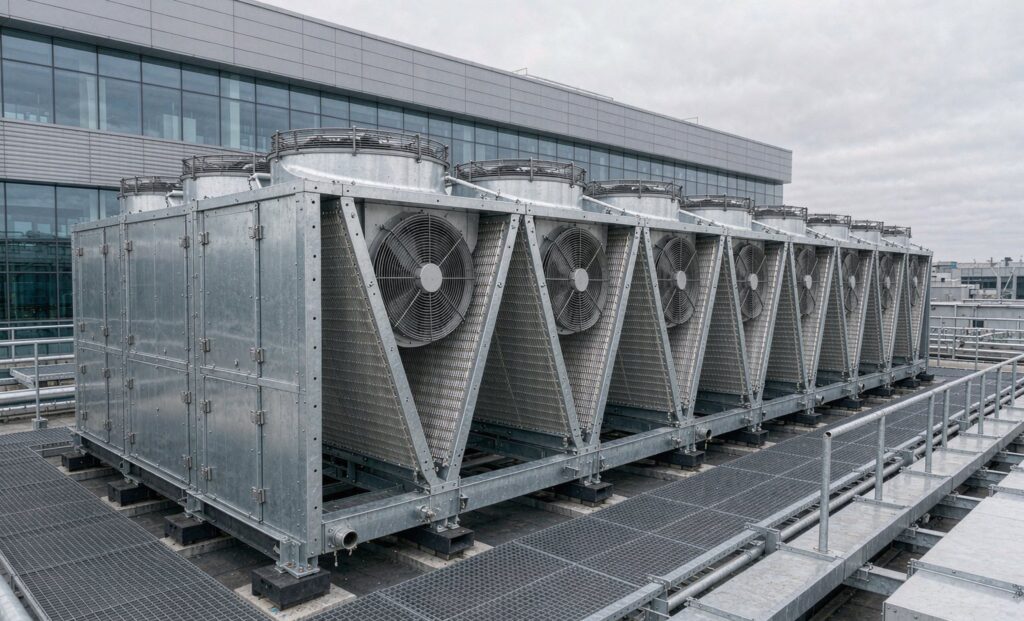
Why data center heat rejection has become a board-level decision
AI training clusters and high-density GPU halls have changed the maths of data center cooling. Racks that drew 5–10 kW five years ago now routinely exceed 40 kW, and the industry has moved to direct liquid cooling as the baseline rather than the exception. That shift pushes enormous amounts of heat into a facility water loop, and something has to reject that heat to the outdoors. The device doing that job determines how much electricity the plant consumes, how much water it drinks, and how high the facility’s PUE lands. This is why the dry cooler for data center cooling has become one of the most specified pieces of thermal equipment in new builds and retrofits alike.
Water is the flashpoint. In many regions — the American Southwest, parts of India and the Middle East, drought-limited European municipalities — evaporative water use is now restricted, taxed, or simply opposed by local communities. A dry cooler rejects heat with zero water consumption, which removes that entire category of permitting and ESG risk from the project.
What a dry cooler does inside a data center cooling loop
A dry cooler is a finned-tube air-cooled heat exchanger with axial fans. Warm water or water–glycol from the facility loop flows through the tubes; fans draw ambient air across the fins; heat crosses the tube wall and leaves as warmed air. Nothing evaporates, nothing is consumed, and the loop stays closed and clean.
In a modern liquid-cooled facility the chain looks like this:
- Cooling distribution units (CDUs) and rear-door heat exchangers absorb heat at the rack and transfer it into the facility water loop.
- The warm loop water — increasingly 40–50 °C return on high-temperature designs — is piped to the dry cooler array on the roof or yard.
- The dry cooler rejects the heat to ambient air and returns cooled water, typically within 3–6 K of ambient dry-bulb temperature.
- Trim chillers, where they exist at all, only run during the few hottest hours of the year.
Because the loop is closed, the coils stay clean, water treatment is a one-time glycol charge rather than a continuous chemical program, and the fin pack is protected from open-water fouling. Our air-cooled heat exchanger and dry cooler range is built around exactly this duty: V-type and flat-type coils, EC axial fans, and sizing for the tight approach temperatures data halls demand.
Free cooling: the economic argument for dry coolers
The reason operators keep choosing dry coolers is not just water savings — it is free cooling. Whenever the ambient dry-bulb temperature is below the required loop supply temperature, the dry cooler can hold setpoint with fans alone and the compressors stay off.
Three trends have widened that free-cooling window dramatically:
- Higher loop temperatures. Modern liquid-cooled IT hardware tolerates warmer supply water than legacy air-cooled halls. ASHRAE’s liquid-cooling guidance and recent GPU platform specifications accept supply water in the 30–45 °C range, which means ambient air does most of the work for most of the year in most climates.
- EC fan technology. Electronically commutated fans modulate efficiently down to very low speeds, so partial-load free cooling costs a fraction of what constant-speed fans once did.
- Smart controls. Weather-following control strategies raise setpoint on cool days and pre-cool thermal mass before warm afternoons, adding further hours of compressor-off operation.
In temperate climates a well-sized dry cooler plant can hold a warm-water loop all year with mechanical refrigeration reserved for peak afternoons. Even in hot-humid regions, night and monsoon-season free cooling still delivers meaningful kilowatt-hours of avoided chiller runtime.
Dry cooler vs cooling tower vs chiller-only
Buyers usually weigh three heat-rejection options. Each has a place, but the trade-offs are stark:
| Criterion | Dry cooler | Cooling tower (evaporative) | Chiller-only plant |
|---|---|---|---|
| Water consumption | Zero | High (evaporation + blowdown) | Indirect only |
| Energy use at design conditions | Moderate (fan power only) | Lowest approach, moderate fan power | Highest (compressor power) |
| Free cooling capability | Direct and simple — same loop | Possible via heat exchanger | None without additional equipment |
| Water treatment | One-time glycol charge | Continuous chemical program | Closed-loop, minimal |
| Legionella / health compliance | Not applicable | Ongoing obligation | Not applicable |
| Fouling of heat rejection coil | Low (closed loop) | Scale and biological growth | Low |
| Best fit | Water-scarce sites, warm-water liquid cooling, free-cooling climates | Hot climates needing very low approach | Small or legacy sites with cheap power |
Adiabatic hybrid variants blur the line further: they run dry for most of the year and spray water on the intake air only during peak hours, extending capacity in hot-dry climates while keeping annual water use a small fraction of a cooling tower’s. For most new liquid-cooled data halls, though, the pure dry cooler plus high loop temperature is the simplest and cheapest system to own.
Sizing a dry cooler for data center cooling: the parameters that matter
A dry cooler is selected, not bought from a shelf. Give your supplier these inputs and the selection will be right the first time:
- Heat rejection duty (kW). IT load plus pump and fan heat; for liquid-cooled halls this is close to total facility IT power.
- Fluid and glycol percentage. Glycol protects against freezing but degrades heat transfer and increases viscosity — the coils must be rated for the actual mixture.
- Required fluid temperatures. Supply and return setpoints define the approach temperature, which is the single biggest driver of coil size.
- Design ambient dry-bulb temperature. Use the site’s statistical design condition, not the record extreme, but state the free-cooling ambient profile if you want annual energy modelling.
- Altitude. Air density falls with altitude; fan performance and coil ratings must be corrected.
- Fan control and redundancy. N+1 fans with EC motors and individual speed control preserve capacity through fan failures.
- Footprint and acoustic limits. V-type coils halve the plan area; low-noise fan curves and night set-back keep the plant inside municipal noise budgets.
Tightening the approach from 6 K to 4 K can add 25–40% more coil face area, so it is worth agreeing early what the loop can tolerate. Over-sizing “to be safe” is equally wasteful: an oversized coil at low fan speed costs more capital and more plot than the marginal energy it saves.
Selection checklist before you issue the RFQ
- Confirm total rejection duty and future expansion — leave plot space or specify modular units that can be added in increments.
- Fix loop temperatures, glycol content and design ambient for the site.
- Decide free-cooling strategy: full dry operation with optional trim chiller, or adiabatic assist.
- Specify EC fans, N+1 redundancy, and BMS integration points.
- Agree casing and fin materials for the local environment — coated fins near coastlines or industrial air.
- Require performance data at your actual conditions, not nominal ratings, and ask for annual energy and water modelling.
- Check the manufacturer’s pressure-vessel and quality credentials for the connected hydronic components.
That last point is easy to overlook. Zhenggong Cooling and Heating Equipment Co., Ltd manufactures heat exchangers at scale in Shandong, China, and holds D1/D2 pressure vessel certification along with ISO 9001 and ISO 14001 — credentials worth verifying on any supplier of pressurized hydronic equipment destined for a mission-critical site.
Where dry coolers fit in the wider heat rejection picture
Dry coolers rarely work alone. They pair with plate heat exchangers that separate IT loops from supplier loops, with trim chillers for peak shaving, and increasingly with heat-recovery systems that route rejected warmth into district heating or neighboring process loads. If you are comparing air-side equipment more broadly, our guide to air cooled heat exchanger design and applications covers fin geometry, fan selection and maintenance in depth, and the blog index collects all of our thermal engineering articles by topic.
Get a sizing proposal for your data hall
If you are planning a liquid-cooled data center, an edge AI site, or a water-restricted retrofit, the fastest route to a realistic budget is a duty sheet reviewed by a thermal engineer. Send your kW duty, loop temperatures and site ambient to Zhenggong’s engineering team and you will receive a sized dry cooler selection with performance data, fan energy estimates and delivery terms for worldwide export.