
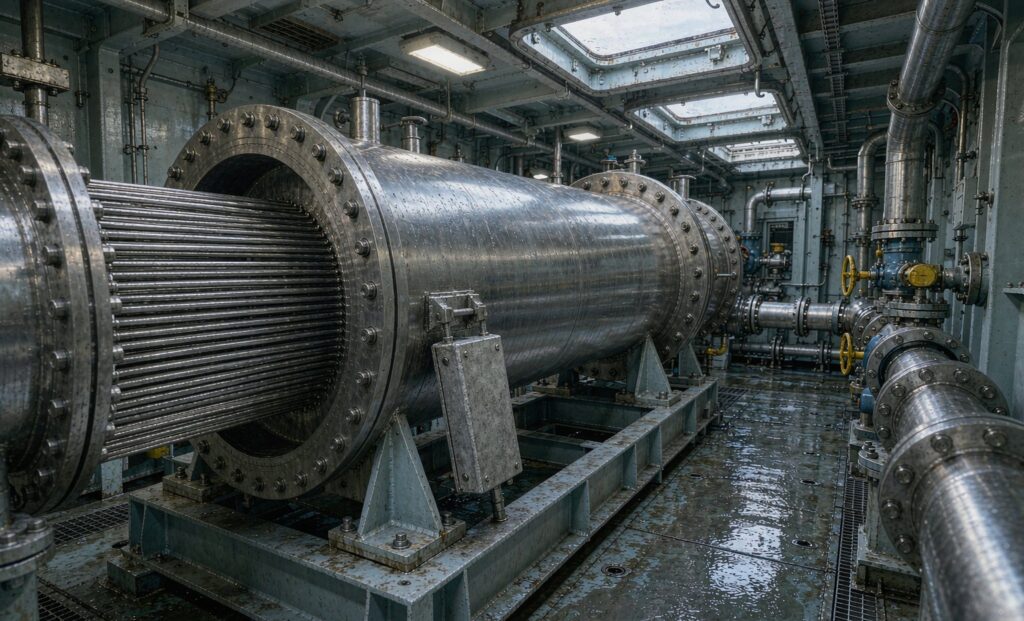
A titanium seawater heat exchanger is specified when the cooling medium is the sea, a harbour, a river estuary or a brackish well, and the consequence of a tube or plate failure is a shutdown, a contamination event or a dry dock. Titanium is not chosen because it transfers heat better than stainless — it does not — but because in chlorinated, aerated, biologically active water it is one of the few common engineering metals that simply does not corrode. The material decision, however, is only half the design. Velocity limits, fouling control and tube-to-tubesheet joint details decide whether the unit reaches its inspection interval or fails in the second season.
This guide compares the real options for seawater duty, sets out the velocity and fouling limits that protect them, and lists the specification items that separate a marine-grade exchanger from an industrial unit painted for the sea.
What a Seawater Heat Exchanger Has to Survive
Seawater is a more aggressive coolant than most plant engineers expect, and it attacks in four ways at once:
- Chloride pitting and crevice corrosion. Chlorides in the 19,000 mg/l range, combined with oxygen and warm metal surfaces, break down the passive film on standard stainless grades. Type 316L is not adequate for seawater service on a wetted surface.
- Erosion–corrosion at velocity. Once flow velocity exceeds the limit for the alloy, the protective oxide layer is stripped mechanically and metal loss accelerates sharply. This is the mechanism that kills most seawater coolers, not general corrosion.
- Biological fouling. Mussels, barnacles, tube worms and slime layers settle in low-velocity zones. The deposit itself is not the main problem — it is the oxygen-depleted, acidic crevice that forms beneath it, plus the loss of heat transfer that forces the unit to operate at a hotter, more aggressive condition.
- Galvanic and stray-current attack. Dissimilar metals in a conductive electrolyte behave as a battery. Copper alloys, carbon steel water boxes and stainless fasteners in the same circuit will drive current through whatever is least noble.
Every material choice in a marine exchanger is a response to one of those four items.
Titanium, Cupronickel or Duplex: The Material Comparison
Four families are in common use. The right answer depends on velocity, sand content, temperature, whether chlorination is available, and how long the unit must go between inspections.
| Material | Seawater performance | Typical velocity limit | Where it fits |
|---|---|---|---|
| Titanium Grade 2 | Essentially immune to chloride pitting and crevice attack; thin, tenacious oxide film; no copper ion release into the marine environment. | Roughly 3–4 m/s for clean seawater; lower with sand or entrained solids. | Offshore platforms, naval and commercial vessels, FPSO utilities, desalination, heat pumps using seawater or brackish sources, aquaria and aquaculture. |
| Cupronickel 90/10 | Good resistance; naturally resistant to biofouling because copper ions inhibit settlement; well-established marine standard with decades of service data. | Roughly 2–2.5 m/s. | Shipboard central cooling, coastal power plants, land-based industrial seawater where biofouling control without chlorination matters. |
| Cupronickel 70/30 | Higher erosion resistance and better performance in higher-velocity or sand-laden water than 90/10; higher cost. | Roughly 3 m/s. | High-velocity seawater, sand-bearing cooling water, condensers where tube life is the governing cost. |
| Super duplex / 254 SMO | Very high strength and good chloride resistance; a practical option where titanium is unavailable or where high pressure demands a stronger tube. | Higher than austenitic stainless; still vulnerable in truly stagnant, creviced condition. | High-pressure offshore circuits, tube-side duties where mechanical strength and wall thickness matter. |
When cupronickel is still the right answer
Cupronickel is often dismissed as old-fashioned, but where chlorination is not permitted or not practical — and where biofouling rather than pitting is the dominant threat — the natural antifouling behaviour of a copper alloy can be worth more than titanium’s corrosion immunity. The material also has a higher thermal conductivity and lower cost than titanium, so for a land-based plant with good filtration and controlled velocity it can deliver a lower total cost of ownership. The trade-off is that copper alloys have a hard velocity ceiling and are damaged by sulphides and ammonia in polluted harbour water.
Where titanium is non-negotiable
- Water with more than trace sulphides, or in ports and estuaries where pollution levels vary unpredictably.
- Equipment that must sit idle, drained-but-not-dried or partially filled, for long periods between voyages.
- Duties where copper release is restricted — aquaculture, marine parks, research and environmental applications.
- Systems with variable flow where genuinely low-velocity or stagnant conditions cannot be avoided at every point.
- Any application where a leak is unacceptable and inspection opportunity is rare, such as an unmanned platform or a submerged installation.
Velocity: The Number That Decides Tube Life
For a given alloy, tube life in seawater is a curve with two failure modes at either end. Too slow, and fouling and under-deposit corrosion take hold. Too fast, and the protective oxide film is eroded away. The usable window is narrower than most selections assume.
- Below about 1 m/s, settlement of macrofouling becomes likely in clean, unfiltered seawater; the practical minimum is often set at 1.0–1.5 m/s.
- Above the alloy limit — roughly 2–2.5 m/s for 90/10 cupronickel, 3–4 m/s for titanium — erosion begins at tube inlets, elbows and any local turbulence.
- Entrained sand or silt lowers every limit. A seawater stream carrying solids should be designed at the low end of the window and with an upstream strainer sized to the tube or channel.
- Tube inlet ends are the first to fail. Ferrules, chamfered inlets or slightly thickened tube ends are standard practice in aggressive service.
- Air and gas pockets create local high-velocity jets and must be avoided by venting and by correct piping arrangement, not by adding wall thickness.
Checking a quotation means asking for the tube-side velocity at design flow and at minimum flow, not just at the design point. A unit that looks comfortable at 1,000 m³/h may fall below the fouling threshold when the plant runs at 40 % load for six months.
Fouling Control and Cleaning
Seawater fouling is not eliminated, only managed. A workable strategy combines three elements:
- Filtration upstream. A strainer or automatic filter matched to the smallest cooling passage removes the mussel spat, shell fragments and debris that block tubes.
- Chemical or thermal control. Intermittent low-dose chlorination is effective for macrofouling but must be compatible with every material in the circuit — it is why a titanium unit that faces chlorinated water is a simpler design problem than a cupronickel one. Thermal shock treatment, where a hot stream is available, is an alternative on some duties.
- Mechanical cleaning. On-line sponge-ball systems keep condensers clean in power and process service at the cost of extra equipment and a pump. Otherwise the unit must be opened and the tubes brushed or hydro-jetted on a defined interval derived from the actual fouling rate, not from the manual.
Monitoring is what turns a cleaning plan into a controlled activity. Log the seawater inlet and outlet temperature, the process-side temperatures, and the flow on both sides. A falling temperature difference at constant flow means the unit is fouling; a rising process-side outlet with everything else constant means the same thing. Trend data will tell you the interval long before a planned outage does. General warning signs are covered in our guide to heat exchanger fouling causes and prevention.
Marine and Offshore Design Details
The difference between an industrial exchanger and one that survives at sea is in the details around the pressure boundary.
- Tube-to-tubesheet joints. Expanded, expanded-and-seal-welded, or welded. In seawater duty a seal weld on the seawater side removes the crevice where pitting starts; specify the joint type rather than leaving it to the workshop.
- Water box material. Untreated carbon steel water boxes in a seawater circuit will corrode internally regardless of the tubes. Rubber-lined carbon steel, or a more noble alloy, is the usual answer.
- Cathodic protection. Sacrificial anodes in the water boxes protect the box and the tubesheet face. They are a consumable — the design must allow them to be inspected and replaced, and the replacement interval must be in the maintenance plan.
- Thermal expansion and vibration. Marine service combines large temperature swings with engine and hull vibration. Floating tubesheets, expansion joints or U-tube construction may be needed, and tube support spacing must be checked against flow-induced vibration.
- Mounting and load cases. Shipboard and offshore units must be designed for the vessel’s motions, not just for static weight. Sea fastening, lifting points and skid design should be stated in the datasheet.
- Fouling-resistant surface finish and drainage. Fully drained, easily opened, and arranged so that no seawater pool sits against a dissimilar metal.
Specifying the Duty: A Checklist
- Seawater chemistry: salinity, chlorides, sulphides, silt or sand loading, temperature range, whether chlorination is available.
- Clean and fouled duty in kW, with the fouling factor stated rather than implied.
- Flow rates and both temperature programmes, at design, part-load and minimum flow.
- Required and calculated tube-side velocity at each of those flow conditions.
- Maximum allowable pressure drop on each side.
- Tube, tubesheet, shell, water box and gasket materials, with the tube-to-tubesheet joint type named.
- Design pressure and design temperature, plus the applicable classification society or client specification.
- Cathodic protection type and its replacement interval.
- Cleaning method, access requirements and the expected inspection interval.
- Documentation: material certificates traceable to the heat, hydrostatic test records, anode drawings, and where required third-party or class inspection.
Common Selection Mistakes
Specifying 316L because it is “marine grade”. Type 316 is a marine atmosphere material. In flowing, aerated seawater it pits, and in a stagnant crevice it fails faster.
Sizing on clean-water heat transfer. Seawater properties, and specifically the fouling that accumulates, must be in the calculation. A unit sized without a fouling allowance will be short of duty within a year.
Ignoring minimum flow. The thermal design is usually done at design flow, while the plant spends most of its life elsewhere. Both ends of the velocity window have to be checked.
Mixing metals without thinking about the battery. Copper alloy tubes with a bare carbon steel water box and stainless fasteners creates a galvanic cell that will consume the least noble part first.
No access for anode replacement. Cathodic protection that cannot be renewed is decoration.
Sourcing a Titanium Seawater Heat Exchanger
Marine and coastal duties are best quoted by a manufacturer who will take the seawater chemistry and the actual operating profile as inputs, rather than selecting from a range table. Zhenggong Cooling and Heating Equipment manufactures shell and tube heat exchangers at its Shandong facility, including units built with titanium, cupronickel and super duplex wetted parts for seawater and brackish-water service, and exports to marine, offshore, power, desalination and process customers worldwide. Pressure-retaining components are produced under D1/D2 pressure vessel certification with ISO 9001 and ISO 14001 management systems, and material certificates are issued with the equipment; the certificates are listed on the certification page.
The shell and tube heat exchanger range is the platform used for seawater duty, with tube material and joint type selected per application. Material behaviour in more general process service is compared in our guide to heat exchanger tube material selection from carbon steel to titanium, and the full manufacturing scope is listed on the product range page.
Next Step
Send the seawater analysis, the duty at clean and fouled condition, both flow rates, the temperature programme, the maximum allowable pressure drop, the design pressure and the inspection interval you need to reach. That is enough to select a tube material, a velocity and a joint type and to price the unit properly. Send your seawater duty to Zhenggong for a quotation and ask for the material certificates and the tube-to-tubesheet joint detail to be included with the offer.