
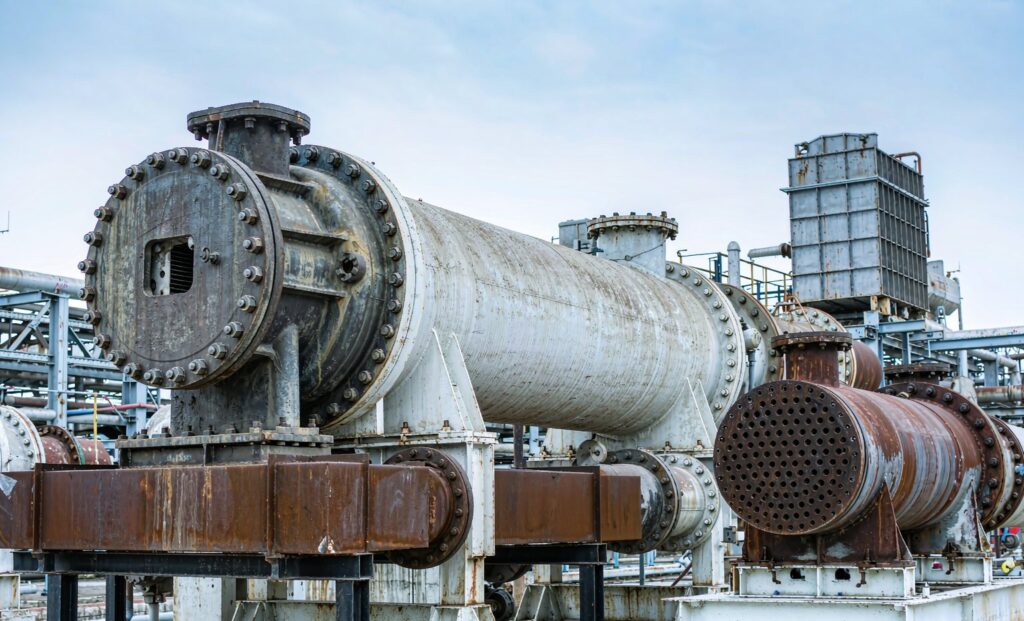
API 660 shell and tube heat exchanger requirements exist because a general pressure vessel code does not, on its own, produce an exchanger that a refinery can maintain. The code tells you the shell will not burst. The standard tells you the tube wall will survive a corrosion allowance, the bundle can be pulled, the girth flange will seal after three shutdowns, and the documentation will let the next engineer work out what is inside the unit ten years later.
That distinction is the source of most of the arguments on a purchase order. A fabricator offers a unit built to a pressure vessel code and TEMA, and it may be a perfectly good exchanger that does not meet the standard the buyer’s specification called for. This is what API 660 covers, where it sits relative to the code and to TEMA, which requirements are absolute and which are left to the purchaser’s data sheet, and what to verify before a bid is accepted rather than after the unit is on site.
What API 660 covers, and what it does not
The standard applies to shell and tube heat exchangers for the petroleum, petrochemical and natural gas industries — the services where a leak is a process safety event rather than a maintenance item. It addresses the mechanical design and fabrication of the exchanger: shell, channel, bonnet, tubes, tubesheets, baffles, flanges, nozzles, supports and the testing and documentation that go with them.
It does not perform the thermal design for you. It does not set the duty, choose the fluid velocities, or decide your fouling allowance. Those come from the process engineer and appear on the data sheet. Nor does it replace the pressure vessel code for the pressure-containing calculations — it works alongside it.
The practical reading is that API 660 is a mechanical specification with a documentation regime attached. If you are buying against it, you are buying a particular standard of construction and a particular standard of paper, and both are auditable.
Where API 660 sits against TEMA and the pressure vessel code
Three documents define most units of this type, and they overlap.
- The pressure vessel code. In most jurisdictions outside North America this is a national code, and inside it ASME Boiler and Pressure Vessel Code Section VIII, Division 1. It governs the pressure-containing calculations: shell thickness, head design, nozzle reinforcement, joint efficiency, and the hydrotest that proves the assembly.
- TEMA. The Tubular Exchanger Manufacturers Association’s standards fix the mechanical conventions of the exchanger as a machine: TEMA types, baffle arrangements, tube counts, minimum thicknesses for non-pressure parts, and the three service classes — R for severe petroleum service, C for general commercial, B for chemical process.
- API 660. Adds requirements on top, in the areas where a general code and a general mechanical standard are not strict enough for refinery service, and ties the whole thing to a purchaser’s data sheet and a documentation package.
For a petroleum duty the TEMA class is normally specified as R, and the difference between R and C is not cosmetic: it changes minimum shell and tube wall allowances, baffle thickness, tie-rod sizing, flange details and the maintenance philosophy the unit is built for. A unit offered to TEMA C against a specification calling for API 660 in refinery service is a non-conformance, not a cost optimisation, and it will usually be found at the drawing review stage by the buyer’s engineer who reads the TEMA class on the general arrangement.
If your duty is not petroleum or gas — a food plant, a general chemical process, an HVAC plant — this standard is the wrong one to invoke, and a general code plus TEMA will describe the machine you want. Our shell and tube heat exchanger page lists the range we build for process and utility duties; the standard you cite should match the service, not the other way round.
If you are specifying a unit, send us the duty and the mechanical basis: the fluid on each side, the flow rate on each side, the inlet and outlet temperatures, the heat duty in kW, and the design pressure, design temperature and standard you are buying to. We will come back with a sized selection against those figures and a quotation for a unit built to that basis — no nominal tonnage, no default TEMA class. The sizing and selection tools cover the thermal inputs in the order a selection needs them.
The purchaser’s data sheet is half the standard
API 660 expects a data sheet, and a large number of its requirements are written as “as specified by the purchaser” rather than as fixed values. That is deliberate: the standard cannot know your corrosion allowance, your design pressure, your allowable pressure drop or your preferred tube size.
The consequence is that a data sheet with blanks, or with a generic set of values copied from a previous project, produces a unit that meets the standard on paper and does not meet the duty. The items that are most often left thin, and most often cause trouble later:
| Data sheet item | Why leaving it thin costs money |
|---|---|
| Design pressure and temperature, each side | Sets wall thickness, flange rating, and whether the unit needs a special closure |
| Corrosion allowance, each side | Directly decides tube wall and shell thickness; a default value is often wrong for one side |
| Allowable pressure drop, each side | Drives tube count, length and baffle spacing; the thermal design cannot be fixed without it |
| Tube size, wall and length | Determines surface, cleaning method and spare part availability across the plant |
| TEMA class and type | Mechanical details and maintainability; type fixes whether the bundle can be removed from either end |
| Code, jurisdiction and stamping | Decides which calculations and which inspection authority apply |
| NDE extent and any third-party inspection | The largest single driver of inspection cost and of schedule risk |
| Documentation language and format | Decides whether the package is usable by the plant that has to maintain the unit |
Tube wall thickness and the corrosion allowance argument
The tube is the part that fails first, and it is the part that cannot be repaired in place. A tube wall is chosen as a calculated minimum for pressure plus a corrosion allowance, and the argument at bid stage is almost always about the allowance rather than the pressure term.
Two failures follow from getting it wrong. Too thin, and the tube fails from the outside in — often at a baffle crossing where erosion and corrosion act together — well before the design life. Too thick, and the thermal performance falls because the wall resistance is part of the overall heat transfer coefficient, and the bundle gets heavier and more expensive without buying the life the allowance was supposed to buy.
Ask the bidder to state the tube wall calculation and the allowance separately, for each side. A bid that quotes a wall thickness without showing the two components has not demonstrated that the number was chosen for your duty rather than defaulted from a table.
Tube-to-tubesheet joints: the joint that decides the maintenance bill
The tube-to-tubesheet joint is where a shell and tube exchanger leaks, and the standard constrains it because the consequences are asymmetric: a leak between shell side and tube side can contaminate a product stream, and a leak to atmosphere at the tubesheet is at least visible.
Three joint families matter. Expanded-only joints rely on rolling the tube into the tubesheet, and they are common in lower-duty service. Seal-welded joints add a weld at the tube face over an expanded joint, which gives a barrier against crevice corrosion at the joint and is the usual choice for hazardous or high-value streams. Strength-welded joints are used where the joint has to carry load, and they need a weld procedure and qualification that matches.
The detail that gets argued is the order of operations and the inspection of the result. A seal weld over a poorly expanded tube hides the expansion defect and fails in service; a weld made without adequate cleaning of the tube face fails at the fusion line. Require the weld procedure, the welder qualification, and a documented inspection of the expanded joint before welding, not after.
Also settle the tube-to-tubesheet clearance and the hole surface finish at the drawing review. These are small numbers with a large effect on whether the joint is leak-tight for twenty years or for two, and they are almost impossible to correct once the bundle is built.
Shell, channel and closure details
The closure is the part that determines how the unit is maintained. A bolted channel head with a removable cover lets you inspect and clean the tube side without disturbing the pipework; a welded channel does not. A bonnet with a removable cover suits a small unit; a full channel with a partition plate suits a multi-pass design. Each of these is a TEMA type decision, and each has a cost and a maintenance consequence that should be chosen deliberately rather than defaulted.
Girth flanges are the other maintenance hinge. They have to seal after being broken and remade at every bundle pull, which means the flange facing, the gasket selection and the bolting have to be right together. A spiral-wound gasket on a facing that is not matched to it will leak at the first thermal cycle, and the leak will be blamed on the gasket rather than on the specification.
Nozzle orientation, impingement protection at the inlet, vent and drain connections, and the location of the supports are all details that appear on the drawing review and rarely get a second look. They matter: an inlet nozzle without impingement protection erodes the tubes under it, and a unit with no vent connection cannot be filled properly at commissioning.
Materials, impact testing and post-weld heat treatment
Material selection follows the process, and the standard’s role is to require that the selection is documented and that the material is traceable. Two areas cause most of the delay in fabrication.
The first is impact testing. Where the design temperature or the material thickness brings the unit into a notch-toughness requirement, the test has to be specified, witnessed and recorded. A fabricator who discovers the requirement after the plates are cut has to re-order material, and the schedule absorbs the delay.
The second is post-weld heat treatment. Thick sections and certain materials require it, and it changes the fabrication sequence — nozzles and attachments that would otherwise be welded on late have to be welded before the treatment or given their own local treatment. A drawing that does not state the PWHT requirement clearly will produce a dispute about who pays for the second treatment.
Inspection, NDE and the hydrotest record
The hydrotest is the moment the unit proves itself, and the record of it is one of the documents that a plant will still be reading in twenty years. The test pressure, the holding time, the water temperature and quality, the gauge identification and calibration, and the witness — all should be recorded, and the record should be traceable to the unit’s serial number.
Beyond the test, the standard’s inspection regime covers the welds: their extent of radiography or ultrasonic examination, the acceptance criteria, and who performs and who witnesses. The important purchasing decision is not the technique but the extent, because extent is where the cost sits. Specifying full radiography of every weld on a utility exchanger is a way of paying for confidence you do not need; specifying none on a hazardous duty is a way of discovering a defect in service.
Third-party inspection is a separate line. If the plant’s insurer or the jurisdiction requires an authorised inspector, that inspector’s involvement has to be planned into the fabrication schedule — hold points that nobody scheduled become weeks of standing time.
Nameplate, documentation and the stamp question
A finished unit should carry a nameplate that identifies it and ties it to its paperwork: the manufacturer, the serial number, the year of manufacture, the design pressure and temperature for each side, the code and any stamp, and the TEMA type and class. Without that plate, the unit becomes anonymous the moment the purchase file is lost.
The documentation package is the other half. At minimum it should contain the general arrangement and detail drawings, the design calculations, material certificates traceable to heat numbers, weld procedure and welder qualifications, NDE reports, the hydrotest record, the PWHT record where applicable, and the operating and maintenance instructions. Ask for the package index at bid stage. It is a cheap way to find out whether the fabricator routinely produces documentation or assembles it when asked.
The stamp question depends on jurisdiction. In some markets the unit must carry a pressure vessel stamp and be registered before it can be operated; in others a national scheme applies with its own marking. Confirm which applies at the destination, not at the fabricator’s works, because a unit built to the wrong scheme cannot be stamped retrospectively without re-inspection.
What to check at bid stage, before the drawings
- The TEMA class on the general arrangement. It is stated on the drawing, and it is the fastest way to find a unit that is not what you asked for.
- The tube wall calculation, with the allowance separated. Ask for both components per side.
- The tube-to-tubesheet joint type and its inspection. Including the weld procedure where a seal weld is used.
- The closure and bundle removal route. Confirm the bundle can actually be pulled in the space the plant has.
- The NDE extent and the hold points. With the third-party inspector’s involvement scheduled, not assumed.
- The documentation index. Before the order, not after the shipment.
- The code and stamping scheme at the destination. In writing, from the buyer.
None of this requires a specialist to interpret. It requires the buyer to read the drawing rather than the price, and to ask for the two or three documents that show the standard was applied rather than cited.
Common non-conformances found at inspection
A unit offered to TEMA C against a TEMA R specification, with thinner baffles and lighter tie rods than the class requires. A tube wall at the code minimum with no allowance stated. A bolted channel replaced by a welded one to save cost, which removes the inspection route the plant assumed it had. A gasket facing that does not match the gasket specified. A hydrotest record with no gauge identification. A nameplate with the design pressure of the shell only. A documentation package that arrives three months after the unit.
Every one of these is cheap to fix before fabrication and expensive to fix afterwards, and every one is visible in a document review. That is the argument for buying against the standard properly: the requirements are mostly about making the unit legible, so that the plant that inherits it can maintain it.
How this differs from API 662 and from national standards
The related standard for plate exchangers, API 662, covers a different machine with a different failure mode; if your duty is a gasketed plate unit, that is the document to cite, and we describe it in our API 662 guide. National standards such as GB/T 151 cover shell and tube exchangers for their own jurisdictions and are widely used for units built in China for domestic and export projects; where a project specifies API 660, the national standard governs the pressure calculations only if the specification says so.
The practical rule is one primary standard per unit, stated on the data sheet, with the others referenced as supporting documents. A specification that lists four standards without saying which governs a conflict produces a bid clarification, then a deviation, then an argument. If the duty is a refinery or gas plant service, the standard to name is this one, and the API standards catalogue is where the current edition and its addenda are confirmed.
If you are specifying a unit and the mechanical basis is still open, the sizing and selection tools cover the thermal inputs, and the contact page is the route to a selection and a quotation against a stated standard.
