
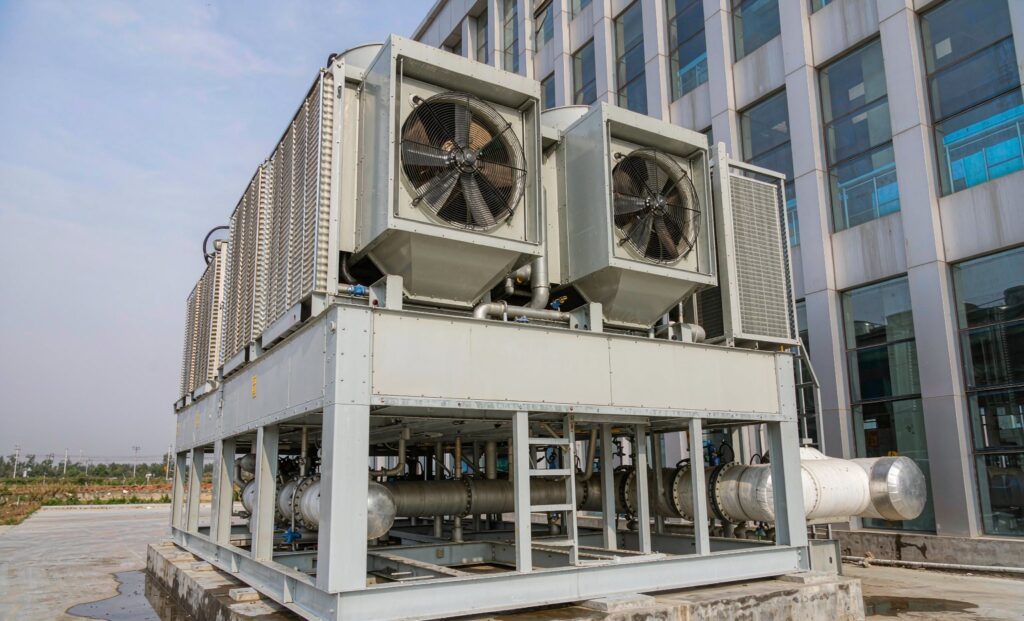
An air cooled screw chiller for data center duty is not a process cooling job with a different load figure. The load runs 8,760 hours a year, the sensible heat ratio sits above 0.95, the machine spends most of its life between 40 and 70 percent load, and the site has no water to spare for a cooling tower. Those four facts decide the compressor type, the condenser, the refrigerant and the control strategy — and they are the reason a chiller selected on nominal capacity at 35 °C will miss its design point on the hottest week of the year.
What makes a data hall different from a process load
The heat load is almost entirely sensible. Servers, UPS losses and lighting produce heat with very little moisture, so the coil runs dry for most of the year and the latent capacity in the catalogue is largely unusable. Design around sensible capacity, not total capacity, and check that the evaporator is selected for a dry coil at the actual entering air or water condition.
Three other characteristics shape the selection:
- Diversity is low. A data hall does not idle overnight. The annual load profile is flat, which means the chiller operates near its design point for thousands of hours and every percentage point of efficiency has real value.
- Redundancy is concurrent. Tier III-style facilities require maintenance without shutting the hall, so the machine count and the piping headers must allow one unit to be isolated while the rest carry the load.
- Uptime outranks efficiency at the design point. A machine that trips on a 46 °C afternoon costs more than one that uses 4% more power all year.
Air cooled or water cooled: the decision before the selection
Most new data centre builds in water-scarce regions go air-cooled for the simple reason that a cooling tower needs make-up water and a water treatment programme. The trade is energy and footprint.
| Criterion | Air cooled | Water cooled + tower |
|---|---|---|
| Water consumption | None at the condenser | High, with plume and treatment |
| Annual energy | Higher, ambient dependent | Lower, wet-bulb dependent |
| Footprint | Large, roof or yard | Compact plant room plus tower |
| Maintenance | Coil cleaning, fan drives | Water chemistry, tower fill |
| Ambient sensitivity | Strong: capacity falls as air rises | Weak: follows wet bulb |
Where water is available and the site is inland-hot, a water-cooled screw chiller with an adiabatic tower will beat an air-cooled machine on annual energy by 20–30%. Where water is restricted or the permitting is slow, air-cooled is the only practical answer — and the design effort moves to managing the ambient penalty.
Ambient derating: the number that decides the machine
An air-cooled condenser rejects heat to ambient air. As ambient rises, condensing temperature rises with it, compressor lift increases and both capacity and efficiency fall. A machine that delivers 500 kW at 35 °C does not deliver 500 kW at 48 °C.
| Ambient | Capacity | Input power | kW/kW |
|---|---|---|---|
| 35 °C | 500 kW (100%) | 175 kW | 2.86 |
| 40 °C | 466 kW (93%) | 181 kW | 2.57 |
| 45 °C | 424 kW (85%) | 188 kW | 2.26 |
| 50 °C | 378 kW (76%) | 196 kW | 1.93 |
The figures are indicative for a single-screw machine with a standard coil, but the shape of the curve is universal: roughly 1.4–1.6% of capacity and 1.2–1.5% of efficiency per kelvin above 35 °C. Two consequences follow.
First, size on the design ambient, not the annual average. A site that sees 44 °C for two weeks still has to carry full IT load on those days. Second, ask for the derating table in writing, at your design ambient, with the fan speed and the fouled-coil condition stated. A quotation that lists one nominal capacity is not a selection.
Part load and IPLV: where the operating cost actually sits
Because the load profile is flat and the ambient swings, the machine spends very few hours at 100% load. In most climates 60–75% of annual hours fall between 30 and 70% load, which is why the part-load metric matters more than the nominal kW/kW.
Screw compressors hold part-load efficiency well when they have a variable-speed drive; a fixed-speed screw with a slide valve loses several points below 50% load because the slide valve unloads the rotors while the oil system and fans keep drawing power. For a data centre duty the practical options are:
- VSD single screw — broadest turndown, best part-load figures, higher capital cost, and the right answer when annual hours dominate.
- Fixed-speed screw with slide valve — lower capital cost, acceptable above 50% load, weak below 40%.
- Multiple smaller machines — the most robust arrangement for redundancy, and it lets the control sequence keep the duty machines near their efficient band.
Ask for the part-load curve at your design ambient, not at AHRI conditions, and check the point where the fan steps begin. Fan power on an air-cooled chiller is 3–6% of total input, and a badly sequenced fan bank will erase the compressor savings.
Free cooling: the hours you get for free
Air-cooled chillers can run in free-cooling mode through a glycol dry cooler or an integrated economiser coil when ambient drops below the chilled water return temperature. In a temperate climate that is 2,500–4,000 hours a year; in a hot-arid climate it may be 800. The economics depend entirely on the site.
Two design details decide whether the free-cooling hours are real:
- Chilled water supply temperature. Raising it from 7 °C to 15–18 °C — which AI and high-density racks allow with cold-plate or rear-door heat exchangers — cuts the hours available for free cooling dramatically upward and improves compressor efficiency at the same time. This is the single largest efficiency lever in a modern data hall.
- Glycol concentration. Free cooling needs glycol on the dry-cooler loop, and glycol costs capacity. A 30% propylene glycol mix reduces heat transfer and raises pump power by roughly 8–12% against water. Size the loop for the mix you will actually run.
The dry cooler data centre guide covers the coil and fan selection for that free-cooling circuit, and the air cooled heat exchanger and dry cooler range covers the units themselves.
Condenser coil specification for a data centre site
The coil is where air-cooled chillers fail early. Data centres sit near roads, generators and diesel exhaust, and the coil fouls from the outside in. Specify for the site, not for the catalogue:
- Fin pitch — 2.1–2.5 mm for clean suburban air; 3.0 mm or wider where there is dust, pollen or generator soot. Wider fins cost surface area and buy cleaning intervals.
- Coating — e-coat or a cathodic dip for coastal and industrial sites; confirm the coating survives coil cleaning with a pressure washer at 40 bar.
- Coil accessibility — removable fan decks and hinged grilles. A coil that cannot be reached from both faces will be cleaned from one side only, and the second row will plug.
- Hail and debris guards — cheap insurance for a roof-mounted machine in a storm region.
- Fan motor access — EC motors with plug connectors, so a failed motor is a 30-minute swap rather than a crane lift.
Refrigerant choice under the F-gas phase-down
Refrigerant selection is now a compliance decision as much as a thermodynamic one. The EU F-gas regulation and its equivalents in other markets are pushing the industry away from high-GWP HFCs, and the phase-down quotas have made R134a-based machines progressively harder to service economically in Europe.
| Refrigerant | GWP (AR5) | Safety class | Practical note |
|---|---|---|---|
| R134a | 1,300 | A1 | Proven, cheap to service, exposed to quota |
| R513A | 631 | A1 | Near drop-in, roughly 5% lower capacity |
| R1234ze(E) | <1 | A2L | Low GWP, larger displacement needed |
| R32 | 675 | A2L | High volumetric capacity, flammable |
For a data centre, the A1 options keep the plant room simple. An A2L refrigerant brings charge limits, ventilation and leak-detection requirements that change the building, not just the chiller — price that in before choosing the greenest label.
Redundancy, controls and the interface that gets forgotten
A data centre chiller plant is judged on what happens when one machine stops. Specify:
- Dual refrigerant circuits on machines above roughly 500 kW, so a single circuit fault leaves half capacity.
- Lead/lag rotation with automatic changeover, and a sequence that brings standby machines on before the duty machines reach 100%.
- Open protocol communication — Modbus TCP or BACnet — with the register list issued at order, not at commissioning.
- Fast restart after power loss: check the minimum time to full load, because UPS ride-through is measured in minutes, not hours.
Selection checklist
- IT load in kW, with growth allowance and the design ambient dry-bulb.
- Chilled water supply and return temperatures, and the flow rate that follows.
- Sensible capacity required at the design ambient, after derating.
- Redundancy scheme (N+1, 2N) and the concurrent maintenance case.
- Free-cooling hours required, and the glycol concentration that goes with them.
- Part-load metric required by the client or the local energy code.
- Refrigerant, GWP limit and any A2L constraints from the building design.
- Coil coating and fin pitch for the actual site air quality.
- Sound pressure at the nearest boundary, at night, with all fans running.
- Pressure vessel and electrical certification required in the destination country.
Inside the machine, the evaporator and condenser are ordinary shell and tube or brazed plate assemblies, and their selection drives both the footprint and the pressure drop that the pumps must carry. The chiller heat exchanger selection guide covers that layer, and the cold storage chiller guide shows how the same logic changes when the evaporating temperature drops instead of the ambient rising.
Zhenggong builds the shell and tube and plate exchangers inside packaged chillers, holds a Chinese D1/D2 pressure vessel manufacturing licence and ISO 9001 and ISO 14001 certification, and supplies OEM and end-user projects worldwide. For a data centre project the useful conversation starts with the load profile and the design ambient rather than the model number — send both to our engineering team and we will return a derated capacity table and a heat exchanger selection that matches it.
