
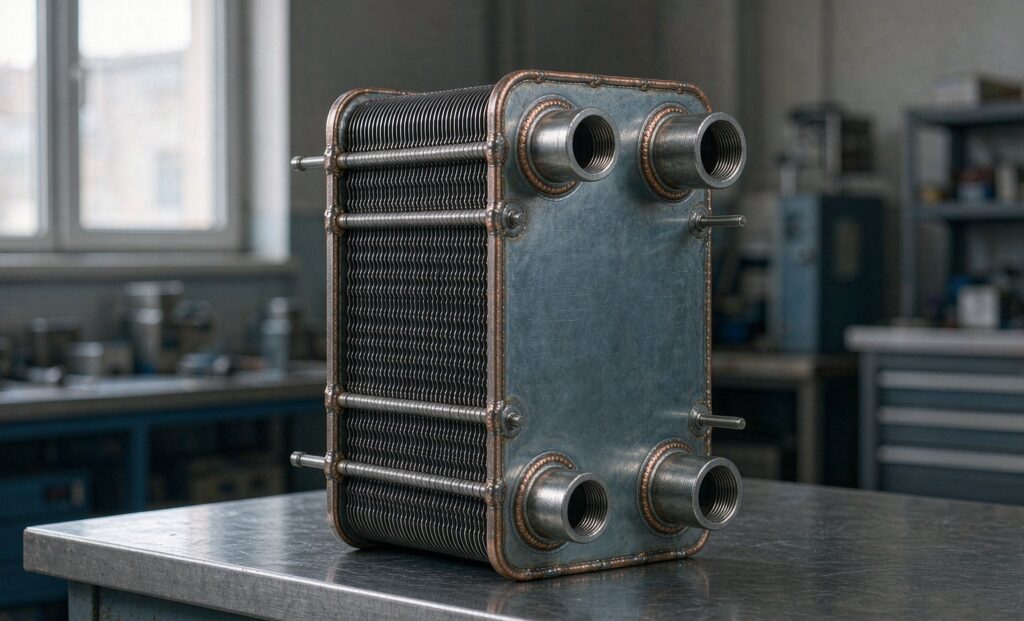
If you are searching for SWEP plate heat exchanger plates replacement, the honest answer arrives early: a brazed plate unit has no plates you can replace. The plate pack is vacuum-brazed into a single sealed block, so there is no gasket to peel out and no plate to slide free. What you replace is the whole exchanger. That is not a sales position — it is the construction. This guide explains why the unit is a single sealed block, how to read the model code so the replacement matches, which failures actually end a brazed unit’s life, and how to specify the new one so it drops into the same pipework without re-rating the system.
Why a brazed unit has no replaceable plates
A brazed plate heat exchanger (BPHE) is built from a stack of pressed stainless steel plates, each pair forming a channel. The plates are stacked with copper or nickel foil at every contact point and passed through a vacuum braze furnace. The filler melts, capillary action pulls it into every plate-to-plate contact, and the stack leaves the furnace as one solid pressure vessel. There is no frame, no tie bolts and no elastomer anywhere in the assembly.
That construction is the reason the product is cheap per kilowatt, compact and almost maintenance-free. It is also the reason plate replacement does not exist. In a gasketed exchanger the plate pack is clamped between two thick frames by long tie bolts; loosen the bolts and each plate lifts out. In a brazed unit the plates are metallurgically joined to each other. Cutting one out destroys the block.
| Feature | Gasketed plate | Brazed plate (BPHE) |
|---|---|---|
| Plate replacement | Yes, individual plates | No, whole unit only |
| Mechanical cleaning | Full dismantle and brush | Chemical (CIP) only |
| Pressure ceiling | Typically 16–25 bar | Typically 25–45 bar |
| Temperature ceiling | Gasket limited, 140–160 °C | Braze limited, around 200 °C |
| Footprint per kW | Larger, needs bolt clearance | Roughly half |
| Typical lead time | 4–8 weeks | 2–4 weeks |
Reading the model code before anything is ordered
Replacement starts with identification, not with a price. A SWEP nameplate typically carries a code in the form B25THx60/1P-SN-S, followed by a serial number. Four fields decide whether a substitute will fit and perform:
- Plate size and port diameter — the letter-number group after the B sets the plate envelope and the port bore. Get this wrong and the pipework will not line up.
- Plate pattern and angle — the letter suffix (H, M or L) indicates the corrugation depth and chevron angle. A high-angle pack gives more turbulence and a higher U-value at a higher pressure drop; a low-angle pack gives the opposite. Swapping one for the other quietly changes both duty and pump head.
- Plate count — the number after the x. This is the heat transfer area. It is the single most common cause of an undersized replacement.
- Pass arrangement and connection type — single pass versus multi-pass, threaded versus flange versus solder, and whether the connections are on the front or back face.
The exact decode is manufacturer-specific and changes with product family, so do not guess from a catalogue. Photograph the nameplate and the port faces, record the serial, and send both. A supplier who quotes without them is quoting a guess.
The failures that actually end a brazed unit
In practice five mechanisms account for almost every brazed exchanger that gets replaced. They are worth separating because only two of them are genuinely terminal, and one is often misdiagnosed.
1. Internal leak at a braze fillet
Cross-contamination between circuits shows up as a pressure decay on one side, a rising conductivity in a closed loop, or refrigerant in the water. It is terminal. There is no field repair: the braze is continuous around every plate edge, and a repair attempt on one fillet simply moves the thermal stress to the next.
2. Freeze burst
Water left in a unit that sees sub-zero ambient expands and balloons the channels. The block distorts, the braze cracks, and the unit leaks externally. Terminal, and entirely preventable with glycol or a drain-down procedure.
3. Erosion at the port
Port velocity above roughly 3 m/s in a two-phase or high-solid stream scours the metal immediately downstream of the connection. The damage is local but the repair is not: the port is part of the brazed block.
4. Chloride stress corrosion cracking
316L plates are the standard build, and 316L has a practical chloride limit well below what many sites assume. Concentrating chlorides — evaporation at a hot surface, or a stagnant wet side — crack the plates at the corrugation roots. Terminal.
5. Fouling that chemical cleaning cannot shift
This is the recoverable one. Scale, milk stone, iron oxide and most process films dissolve. Polymerised organics, hardened coke and biological mats with a mineral crust often do not, because the deposit sits in the corrugation troughs where a cleaning flow cannot reach it.
What chemical cleaning can still recover
Before condemning a unit, clean it properly. A cleaning that recovers 90% of the original duty is worth an afternoon; a cleaning that recovers 20% tells you the pack is finished.
- Circulate in reverse flow first, at 1.0–1.5 m/s, so loosened deposit exits the way it came in.
- Use an inhibited acid matched to the deposit: 3–5% inhibited hydrochloric or sulphamic for carbonate scale, 2–4% phosphoric or a proprietary chelant for iron oxide and milk stone.
- Hold the cleaning solution at 40–50 °C. Above 60 °C the inhibitor film weakens and the acid starts attacking the braze.
- Neutralise with a mild alkali, then flush to a conductivity within 10% of the incoming water.
- Limit the unit to one, at most two, aggressive cleaning cycles over its life. Every acid pass thins the plate and the braze fillet.
If the approach temperature is still more than double its design value after a documented clean, the exchanger is done. That number — not the calendar — is the replacement trigger.
Specifying the replacement without re-rating the system
The mistake buyers make is ordering “the same model”. Unless the duty is identical, the correct brief is a duty specification. Work through this list:
- Duty and temperatures — heat load in kW, and all four terminal temperatures, from the system design rather than from the old nameplate if the plant has since changed.
- Media and concentration — including the chloride level and whether either side is a refrigerant.
- Allowable pressure drop — both sides, in kPa, taken from the pump curve margin. A replacement that meets the duty with 40% more pressure drop will not deliver the flow.
- Design pressure and temperature — with a margin above the relief valve setting, not equal to it.
- Material and braze — 316L is standard; nickel braze is mandatory where copper is incompatible.
- Connections — size, type, orientation and the centre distances that the existing pipework fixes.
- Certification — the pressure vessel class your jurisdiction requires, stated explicitly.
Send those seven items and a competent supplier can propose a drop-in unit. Send only a photograph and you will get a unit that is either oversized, wrongly ported, or unable to meet the pressure class.
Copper or nickel braze — the decision that is easy to get wrong
Copper brazing is the default because it is stronger, cheaper and gives better thermal contact. It is also incompatible with two common duties. Ammonia attacks copper directly, so an ammonia or ammonia-adjacent circuit needs a nickel-brazed or all-stainless unit. And high-pressure CO2 systems, where the gas cooler may sit near 100–120 bar, need a construction rated for it rather than a standard copper-brazed block.
Nickel brazing costs more and, at the same plate count, transfers slightly less heat. Specify it for a reason and check the pressure rating that comes with it, because the nickel-brazed family usually has a lower design pressure than the copper equivalent.
When to stop replacing brazed units and fit a gasketed one
If the same exchanger has been chemically cleaned twice in three years, or if the deposit is one that only mechanical cleaning removes, the cheapest long-term answer is a different product, not another brazed block. The gasketed frame costs more up front and takes more floor space, but the plate pack can be opened, brushed, inspected and partly renewed. For steam duties above 160 °C, for crystallising solutions, and for anything with a fibre or pulp content, the gasketed or a welded plate-and-shell design is the better fit.
For a clean refrigerant, glycol, oil or demineralised water circuit at moderate pressure, the brazed unit remains the right choice — and replacing it every 10–15 years is still cheaper than maintaining a frame.
Lead time, spares and the alternative-supplier question
Brazed exchangers are largely stock-and-configure products. A reputable manufacturer will hold plate patterns and braze fixtures for the common sizes, which is why 2–4 weeks is realistic and 12 weeks is a warning sign. There are no user-serviceable spares: the entire spare parts list is the unit, the mounting studs and the insulation shell.
Equivalent units from other manufacturers are a legitimate route, provided the duty, pressure drop, port size, connection type and pressure class are matched rather than approximated. A like-for-like swap on plate count alone is the classic error, because plate patterns differ between makers and a 60-plate pack from one supplier is not a 60-plate pack from another.
Zhenggong manufactures brazed and fusion-bonded plate exchangers alongside gasketed, welded and shell and tube ranges, and holds a Chinese D1/D2 pressure vessel manufacturing licence with ISO 9001 and ISO 14001 certification. If the failed unit carries a pressure class your insurer cares about, send that requirement with the duty data and it will be quoted against the correct construction rather than the nearest catalogue size. The brazed and fusion-bonded plate heat exchanger range covers the standard envelope, and the brazed plate sizing guide explains how plate count and port size are derived when no like-for-like model exists.
The five-minute replacement brief
Summarised, a replacement order needs: the nameplate photograph, the serial, the seven duty items above, the failure mode (so the new unit is not specified into the same trap), and the certification class. With those in hand, a brazed unit can be quoted, built and shipped in weeks rather than months — and the plant gets a unit sized to its actual duty instead of to a code that may have been superseded twice.
If the exchanger sits in a system where a repeat failure would be expensive, the sizing assumptions are worth a second pair of eyes. Send the duty data and the nameplate photographs to our engineering team and we will confirm whether a brazed replacement, a gasketed frame or a welded plate unit is the right answer for that circuit — including the pressure drop budget that often decides it.
