
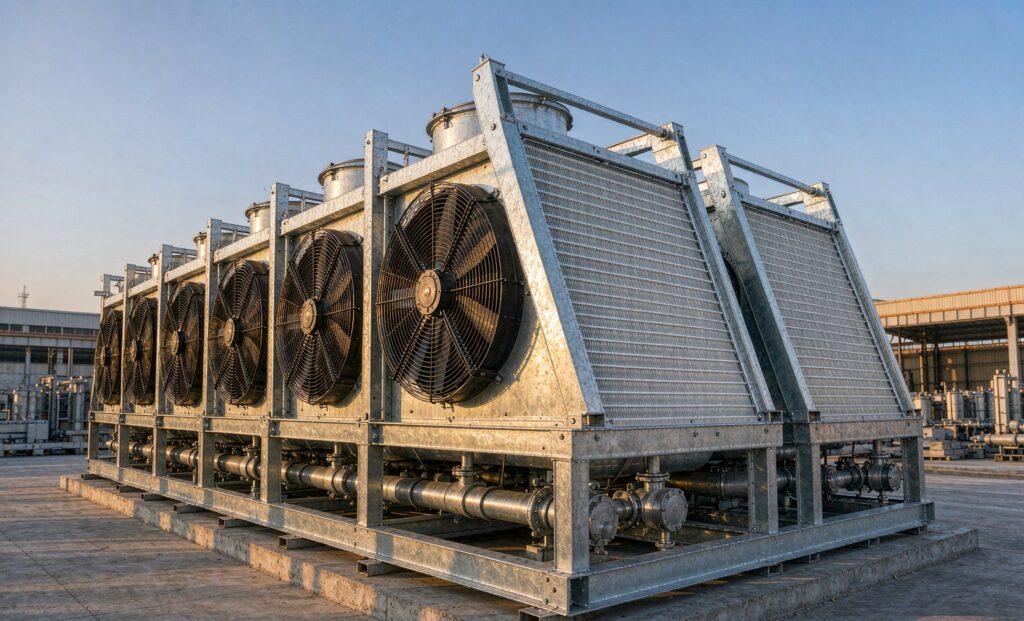
What an Air Cooled Heat Exchanger Dry Cooler Supplier Is Really Being Asked to Guarantee
Choosing an air cooled heat exchanger dry cooler supplier is a procurement decision disguised as an equipment purchase. The unit itself is a coil, a set of fans and a steel frame — there is very little mystery in the hardware. What you are actually buying is a thermal guarantee at a specific ambient, a mechanical design that survives your air quality, and documentation that satisfies whoever inspects the installation. A supplier who can deliver the first and not the other two will cost you more than the price difference ever saved.
The failure pattern is consistent across projects. A purchase order is placed against a catalogue rating at nominal conditions, the unit arrives, and the plant discovers in July that it delivers 82% of the quoted duty because the selection was made at 25 °C ambient instead of the site’s 41 °C design dry bulb, or because the fin pitch chosen for a compact footprint packed solid with cottonwood in three weeks. This guide is the checklist that prevents that, written from the supplier’s side of the table.
The RFQ Package That Separates Real Suppliers From Brokers
A dry cooler cannot be selected from a kW figure. Give every bidder the same structured input and you will get comparable offers instead of three numbers with different assumptions behind them. At minimum, the enquiry should state:
- Duty in kW at normal and peak conditions, with the process description.
- Fluid: water, water-glycol with concentration by volume, oil, or a process stream with its properties.
- Flow rate and the allowable fluid-side pressure drop.
- Inlet and required outlet temperature, which together define the approach to ambient.
- Site: city, country, elevation, design dry bulb, and coincident wet bulb if adiabatic assist is allowed.
- Air quality: dust, sand, pollen, sea spray, industrial emissions, or a neighbouring cooling tower plume.
- Footprint, height and weight limits, plus any airflow obstruction from walls or other equipment.
- Electrical supply, control philosophy and BMS protocol.
- Sound limit and the measurement position that applies to it.
- Redundancy and part-load requirement.
- Codes and documentation: pressure vessel certification, inspection regime, test records, language.
- Destination and shipping terms, because a unit that fits a 40 ft container needs a different frame from one that ships as a breakbulk lift.
The replies are diagnostic. A supplier who asks two or three follow-up questions about altitude, glycol percentage or air quality is selecting. A supplier who quotes from the kW figure alone is guessing, and the guess will be resolved at commissioning, in your favour only by luck.
Dry, Adiabatic or Hybrid: Get Each Mode Priced Separately
Adiabatic pre-cooling is the most commonly mis-sold option on a dry cooler. It genuinely helps in hot, dry climates, and it genuinely does nothing in humid ones. It also converts a water-free unit into one with nozzles, water treatment, drains and a wet-dry changeover sequence that somebody has to maintain.
| Criterion | Fully dry cooler | Adiabatic / hybrid |
|---|---|---|
| Water consumption | None in operation | Only during assisted hours; typically a few percent of an evaporative tower’s annual draw |
| Hot-weather capacity | Limited by dry bulb and coil area | Improved entering-air condition while the spray is enabled |
| Maintenance scope | Coil cleaning, fans, fluid loop | All of that plus nozzles, water quality, drains and spray inspection |
| Controls | Fan staging, bypass, freeze protection | Adds water enable, conductivity or quality interlocks, wet-dry changeover |
| Right answer when | Water is scarce, the climate is temperate, the loop can run warm | Peak ambient is severe, plot space is tight, water is available and treatable |
Insist on separate performance data for dry and assisted modes, with the assumed spray water quality, and reject any single “maximum capacity” figure that does not say whether the spray was running when it was measured.
Coil Geometry: Where the Cheap Quotation Hides
Two quotations for the same duty can differ by 40% in coil face area and still look identical on the datasheet. What changes is fin pitch, tube diameter, rows and face velocity — and with them, the unit’s behaviour after the first dusty season.
| Parameter | Typical range | What it decides |
|---|---|---|
| Fin pitch | 2.1–3.2 mm standard; 4–6 mm for dusty or fibrous air | Cleanability versus compactness. A dense coil performs well clean and badly fouled |
| Tube diameter | 3/8 in to 5/8 in copper or stainless | Internal volume, glycol charge, burst margin, repairability |
| Face velocity | 2.5–3.5 m/s | Air-side pressure drop, fan power, and how fast the coil blinds over |
| Fin material and bond | Aluminium fins, mechanical or brazed bond | Thermal contact over life; a mechanical bond degrades as the coil cycles |
| Coating | None, e-coat, phenolic, or equivalent | Coastal and industrial life. Specify the exposure, not the product name |
| Casing | Galvanised, powder-coated, or stainless | Frame life at the site, and whether the unit is repairable in year eight |
Ask the supplier to justify the fin pitch against your air quality and to state the cleaning method and access side. A quotation that cannot answer “how will this coil be cleaned” has not been engineered.
Fans, Motors and Sound: Where Budget Units Fail First
Fan power on a dry cooler is typically 2–4% of the rejected duty, which sounds trivial until it is applied continuously for 6,000 hours a year. EC fans with individual speed control hold part-load efficiency that AC motors with simple staging cannot match, and they report faults individually. They also sit inside electronics that must be rated for the temperature of the air they are moving, which on a hot day is not the ambient temperature.
Three specifics to demand:
- Absorbed power at the selected operating point, corrected for site altitude and for motor temperature rise — not nameplate kW.
- Sound pressure level with a stated distance and standard. A figure of “68 dB” means nothing without “at 10 m, free field”. Ask for the octave band data if the site has a tonal or night-time limit.
- N+1 fan arrangement with the capacity loss stated. Redundancy that costs 30% of capacity when one fan stops is not redundancy.
Certification and Documentation: The Boring Part That Decides Acceptance
On a dry cooler the coil and headers are pressurised, and depending on the jurisdiction and the volume and pressure involved, the wetted pressure parts may fall under a pressure vessel code. A supplier who manufactures to a recognised system will hold the certificates as a matter of course: Zhenggong, for example, holds D1/D2 pressure vessel certification alongside ISO 9001 and ISO 14001, which is the minimum evidence a serious buyer should ask to see before a purchase order, and the documentation package should be named in the offer rather than promised afterwards.
The documentation package should include the thermal selection sheet, the controlled drawing revision with connection sizes and centrelines, the pressure and leak test records with the serial numbers covered, material certificates for the tubes and headers, fan and motor data sheets, the coating specification and its dry film thickness, and a commissioning checklist with setpoints and acceptance measurements. At approval, tie four records together: the selection sheet, the drawing revision, the test record and the packing list. That is what makes a claim possible if the unit underperforms.
Twelve Checks Before You Place the Order
- The selection sheet states the duty at your design ambient and altitude, not a nominal rating.
- Dry and adiabatic performance are quoted separately, with water quality and consumption stated.
- Approach temperature is agreed in writing, and you understand that tightening it by 1 K adds roughly a fifth to the coil area.
- Fin pitch and coating are justified against your air quality, not chosen for footprint.
- Absorbed fan power is quoted at the operating point with altitude correction.
- Sound is quoted as dB(A) at a stated distance, with octave bands available.
- N+1 fan redundancy is priced, and the capacity with one fan down is stated.
- Freeze protection is defined for your lowest ambient: glycol, drain-down, trace heating or a control sequence.
- Pressure vessel certification and welding qualifications for the wetted parts are named.
- Factory acceptance testing is offered, with the tests listed and witness arrangements agreed.
- Packing is specified for export, with fin protection, lifting points and a container or breakbulk plan.
- Lead time is given as a date, with the milestones that drive it and a named warranty position.
Red Flags in a Dry Cooler Quotation
- A single capacity number with no ambient or fluid stated. It cannot be verified and it will not be met.
- “Suitable for 50 °C ambient” without a selection sheet at that condition. Operating and delivering full duty at 50 °C are different claims.
- A coil so dense that no cleaning method is described. The unit will lose capacity permanently, not temporarily.
- No altitude correction on a site above roughly 500 m. Air density falls, and so does the fan curve and the coil rating.
- Sound quoted as a sound power level presented as if it were sound pressure at the fence line.
- Certificates promised after the order. If the manufacturer holds them, showing them costs nothing.
- A price that is 30% below the others with an identical datasheet. Something in the coil, the frame or the documentation has been removed.
What Good Looks Like at Handover
The unit arrives on a cradle, not on its fins. The connections match the drawing revision you approved. The test certificates carry the serial numbers on the nameplate. The fan rotation is correct on first start, the controls sequence through the setpoints without an alarm, and the measured approach at commissioning matches the selection sheet within the stated tolerance. None of that is luck; all of it is a consequence of what was specified at enquiry stage.
If you are specifying dry cooling for a process, a data hall or a power application, send the duty, the site conditions and the fluid data through the contact form and our engineers will return a selection sheet with performance at your actual ambient, fan power, sound data and lead time. The air cooled heat exchanger and dry cooler range covers V-type and flat-bed configurations for export, and for the underlying thermal and mechanical detail our guide to air cooled heat exchanger design works through fin geometry, fan selection and maintenance. Buyers sizing a water-free data centre loop will find the specific case worked through in the dry cooler guide for data center cooling.
