
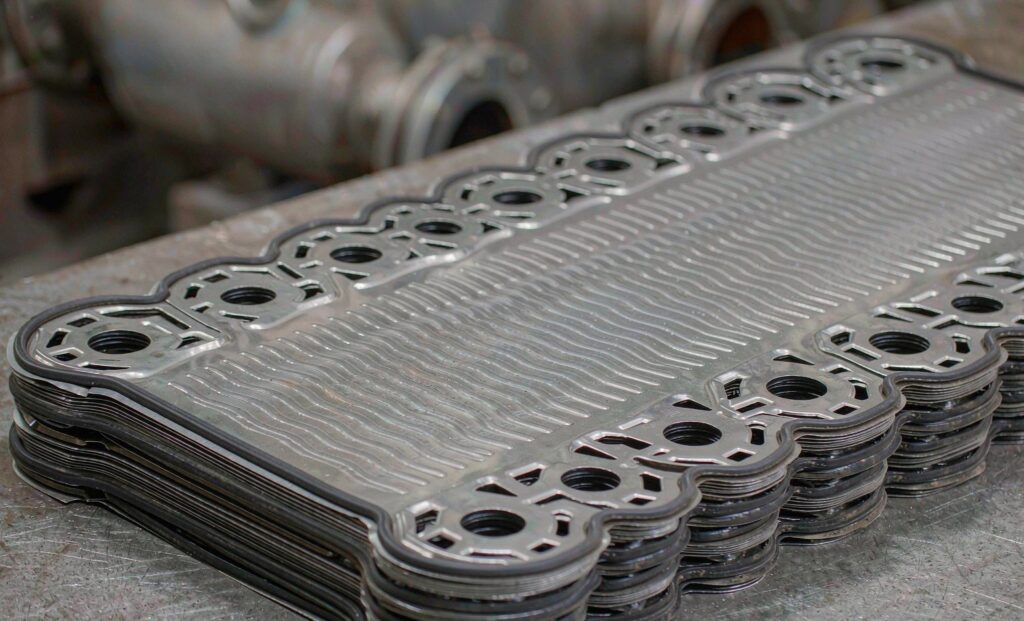
What Gasket Failure Actually Looks Like
A gasketed plate heat exchanger rarely fails suddenly. It leaks slowly, first as a thin film of moisture at a port or a plate edge, then as a visible drip, and only eventually as a jet of hot process fluid across the plant floor. Because the progression is gradual, the failure is usually noticed late — often by whoever finds the puddle. Understanding the four distinct mechanisms behind gasket leakage lets you catch the problem at the film stage instead of the puddle stage.
This guide covers the failure modes, how to tell them apart, and what to check during a plate pack inspection so you can decide whether to retighten, replace gaskets, or replace plates.
The Four Failure Mechanisms
1. Compression Set and Thermal Ageing
Plate gaskets are elastomer, most commonly nitrile (NBR) for water and oil duties, EPDM for hot water and steam, and FKM or PTFE-encapsulated grades for aggressive chemicals. All elastomers take a permanent set over time. They are compressed in a groove between two plates, and the elastomer slowly stops pushing back. Sealing force decays, and at some point it falls below what is needed to hold the differential pressure.
Heat accelerates this dramatically. A rough rule is that elastomer service life roughly halves for every 10 to 15 °C above the rated reference temperature. A gasket rated for five years at 80 °C may give eighteen months at 120 °C. If your units are failing on a predictable cycle, compression set is almost always the cause, and the fix is to specify a higher-temperature elastomer rather than to keep retightening.
2. Over-Compression From Over-Tightening
The opposite mistake. Operators chasing a small weep tighten the tie bolts beyond the manufacturer’s dimension, which crushes the gasket and in some cases deforms the plate’s gasket groove. The gasket then cannot be re-seated properly and the leak gets worse, not better. Every gasketed plate unit has a specified plate pack dimension, measured across the assembled stack or between the frame and follower. That dimension is a measurement, not a suggestion — the bolts should be tightened to reach it and no further.
3. Chemical Attack and Swelling
Incompatible fluids cause the elastomer to swell, soften, harden or crack. Swollen gaskets sit proud of the groove and prevent the plates from closing to the correct dimension, so the unit either leaks or the plate pack will not compress. Hardened gaskets crack at the corners where they turn around the port holes, which is the most common place to find a chemical failure. The cause is almost always a fluid the gasket was not specified for — a cleaning chemical, a changed process additive, or a solvent used during maintenance.
4. Mechanical Damage and Plate Deformation
Gaskets are damaged during handling far more often than during operation. A plate dropped on its corner, a gasket nicked by a scraper during cleaning, or a plate installed the wrong way round so the gasket faces the wrong channel. Plates can also deform if the unit is put back into service with uneven bolt tension, which opens a gap at one corner under pressure. Warped plates are visible as a rock when the plate is laid on a flat surface.
Diagnosing Which One You Have
The position and appearance of the leak narrows the cause quickly.
| Where and how it leaks | Most likely cause | Correct action |
|---|---|---|
| Uniform weep around the whole perimeter | Compression set — sealing force has decayed | Measure the plate pack dimension; retighten to spec. If already at spec, replace gaskets |
| Localised leak at one corner near a port | Cracked gasket from chemical attack, or a deformed plate | Replace that gasket; check the plate for warp before refitting |
| Leak at a port connection only | Port gasket or liner damage, often from over-tightening the pipe flange | Replace the port liner; check flange alignment |
| Leak appears only when hot | Differential thermal expansion, or a borderline compression set | Re-specify for the hot-service temperature; consider a higher-grade elastomer |
| Cross-contamination between the two streams | Pinhole in a plate, or a gasket bridging two channels | Pressure test the plate individually; replace the failed plate |
| Leak immediately after a service | Plate installed backwards, or a gasket displaced from its groove | Reopen the pack and check every plate orientation and gasket seat |
A Plate Pack Inspection Checklist
- Measure and record the plate pack dimension before loosening anything.
- Check whether it is still at the value stamped on the unit’s nameplate.
- Inspect every gasket for cracking at the corners around the port holes.
- Feel for gaskets that sit proud of the groove — a sign of swelling.
- Lay suspect plates on a flat surface and check for rock.
- Hold the plate up to a light to look for pinholes before refitting.
- Confirm each plate faces the same direction; a single reversed plate leaks.
- Clean gasket grooves before refitting and never use a metal scraper on them.
- Tighten bolts diagonally in stages, not one side to full torque first.
Preventing the Next Failure
The cheapest intervention is usually a change of elastomer grade. If your unit runs hot water above 100 °C, EPDM rather than NBR. If the process involves hydrocarbon solvents at all, check whether the NBR is actually resistant or whether you need FKM. Most premature plate gasket failures we see are the wrong elastomer for the duty, not a bad gasket batch.
The second intervention is a maintenance schedule that records the plate pack dimension at every opening. A slowly closing dimension means the gaskets are taking set, and you will see the trend building before the leak appears. That single measurement turns gasket replacement from a reaction into a plan.
If your duty is aggressive enough that gaskets are a recurring cost, it is worth comparing a gasketed plate unit against a welded alternative. Our guide to brazed and fusion bonded plate heat exchangers explains where a gasket-free construction removes the problem entirely, and our plate heat exchanger cleaning guide covers the cleaning practice that avoids most handling damage. For a general comparison of construction types, see shell and tube versus plate heat exchangers.
When to Replace Rather Than Repair
Replace gaskets when the pack dimension has reached the minimum spec and leaks persist. Replace individual plates when you find a pinhole or warp. Replace the whole plate pack when more than about a third of the gaskets fail at the same opening, because at that point every remaining gasket is the same age and the unit will be back down within a year.
Zhenggong Cooling and Heating Equipment Co., Ltd manufactures plate, shell and tube and air-cooled heat exchangers in Shandong, China, with D1/D2 pressure vessel certification and ISO 9001 / ISO 14001 quality and environmental management. We supply replacement plates and gaskets to the original dimensions, and can advise on the correct elastomer grade for your fluid. Contact us through our contact page with your unit’s serial number and process fluid, or browse our full product range.
Last updated: October 2026.
Source: European Sealing Association, elastomer sealing material guidance.