
What a chiller’s two heat exchangers actually do
Every vapour-compression chiller is built around two heat exchangers. The evaporator absorbs heat from the chilled-water loop as the refrigerant boils, and the condenser rejects that heat plus the compressor’s work to a cooling tower, a closed loop or the outside air. Compressor, expansion valve and controls only move energy around — the exchanger surfaces are where the thermodynamics actually happen. That is why chiller heat exchanger selection decides the COP, the footprint, the maintenance burden and a large share of the capital cost before a single line of the control logic is written.
Get the exchangers right and the chiller behaves predictably for twenty years. Get them wrong and you inherit a machine that cannot reach design capacity on a hot day, drinks compressor power to cover a 5 °C approach loss, or needs its bundles pulled every second season. This guide walks through the selection logic for both exchangers, in the order a thermal engineer usually works.
Chiller heat exchanger selection: fix the duty before you pick hardware
Suppliers are routinely asked to quote “a 500 kW chiller evaporator”. That is not enough information to select anything. The exchanger is defined by the fluid pair, the duty and the allowed pressure drop — not by the tonnage figure alone. Four numbers must be fixed on the datasheet before geometry means anything.
The four numbers that define the selection
- Duty and mass flows on both sides. kW alone is insufficient; the water-side flow rate and the refrigerant mass flow set the velocities that govern heat transfer coefficients and fouling.
- Entering and leaving temperatures on both sides. These give the log-mean temperature difference and, critically, the approach temperature — the pinch between the leaving chilled water and the evaporating refrigerant.
- Design pressure and temperature, not operating values. Withstand the worst case: high-side trip pressure, water-hammer, hot-gas defrost and pump shut-off head.
- Allowed pressure drop. A tight pressure-drop budget pushes you towards larger, more expensive surface; a loose one lets you shrink the unit and pay at the pump.
A useful sanity check: if a proposed selection achieves a 1 °C approach on the evaporator, it is either generously oversized or the supplier has not accounted for oil in the refrigerant. Realistic flooded evaporator approaches sit at 1–2 °C, DX brazed plate evaporators at 2–4 °C, and condensers at 3–5 °C for water-cooled duty. Anything dramatically better than those ranges deserves a question, not a purchase order.
Evaporator selection: flooded shell and tube versus brazed plate
Two families dominate chiller evaporators, and they suit different machine sizes and different buyers.
Flooded shell and tube evaporators
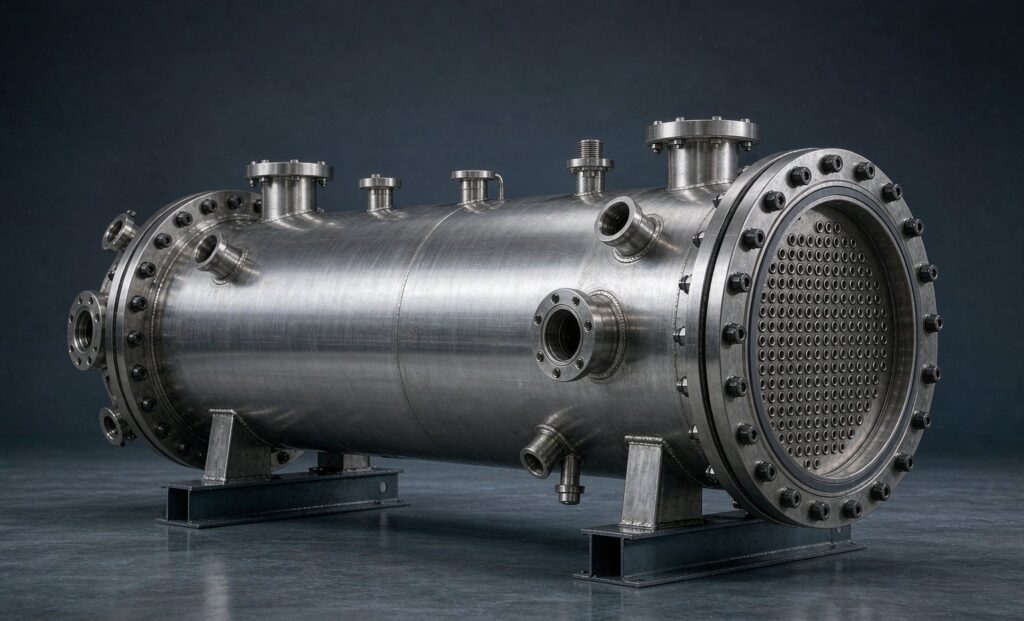
In a flooded evaporator the refrigerant surrounds the tube bundle and boils on the outside of the tubes while water passes inside. The large shell-side volume acts as a liquid separator, so carry-over is controlled, and the surface is not fed through a distributor — which makes the design robust against load swings and tolerant of oil returning to the sump. Efficiency is typically the highest of any evaporator type because the entire tube surface stays wetted. The trade-off is physical size, refrigerant charge and cost at small capacities. Most large centrifugal and screw chillers use this arrangement.
Brazed plate evaporators for compact chillers
Below roughly 300–400 kW, a brazed plate heat exchanger usually wins. The corrugated plate pack produces very high heat transfer coefficients at low flow rates, holds only a fraction of the refrigerant charge, and fits in a machine-frame corner where a flooded bundle would not. It is also the standard choice for modular and inverter-driven scroll chillers. The constraints are equally clear: plate channels do not tolerate solids, so the water side needs filtration; mechanical cleaning is impossible, so chemical cleaning-in-place is the only maintenance route; and the unit must be correctly specified at order because the block cannot be opened or extended later. Our detailed brazed plate heat exchanger selection guide covers brazing material, channel geometry and refrigerant-side considerations in depth.
Water cooled condenser selection for chillers
Once the evaporator is fixed, the condenser is a mirror problem with one important difference: the fouling risk moves to the cooling-water side. Tower water, river water and poorly treated closed loops deposit scale and biological film on the tubes, and every millimetre of scale is insulation between the refrigerant and the heat sink.
Approach temperature drives compressor power
Condensing temperature is set by the cooling-water temperature plus the approach. Because compressor power rises roughly 2–3% for every 1 °C increase in condensing temperature, a condenser that develops a 6 °C approach after two seasons of scaling can cost more in electricity than it saved at purchase. Two selection habits protect against that:
- Specify a fouling allowance. Oversize the surface by the cleanliness factor your water chemistry justifies — typically 10% for treated tower water, more for raw water — instead of assuming clean tubes forever.
- Plan the cleaning route. Use removable water boxes or straight-tube designs with accessible heads, so brushing is a routine job rather than a crane lift. Fixed-head condensers save money once and cost money every year.
Comparing the practical options side by side
| Duty | Best-fit design | Typical approach | Watch out for |
|---|---|---|---|
| Chiller evaporator, 50–300 kW | Brazed plate (BPHE) | 2–4 °C | Solids in water side; no mechanical cleaning |
| Chiller evaporator, >400 kW | Flooded shell and tube, enhanced tubes | 1–2 °C | Refrigerant charge; physical size; oil management |
| Water-cooled condenser, tower water | Shell and tube, straight tubes, removable heads | 3–5 °C | Scale; must be brushable |
| Water-cooled condenser, clean closed loop | Brazed or gasketed plate | 1–3 °C | Requires good water treatment and filtration |
| Air-cooled / remote condenser duty | Finned coil with fans or dry cooler | 5–10 °C (ambient-dependent) | Ambient derating; fan power; coil cleaning |
Chiller heat exchanger sizing checklist
- Fix duty, both-side flows, entering/leaving temperatures and allowable pressure drop.
- State the refrigerant and the design pressure on the high side, including trip and defrost cases.
- Choose evaporator family on capacity and water quality, not on price alone.
- Set the approach targets from the table above and reject selections that beat them without justification.
- Size the condenser with an explicit fouling allowance for the actual water chemistry.
- Confirm connection sizes, orientation and nozzle positions against the machine frame drawing.
- Require thermal performance data, pressure-drop curves and a dimensional drawing with the quotation.
- Verify the manufacturer holds pressure vessel certification appropriate to the design pressure.
- Agree the cleaning method and access provision before the unit is released for manufacture.
Materials, water quality and long-term reliability
Tube and plate material selection follows the water, not the refrigerant. Stainless steel 316L handles most tower and process water; titanium is warranted where chlorides are high or where brackish cooling water is unavoidable; copper alloys remain common for clean loops but suffer in ammonia systems, which attack copper outright. On the refrigerant side, the inner surface matters as much as the alloy — enhanced tubes with internal ridges raise refrigerant-side coefficients substantially and are standard on modern flooded evaporators.
Whatever the material, an inexpensive 40–60 mesh strainer on the water inlet prevents most premature failures of plate evaporators, and a documented water-treatment programme at commissioning protects everything downstream of it.
Pressure vessel documentation for chiller exchangers
A chiller evaporator or condenser above the small-vessel thresholds is a pressure vessel, and the paperwork matters as much as the thermal rating: material certificates, weld procedures, non-destructive testing records, hydrostatic test reports and a nameplate that matches the design conditions. Zhenggong Cooling and Heating Equipment Co., Ltd manufactures shell and tube and plate exchangers for chiller and refrigeration duty in Shandong, China, under D1 and D2 pressure vessel production qualification certificates and ISO 9001 and ISO 14001 quality systems, and exports worldwide. The relevant evidence sits on our certification page.
For the equipment itself, the stainless shell and tube heat exchanger range covers flooded evaporator and condenser configurations, while the brazed and fusion bonded plate heat exchanger range covers compact evaporators for modular chillers. Both sit inside the wider product range, and the same engineering team supports chiller, HVAC and process cooling projects listed under applications by industry.
Get a chiller heat exchanger selection from our engineers
Send the duty, both-side flows, temperatures, allowable pressure drop and water chemistry, and Zhenggong’s thermal engineers will return a chiller heat exchanger selection with performance data, pressure-drop figures, dimensions and lead time. For quotations, custom designs and export documentation, contact the engineering team.