
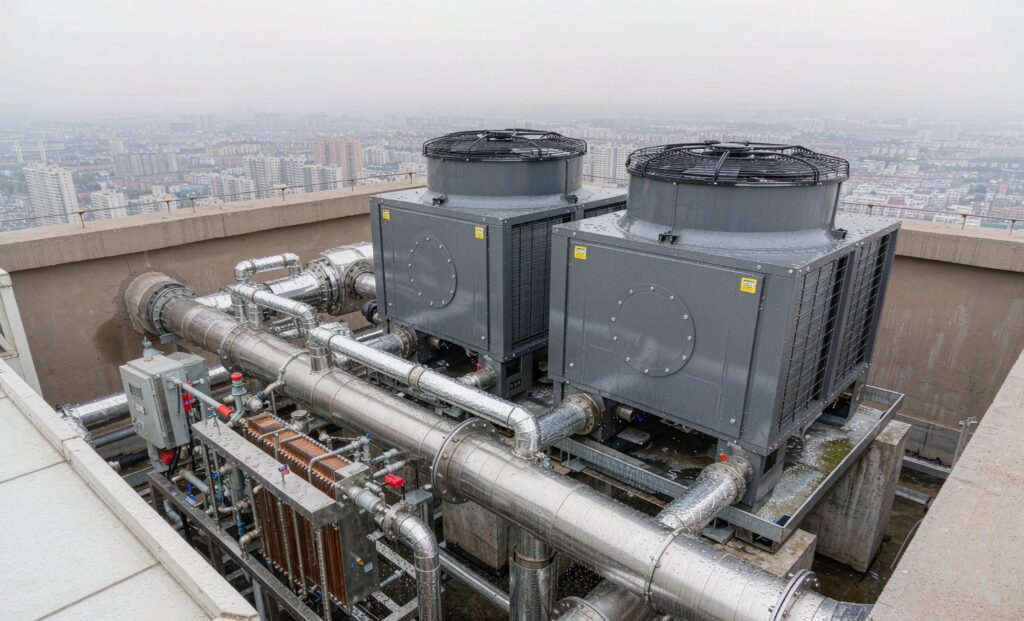
An air source heat pump for hotel duty is usually sold on a single number, the kilowatt rating at a nominal ambient, and then judged on a completely different one, which is how much hot water arrives at the top floor at seven in the morning in February. Those two numbers are not the same, and the gap between them is where most hotel heat pump projects disappoint.
This guide is about closing that gap. It covers how domestic hot water demand in a hotel actually behaves, why storage volume and not compressor size decides whether the plant keeps up, what happens to capacity and efficiency as the ambient temperature falls, how the heat exchanger between refrigerant and water governs the whole system, and what to specify so that a quotation means something.
What an air source heat pump for hotel duty is actually being asked to do
A hotel hot water load is not a heating load with a different temperature. It is a batch load with a sharp peak, a large daily volume, and a return temperature that depends on how the building was plumbed.
- Volume. Demand scales with occupied rooms and with the standard of the property. A room with a bath and a large shower draws several times what a budget room draws.
- Peak. Most of the daily volume is drawn in two windows, early morning and early evening. The plant either has storage to ride the peak or it has to be sized for the peak, and sizing for the peak is the expensive way.
- Temperature. Hot water is stored hot and delivered blended. The storage temperature sets the legionella regime, and the delivery temperature sets the blending valve.
- Recovery. Between peaks the plant has hours, not minutes, to rebuild the store. That is the window a heat pump is good at, because it runs steadily at a moderate condensing temperature instead of short-cycling.
Read together, those four points say something simple: a hotel heat pump is a storage-and-recovery machine, not a instantaneous heater. Design it as one and the equipment gets smaller, quieter and more efficient.
Sizing from occupancy: the four numbers that decide the plant
Room count alone will mislead you. Four numbers do the work.
- Occupied rooms at peak, not total rooms. A 120-room property might peak at 95 occupied in season and sit at 40 out of season; sizing for 120 wastes capital and cycling.
- Litres per occupied room per day at the property’s standard, taken from metered history where it exists. If there is no history, use the previous boiler’s fuel consumption to back-calculate the delivered energy, which is more reliable than any rule of thumb.
- Peak-hour fraction. What share of the daily volume is drawn in the busiest hour. This is what storage has to absorb.
- Cold water inlet temperature in the coldest month, because the plant has to raise water from that figure, not from a summer average.
From those four you get a daily energy figure and a peak-hour energy figure. The difference between them is what the store has to carry, and the steady load between peaks is what the heat pump has to deliver. That is the whole sizing argument, and it is why two hotels of the same size can need very different plants.
If you are sizing a unit now, send us the fluid, the flow rate, the inlet and outlet temperatures you need to hold, and the heat duty in kW. That is enough for us to come back with a sized quotation against your own numbers rather than a catalogue range. The enquiry form is on the contact page, and the selection worksheets on the sizing tools page will give you the flow and duty figures if you do not have them to hand.
Storage volume: why an air source heat pump for hotel duty is sized on the tank
Once the peak-hour energy is known, storage volume is the variable that shrinks the plant. A larger store lets a smaller heat pump run longer at a better condensing temperature, which raises efficiency and reduces cycling. The trade is space, structural load and standing loss.
Three practical points decide whether the store works.
- Stratification. Hot water should leave the top of the tank and cold water should return to the bottom, with nothing stirring the two together. A poorly baffled tank mixes and delivers lukewarm water from a store that is, on paper, full of hot water.
- Sensor placement. A single sensor halfway up the tank will let the top go cold before the plant restarts. Two sensors, top and bottom, give the controller a usable picture.
- Standing loss. An insulated store loses heat continuously. In a plant room at 30 °C the loss is modest; outdoors in wind it is not, and the loss is paid for every hour of the year.
Where space is tight, a buffer vessel plus a plate heat exchanger can replace a large calorifier, but the exchanger then becomes a critical component and has to be sized for the peak draw, not the average.
Flow temperature, return temperature and the COP you will actually see
Heat pump efficiency is a function of the temperature lift: the difference between the source air and the water the unit has to produce. Two design decisions move that lift, and both are cheaper than a bigger compressor.
Lower the delivery temperature. Storing at 60 °C and blending down at the outlet costs more than storing at 50 °C and boosting at the point of use where regulations require it. Every few degrees off the storage temperature is worth more than it looks, because the compressor works against a lower condensing pressure all year.
Raise the return temperature. This sounds backwards, but a hot water system that returns water at 30 °C instead of 10 °C has to be lifted less. Dead legs, uninsulated secondary pipework and long distribution runs all drag the return temperature down, and the plant pays for it on every litre.
The rated efficiency on a datasheet is measured at one ambient and one water temperature. The annual figure depends on the climate, the storage regime and the control strategy. A unit rated at a mild ambient will not deliver that figure on a January morning, and a quotation that quotes only the rated number is answering a question nobody asked.
Defrost, cold snaps and the bivalent point
In cold, humid air the outdoor coil fins drop below freezing and frost builds. The unit then runs a defrost cycle, which briefly reverses the circuit to melt the frost, and during that cycle it is not heating water. In a well-designed system defrost is invisible; in a badly sited one it happens constantly and the plant appears to lose a third of its capacity exactly when demand is highest.
Siting helps more than control logic. A unit placed in a sheltered corner where cold, damp air pools will frost more than the same unit on an open roof with free airflow. Recirculation between units on a tight roof is the other common fault: warm discharge air pulled back into the coil raises the frosting rate and drops capacity.
The bivalent point is the ambient at which the heat pump alone can no longer meet the load. Below that point something else has to contribute — an electric immersion, a boiler, or acceptance of a lower storage temperature. Deciding where that point sits, and what covers the gap, is part of the design rather than an afterthought.
The heat exchanger between refrigerant and water
On most commercial units the refrigerant-to-water heat exchanger is a brazed or gasketed plate pack, and it is the component that decides how much of the compressor’s work reaches the tank. Its job is to transfer heat across a small temperature difference without adding pressure drop that the compressor has to pay for.
Three things go wrong with it.
- Fouling. Hard water deposits scale on the water side, and scale is an insulator. A plate pack that has scaled loses capacity progressively, and the symptom is a slowly rising condensing temperature that nobody notices until the unit trips on high pressure.
- Wrong sizing at part load. An exchanger sized only for the design point can be poor at low flow, where the velocity falls and the heat transfer coefficient with it.
- Freezing. A water-side flow failure during a defrost cycle can freeze a plate pack and split it. Flow switches and a low-limit cut-out are not optional.
Where the water is hard, the exchanger needs either a softened supply, periodic chemical cleaning, or a design margin that accepts some fouling. Choosing none of those is how a plant loses its efficiency in three years and gets blamed on the refrigerant.
Water quality, scaling and the plate heat exchanger
Water quality is the most under-specified input in hotel hot water projects, and it is the one that decides maintenance cost. Three parameters matter: hardness, chloride content and suspended solids.
Hardness drives scale. Chlorides drive corrosion, particularly where stainless plates meet a stagnant, warm, chlorinated water. Suspended solids settle in low-velocity passages and give scale somewhere to start. A water analysis before the plant is specified costs a fraction of a descaling programme and occasionally changes the material selection outright.
Where the supply is chlorinated for potable use, the concentration and the temperature together decide which stainless grade is appropriate. That is a materials question for the exchanger supplier, and it is worth asking explicitly rather than assuming that any stainless will do.
Legionella, stratification and the weekly cycle
Hot water storage in a commercial building carries a bacterial risk that has to be designed out rather than managed by habit. The routine control is a periodic raise of the store temperature, held long enough for the whole volume to reach it, followed by a return to normal service.
The practical difficulty is that the cycle has to heat the entire store, including the bottom, and a stratified tank with a single sensor can satisfy the controller while leaving a cool layer at the base. Two consequences for the design: the heat pump must be able to reach the top of the required range without an excessive lift, and the tank must be plumbed and sensored so that the whole volume actually turns over.
Where the heat pump cannot reach the required temperature economically, the usual arrangement is a final boost by immersion or a small boiler on the cylinder outlet. That is a legitimate design, but it has to be in the quotation rather than discovered during commissioning.
Noise, roof load and siting
Air source units are not quiet, and hotels have bedrooms. The two constraints are sound at the nearest sensitive window and structural load on the roof.
- Sound falls with distance and is affected by barriers and reflections. A unit on a plant deck between two wings can be louder at the window than the same unit on an open roof.
- Night operation is when the plant works hardest in winter and when noise limits are strictest.
- Weight matters: a large unit full of water and mounted on anti-vibration mounts still loads the structure, and a roof designed for plant that was never there may need assessment.
Anti-vibration mounts, flexible connections on both water pipes, and a siting plan drawn before the plant is ordered solve most of this. Retrofitting acoustic treatment after a complaint is expensive and rarely fully effective.
Metering: what to log to prove the saving
A hotel heat pump is usually justified on a projected saving, and the justification is only credible if the plant can be measured. Three measurements cover it: electrical input to the heat pump, heat delivered to the store, and the outdoor ambient temperature.
With those three logged hourly you can compute the actual seasonal efficiency and compare it with the projection. Without them, the argument after the first winter is about opinions. The metering cost is trivial next to the plant, and it is the difference between a case study and a guess.
Retrofit against an existing boiler plant
Most hotel projects are retrofits, and the existing system dictates more of the design than the new equipment does. The questions worth answering before anything is ordered:
- What condition is the distribution in, and what is the actual return temperature at the plant?
- Is the storage adequate, or was the boiler oversized precisely because the storage was not?
- Can the heat pump be added in parallel, with the boiler as backup, or does the hydraulic arrangement need rework?
- What is the electrical capacity at the plant room, and does a new supply need to be run?
The parallel arrangement with the existing boiler kept as backup is usually the pragmatic answer: it keeps the hotel in hot water during commissioning, covers the bivalent point, and lets the heat pump take the base load where its efficiency is best.
What to specify before you ask for a quotation
A quotation is only as good as the inputs. The list below is the minimum that lets a supplier size a plant honestly rather than guess.
- Occupied rooms at peak and litres per occupied room per day, or the metered history.
- Cold water inlet temperature in the coldest month.
- Required storage temperature and the delivery temperature at the outlet.
- Peak-hour draw and the storage volume available or planned.
- Ambient design condition for the site, and the lowest ambient the plant must still work at.
- Water analysis: hardness, chlorides, suspended solids.
- Electrical supply available at the plant room.
- Space, weight limit and noise limit at the nearest sensitive window.
With those in hand the selection is arithmetic, and the conversation moves from catalogue ranges to a plant that fits the building. Our product range covers the heat pump and heat exchanger side of this work, and where the hot water is distributed through a plate pack the relevant selection notes sit with the shell and tube and pressure vessel ranges.
Reference: European Heat Pump Association, market and technology information — ehpa.org.
