
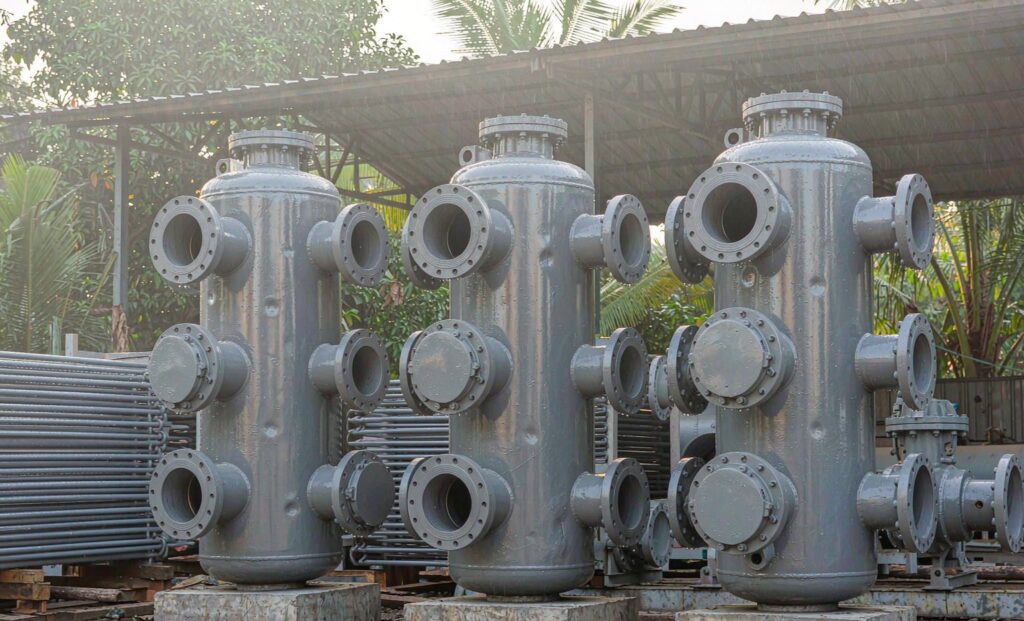
A buyer in Jakarta or Surabaya asking a heat exchanger supplier Indonesia for a quotation is usually holding three documents: a process datasheet written by an engineering contractor, a maintenance report from a unit that failed last quarter, and a schedule that says the plant is back up in eleven weeks. What that buyer needs is not a price. It is a unit that will pass the mechanical completion walk-down, survive the first wet season and still be readable on the rating plate in ten years.
This guide is about the specification, documentation and logistics side of that job, from the point of view of what actually goes wrong when a heat exchanger crosses from a Chinese workshop into an Indonesian plant.
What an Indonesian buyer is actually asking for
Three things, in this order. First, a unit that meets the datasheet duty at the stated fouling allowances, with the pressure drop inside the budget, because the pump has already been bought. Second, documentation that satisfies the inspector, because mechanical completion is a paper exercise as much as a physical one. Third, a delivery that arrives at the right port with the right paperwork, because a container held at Tanjung Priok costs more per day than the freight did.
A supplier who quotes only against the duty and ignores the other two is quoting half a job. The most common failure in this market is not a badly designed exchanger; it is a correctly designed exchanger that arrives without the mill certificates, the test report or the packing that the climate demands.
Heat exchanger supplier Indonesia: the four sectors that set the specification
The duty envelope in Indonesia is set by four industries, and each one pushes the specification in a different direction.
Palm oil. Crude palm oil mills run continuous duty with streams that foul, and the exchangers are often on the hot side of a sterilisation or clarification train. Fouling allowance and cleanability matter more than nominal efficiency, and a wide-gap plate pattern or a shell and tube unit with removable bundle is often the right answer.
Geothermal. Indonesia is one of the largest geothermal power producers in the world, and geothermal brine is a materials problem before it is a thermal one. Chlorides, silica scaling and hydrogen sulphide all appear in the same stream, and the material selection has to be made against the actual chemistry, not against a generic stainless assumption.
Fertiliser and petrochemical. Ammonia and urea plants run shell and tube exchangers to API 660 and ASME Section VIII, with full radiography and third-party inspection. The paperwork burden here is the heaviest of the four, and the ITP is agreed before the first plate is cut.
Food, beverage and textile. Hygienic duties, often plate units, with gasket material and surface finish specified by the end user’s own standard. These are the duties where a wrong gasket compound is discovered by a taste panel rather than by an instrument.
Send us the fluid, flow rate, inlet and outlet temperature and heat duty, and we will return a sized quotation with the plate pattern or tube layout, the material and the pressure drop, so the comparison against the datasheet is on the same basis. That is the only way to tell whether a cheaper quote is a cheaper unit or a smaller one.
Materials for a tropical, coastal plant
Indonesia is hot, humid and often coastal, and the combination is harder on carbon steel than the process conditions alone would suggest. External corrosion on shells, supports and bolting is a maintenance cost that is easy to under-specify at the quotation stage and expensive to live with.
On the process side, the material ladder usually runs: carbon steel for clean water and non-aggressive streams, 304 stainless where the chloride level is genuinely low, 316L for mild chloride and general chemical service, duplex 2205 where chloride stress corrosion cracking is a real risk, and titanium or a super-austenitic grade for seawater and high-chloride brine.
Two traps are worth flagging. The first is using 304 in a coastal environment because the process water is “clean”. The external surfaces see the same humid, chloride-laden air as the structure, and external stress corrosion cracking on insulated 304 is a known failure. The second is assuming 316L solves a seawater problem. It does not; chlorides at seawater concentration will crack it under the right stress and temperature conditions, which is why titanium and duplex exist.
On the external side, specify the coating system and the support details rather than leaving them to the fabricator’s standard. The paint on a heat exchanger in Medan is not a cosmetic item.
Design codes the audit will ask for
Most Indonesian projects in the process industries specify ASME Section VIII Division 1 for the pressure boundary, with TEMA for the mechanical details of shell and tube units and API 660 where the client is an oil and gas operator. Plate units are frequently designed to ASME VIII-1 as well, or to the Pressure Equipment Directive where a European licensor is involved.
What matters at the audit is not the code name on the datasheet but the evidence: the design calculations, the material certificates traceable to heat numbers, the welding procedure and qualification records, the radiography or other NDT reports, and the hydrotest certificate with the gauge reading and the witness signature.
API 660 and ASME both publish the requirements, and their scope is the reference point for the ITP: api.org for the API standards, ASME for the code itself. Where the client’s specification is stricter than the code, the client’s specification governs, and the quotation should say so explicitly rather than leave it to be discovered at the witness point.
TKDN, SNI and local content
Local content rules apply to a large part of Indonesian public procurement, and the relevant measure is TKDN, the domestic component level, administered through the Ministry of Industry. For imported equipment the calculation is not something a foreign supplier can complete alone, and a buyer who needs a TKDN figure should establish early whether the package qualifies and how the calculation will be documented.
SNI, the Indonesian national standard, applies to certain product categories and is mandatory for some of them. A heat exchanger is not universally SNI-marked, but the plant it goes into may be, and the buyer’s own specification may require compliance for accessories, electrical components and instrumentation.
The practical advice is to raise both questions at enquiry stage, not at shipment. A supplier who says “not applicable” without asking what the plant is for has not understood the question.
Logistics: ports, consolidation and humidity
The main gateways are Tanjung Priok for Jakarta and the west, Tanjung Perak for Surabaya and the east, and Belawan for Sumatra. The choice follows the plant location and the available consolidation, not the ocean freight rate alone.
Sea freight into the tropics is a humidity problem. A heat exchanger shipped in a container without protection will arrive with condensation on machined surfaces, and the rust starts before the crate is opened. Specify desiccant, VCI film on machined faces, sealed flange covers and a crate that vents rather than traps. For plate units, the plate pack should be clamped and the frame braced so the pack does not shift in transit.
Lifting and handling marks matter as much as packing. A shell and tube unit lifted on the nozzles will distort the shell, and the resulting misalignment is discovered at commissioning, not at delivery.
Documents that travel with the unit
The document package should be agreed at order, not assembled afterwards. The usual minimum is: general arrangement drawing, datasheet as built, material certificates, weld and NDT records, hydrotest certificate, painting and coating report, packing list with weights and dimensions, and the operating and maintenance manual in a language the plant can use.
For import, add the commercial invoice with the correct description and HS code, the packing list matching the invoice line by line, the certificate of origin, and where applicable the Form E under the ASEAN-China free trade arrangement or the equivalent under RCEP. A mismatch between the invoice description and the packing list is one of the most common causes of a container sitting at the port while a buyer argues with a broker.
Send one set in the crate and one set by email before shipment. The set in the crate gets wet; the set by email gets read.
The enquiry file: nine fields
A quotation is only as good as the enquiry. These nine fields remove almost all of the back-and-forth:
- Fluid name and concentration, both sides.
- Flow rate, both sides, with the unit.
- Inlet and outlet temperature, both sides, with the design case and the normal case separated.
- Heat duty, and whether it is sensible, condensing or evaporating.
- Allowable pressure drop, both sides.
- Design pressure and design temperature, with any vacuum case.
- Material requirement, or the chemistry that determines it.
- Connection sizes and orientation, plus the available footprint.
- Code, third-party inspection requirement and the document package.
If the buyer has an existing unit being replaced, add the rating plate data and a photo. Re-using a frame or matching an existing footprint is often the difference between a two-week installation and a shutdown extension.
Inspection and test before shipment
Agree the inspection and test plan before fabrication starts. For a shell and tube unit that means material identification, dimensional checks, weld visual and NDT, hydrotest at the specified pressure with the correct hold time, and a final dimensional and painting check. For a plate unit it means plate thickness and pattern verification, gasket material verification, and a pressure test of the assembled pack.
Third-party witness is normal on process industry orders. Confirm which hold points are witness and which are review, and confirm who pays for the inspector’s attendance, because that is a line item that appears late if it is not discussed early.
What goes wrong in the first year
Four failures account for most first-year problems on imported units, and three of them are preventable at the enquiry stage.
Under-surfaced at the real fouling rate. The unit met the datasheet and not the plant. Fix: state the actual cleaning interval and let the supplier select against it, rather than accepting a generic fouling factor.
Wrong gasket compound. Nitrile where EPDM was needed, or the reverse, discovered after a month of service. Fix: specify the fluid, the concentration and the temperature, and ask for the gasket material to be confirmed in writing.
Corrosion at the wrong grade. 304 in a chloride environment, or carbon steel on a stream that was described as “process water”. Fix: give the chloride level and the temperature, both sides, including the cooling medium.
Documentation gaps at handover. The plant cannot close out mechanical completion because a mill certificate is missing a heat number. Fix: make the document package a line item in the purchase order with a due date, not an afterthought.
Choosing a heat exchanger supplier Indonesia projects can audit
The test of a supplier is not the quotation, it is the file behind it. Ask three questions before the order. Can you show me a similar unit’s document package? Who signs the hydrotest certificate, and can a third-party inspector witness it? And what is the material certificate route for the plates or tubes, traceable to heat number?
A supplier who answers those three without hesitation is a supplier who has been through an audit. The shell and tube heat exchanger range covers the pressure vessel side, and the product overview shows the plate and air-cooled options alongside it. For a first pass on whether a duty needs a plate unit or a shell and tube unit, the sizing and selection tools will give the surface and the pressure drop before anyone commits to a datasheet.
The contact page takes the enquiry file directly. Send the nine fields and the destination port, and the reply can be compared line by line against the contractor’s datasheet rather than against a headline price that describes a different unit.
