
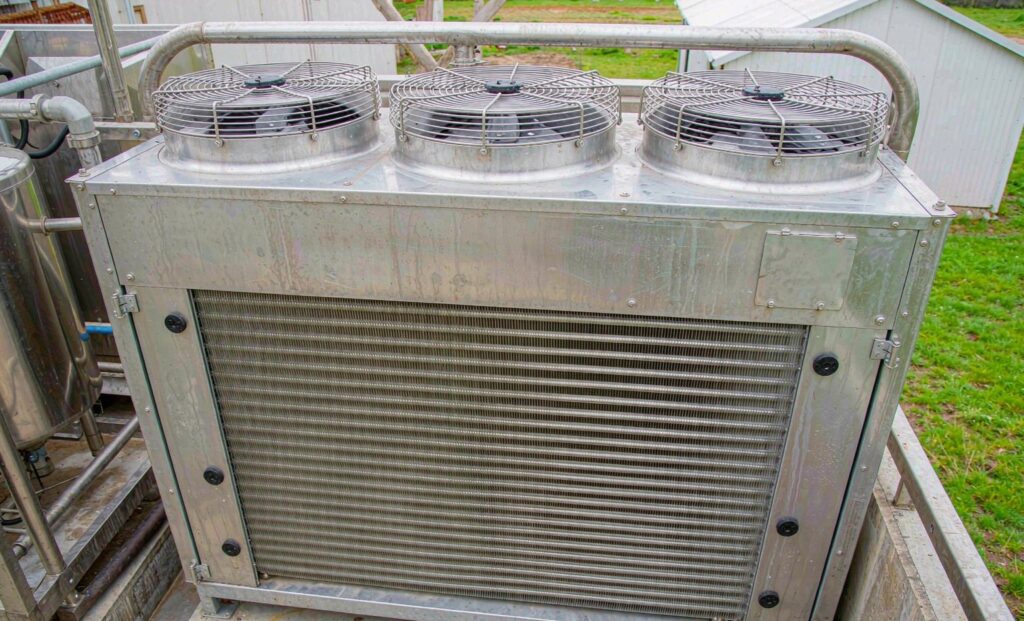
A dairy farm buys heat twice a day and throws it away twice a day. The milking plant chills milk from about 35 °C down to 4 °C and dumps the recovered heat to atmosphere through the condensing unit, while the wash cycle heats water to 60–80 °C in a tank a few metres away. An air source heat pump for dairy farm duty is worth considering for exactly one reason: it is the only machine on the site that can move that heat from the place it is not wanted to the place it is, and it can do it while the two loads are happening at the same time.
What a dairy farm actually uses heat for
The loads are predictable and they are not all the same temperature.
- Wash water for the milking plant. The largest and least flexible load. Cluster and liner washing, the milk line and the bulk tank all need water in the 60–80 °C band, delivered as a volume at a defined time, usually immediately after milking. This is the load that sizes the heat pump.
- Bulk tank and plate cooler. Not a heating load at all on the water side, but the source of the heat the heat pump can recover if the refrigeration circuit is arranged to reject into it rather than to air.
- Calf milk and calf pen heating. Small volumes at 40 °C, but a long, low-grade load that a heat pump handles efficiently.
- Space heating and wash-down water. Low-grade, weather-dependent, and the load that makes a heat pump look undersized on the coldest week if it is the only thing considered.
- Staff and office domestic hot water. Small, but it runs all year and it is usually the easiest load to attach to a buffer tank.
The important point is that the wash water load is a batch load with a deadline, not a continuous draw. A heat pump sized to the daily energy total will not deliver a tank of 70 °C water in the 45 minutes between the end of milking and the start of the wash, and a heat pump sized to that peak will be oversized for the other twenty-three hours. The resolution is usually a buffer: size the machine nearer the average and let a stratified tank carry the peak.
Why an air source heat pump for dairy farm duty is a different specification
If you would rather not build the lift calculation from a data sheet, send us what any sizing exercise needs — the fluid on each side, the flow rate, the inlet and outlet temperatures, and the heat duty for the wash water and the milk cooling separately. The sizing and selection tools take those inputs and return a sized unit, and the contact page puts the same information in front of an engineer who can confirm the design basis. What comes back is a sized quotation for the unit that fits the duty, not a price or a lead time.
A domestic hot water heat pump is rated at a 7 °C air temperature and a 55 °C delivery, and it is expected to work for two hours a day. A dairy machine runs at a 40–60 °C lift for an hour at a time, twice a day, in an environment full of dust, ammonia and wash-down water, and it has to hold 70 °C in the tank rather than 55 °C. The differences that follow from that are not cosmetic.
Compressor selection changes: a machine that must hold a high condensing temperature across a wide ambient range needs either a compressor rated for that envelope or a two-stage arrangement, and a single-stage scroll chosen on its nominal capacity will not hold 70 °C water at −5 °C ambient without either derating or tripping on discharge temperature. The evaporator changes too, because a coil that has to absorb heat at low ambient needs more face area and a defrost strategy that does not dump the tank temperature every cycle. And the controls change, because a dairy needs the tank at temperature at a known time, which is a scheduling problem rather than a thermostat problem.
The simultaneous load: cooling milk and heating wash water
The economics of a dairy heat pump live in the overlap. Milking takes one to two hours, twice a day. During that window the bulk tank refrigeration plant is rejecting a large heat load, and the wash water tank is being brought up to temperature. If the two are connected — the heat pump taking its source from the milk cooling circuit or from the condenser side of the existing plant rather than from outdoor air — the effective lift collapses and the coefficient of performance rises sharply.
There are three ways to arrange it, and they are not equivalent.
| Arrangement | Source temperature | What it buys | What it costs |
|---|---|---|---|
| Air source only | Ambient, −10 to 35 °C | Simplest, independent of the milking schedule, works all year | Worst performance in winter, exactly when the heating load peaks; defrost cycles in humid cold weather |
| Milk-cooling heat recovery only | Condensing refrigerant or warm cooling water, 25–45 °C | Highest efficiency, very short payback, no outdoor unit | Only works while the plant is chilling; the tank has to be at temperature before or during milking |
| Hybrid: recovery with air-source backup | Either, switched | Recovery efficiency most of the year, air source covers the gap and the summer wash | More controls, two sources to maintain, needs a real changeover strategy |
The hybrid is what most retrofits end up as, and the design question is the changeover. A recovery-only system that cannot make its tank on a day when the milk arrives already cold is a system that fails in a way the farmer discovers at 6 a.m. The air-source side has to be sized to cover the full wash load on its own, with the recovery treated as an efficiency gain rather than as capacity.
Temperature lift is the number that decides the machine
Lift is condensing temperature minus evaporating temperature, and it is the single strongest determinant of performance. As a rule of thumb, every 10 K of additional lift costs roughly 20–30 % of heating capacity at the same compressor power. That is why a machine that looks generous on a 7 °C ambient rating can look marginal at −5 °C, and why the same machine looks excellent when its source is 40 °C milk-cooling water instead of winter air.
Work the numbers at the worst case, not the average. For a dairy in a cold climate the design point is the coldest week that still requires a full wash cycle, which is usually a night-time ambient well below freezing. Take the required tank temperature — 70 °C is a common wash target, some plants run hotter for the final rinse — subtract the source temperature at that hour, and add the approach in the condenser and the exchanger. A 70 °C tank with a 55 °C return and a source at −5 °C is a lift in the region of 80 K including approach, which is beyond a single-stage machine’s comfortable envelope and pushes the design towards a two-stage or cascade arrangement, or towards holding the tank at a lower temperature and boosting at the point of use.
The honest answer for many sites is a split: heat pump to 55–60 °C, which is a comfortable single-stage duty, and a small inline booster or an immersion heater for the last 10 K, used only when the tank is drawn down. That is less elegant than one machine doing everything and it is usually cheaper to run than a single machine fighting a lift it was never designed for.
Refrigerant choice: propane, CO2 and the high-temperature case
Three refrigerant families turn up in dairy heat pumps and the choice is driven by the delivery temperature and the charge size, not by preference.
R290 (propane) is the natural choice for a small-to-medium packaged unit delivering up to about 70 °C. It has excellent thermodynamic properties at high condensing temperature, a low global warming potential, and it is cheap. The constraint is charge size: many jurisdictions limit the charge in a single circuit, which caps the capacity per module and pushes larger duties towards multiple modules. It is also flammable, so the unit needs a compliant location and no ignition sources in the enclosure.
R744 (CO2) in a transcritical cycle is the strong option where delivery temperatures above 70 °C are needed, because the transcritical cycle’s temperature glide on the gas cooler lets it produce hot water at 80–90 °C while returning water at 30–40 °C — a large temperature drop that suits a stratified tank very well. The penalty is that the cycle is inefficient when the ambient is high and the load is low, so CO2 units are best where there is a genuine simultaneous cooling load and a high delivery temperature.
R32 and the HFO blends are common in mid-range commercial units, deliver 55–65 °C comfortably, and are the pragmatic choice where a propane charge limit or a CO2 efficiency penalty rules the others out. They carry a global warming potential that is no longer negligible and will attract refrigerant accounting in some markets.
Whatever the refrigerant, the unit falls under the pressure equipment and refrigerant-handling rules of the country it is installed in, and the rating should be quoted to a recognised standard — EN 14511 for the heat pump performance, and EN 16147 where domestic hot water performance is being compared. A supplier quoting “COP 4.5” with no statement of the conditions, the standard, or whether it includes pump power has given you a number that cannot be compared with anything.
Sizing an air source heat pump for dairy farm wash water
The sizing sequence that works is energy first, then peak, then buffer.
- Daily energy. Litres of wash water per cycle × cycles per day × temperature rise × 1.163 Wh per litre-kelvin, plus standing losses from the tank. That gives kWh per day.
- Peak rate. The tank has to be at temperature at the start of the wash. If the window between the end of milking and the start of the wash is 45 minutes, the machine plus the stored energy has to cover the whole tank in that window.
- Buffer volume. A stratified tank lets a smaller machine work for longer. As a starting point, a tank that holds a full day’s wash water and is heated across the day rather than in one burst will let the machine be sized on daily energy divided by available hours, which is typically a third of the peak rate.
- Recovery. If the tank is drawn to 40 °C by a wash cycle, the machine must be able to recover to setpoint before the next cycle. With two cycles a day there is usually ample time; with three or four, the recovery rate becomes the constraint.
The plate heat exchanger between milk and water
Where the heat pump recovers heat from the milk cooling circuit, the interface is usually a plate heat exchanger, and it has one rule that matters more than efficiency: the milk side must be at a higher pressure than the water side at every point. If the water side can exceed the milk side, a pinhole in a plate becomes a route for wash water into milk, which is a food safety failure rather than a maintenance issue.
Practically that means the water circuit is arranged with a break tank or a pressure-limiting valve, the exchanger is selected with the milk side as the higher-pressure stream, and the plates are inspected at each service for pinholes and for gasket creep. A double-wall plate exchanger removes the risk entirely at a cost in effectiveness and in footprint, and for a dairy it is often the right trade.
Fouling is the second consideration. Milk-side fouling is a protein and mineral film that forms quickly above 50 °C, and it is removed by the CIP cycle rather than by manual cleaning, so the exchanger has to be designed for the CIP flow rate and the CIP temperature, not only for the process duty. A generously sized exchanger with a low pressure drop fouls more slowly and cleans more completely than one selected tight to the duty.
Cold-climate operation: defrost, derating and siting
An air source unit in a dairy climate spends part of the year below 5 °C with high relative humidity, which is the worst combination for frosting. Frost builds on the evaporator, airflow falls, capacity falls, and the unit enters a defrost cycle that either reverses the refrigerant circuit or stops the compressor and runs a fan.
Each strategy has a cost. Reverse-cycle defrost takes heat out of the water side, which is exactly the heat the tank needs; a hot-gas bypass defrost is gentler but slower. What matters at specification is the defrost initiation logic — demand-based defrost, which measures the actual loss of performance, is better than a fixed timer because a timer defrosts a clean coil and wastes energy — and the stated capacity at the design ambient including the defrost penalty. A rating that ignores defrost overstates the machine by a margin that shows up as a cold tank on the coldest week.
Siting is the other half. The unit needs clear air on the evaporator face, and a dairy is a bad place for restrictions: silage clamps, straw, dust from bedding and the warm, moist air off a wash-down all degrade a coil. Put the unit upwind of the parlour, clear of the tanker route, with enough space to clean the coil, and away from where ammonia from slurry will reach it — ammonia plus copper tubing is a corrosion problem that no coating fully solves.
Materials and corrosion in a dairy environment
A dairy atmosphere is a mild ammonia environment with frequent wetting and chloride from wash chemicals. That is enough to make a standard epoxy-coated coil a five-year item and a bare copper-aluminium coil worse.
The choices that hold up are a hydrophilic coating on the coil with a corrosion-resistant substrate, stainless steel for the wetted parts of the water circuit, and a casing that is either stainless or a well-coated galvanised steel with the cut edges treated. Where the unit sits near slurry storage, the ammonia concentration justifies a coated coil and a casing that will not rust through at the fixings — the fixings are usually where corrosion starts.
Controls, metering and the wash cycle
The control requirement is a schedule, not a setpoint. The machine needs to know when the wash is due, how much water it must have at temperature by then, and what the electricity tariff is doing in between. That means a controller with time-of-use scheduling, a tank temperature sensor in at least two positions to see stratification, and a record of what happened — plus a heat meter and a separate electricity meter, because an installation that cannot measure itself will produce an argument rather than a seasonal performance figure in its first winter.
Commissioning checks and the failures that show up in year one
Three failures account for most of the first-year complaints.
The tank never reaches temperature on cold mornings. Almost always a sizing error — the machine was selected on nominal capacity, or the recovery window was overstated, or a standing loss was omitted. The fix is usually a buffer volume increase or a booster, not a bigger compressor.
The coil ices and stays iced. Defrost initiation is wrong, or the unit is sited where it recirculates its own cold discharge, or the coil is blocked with dust and bedding. Check the siting and the coil before touching the control parameters.
The milk cooler and the heat pump fight each other. Two refrigeration systems on one milk line with independent controls will each try to hold their own setpoint, and the result is short cycling. The changeover logic has to have a clear priority — recovery first while the plant is running, air source when it is not — and it has to be commissioned with both systems live, not tested separately.
The commissioning record worth keeping is short: measured capacity at the design ambient, tank recovery time from a known drawdown, the defrost log over a cold week, and the heat meter reading against the electricity meter. Those four numbers tell you in year one whether the machine is doing what the quotation said.
What to put in the enquiry
A dairy heat pump enquiry that gets a useful answer contains the following, and a supplier who quotes without asking for most of it is quoting a catalogue box.
- Wash water volume per cycle, cycles per day, required temperature and the time window available.
- Tank size and insulation condition, or the standing loss if it is known.
- Milking times and the milk cooling plant’s capacity and condenser type.
- Design winter ambient and the site’s altitude.
- Whether the unit will sit outdoors, under a roof, or in a plant room, and the acoustic limit at the nearest dwelling.
- Electrical supply and maximum demand, and whether a time-of-use tariff applies.
- Refrigerant preference or restriction, and the local charge limit.
- Whether domestic hot water is on the same system.
Our heat pump range and the cold-climate air source units are selected against exactly this list, and the plate exchangers for the milk-cooling interface come from the same brazed plate range used on the process side. The selection is done from the duty, not from a model number.
A dairy heat pump is not a complicated machine. It is a machine that has to be honest about its lift, its defrost behaviour and the volume of water the farm actually needs at seven in the morning.
