
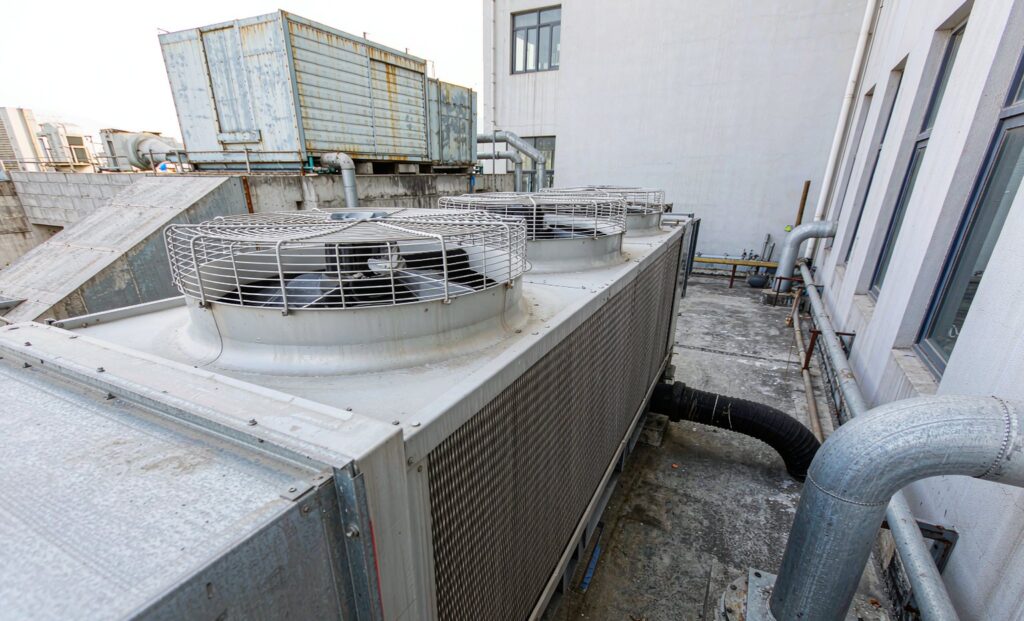
An air cooled screw chiller for a pharmaceutical plant is usually bought for reasons that have nothing to do with the compressor. It is bought because the plant has no cooling tower and cannot get a water permit, because the roof is the only free space, because a water-cooled machine would need a condenser water loop with its own treatment and legionella control, and because a packaged air cooled unit arrives with one set of responsibilities attached instead of three. The screw compressor is then chosen because the load is in the range where a screw is more efficient and more durable than an array of scrolls.
That is the easy part of the decision. The difficult part is that a pharmaceutical plant asks more of a chiller than an office does: it runs continuously, it has batches that cannot be interrupted, it has a quality system that wants records, and it has a load profile that is nothing like the peak number on the data sheet. This page is the selection logic that survives all four.
Why a pharmaceutical plant is a different chiller problem
Three loads usually end up on one chilled water system, and they behave differently. The air handling load follows ambient temperature and occupancy, so it peaks in the afternoon and falls at night. The process load follows the batch schedule: reactor jacket cooling, condenser duty on a distillation step, jacket cooling on a centrifuge, all of which arrive as steps rather than ramps. The utility load — purified water generation, lyophiliser condenser, clean steam — is small but continuous and intolerant of interruption.
Then there is the quality system. A chiller in a GMP facility is a utility that can affect product, so it will be qualified, it will appear in change control, and its alarms and trends will be looked at during audits. A machine that cools perfectly but cannot produce a trend of chilled water temperature against time is a machine that creates work for the validation team. That is a selection criterion, and it is not on most data sheets.
Start from the load blocks, not the peak
The single most useful thing a plant can do before approaching a supplier is to build a load profile in blocks: a table of hours per year against load band, per system, with the process steps identified. A peak of 800 kW that occurs for forty hours a year and a base of 350 kW that runs for eight thousand hours are completely different machines, and a single peak figure cannot distinguish them.
If the profile is not available, send what is: the systems to be served, the design chilled water temperatures, the process steps and their durations, and the expected operating hours per year. A selection made against a peak alone will be oversized for the base load, which is where most of the energy is spent.
Send the same four inputs that any sizing exercise needs — the fluid, the flow rate, the inlet and outlet temperatures and the heat duty for each circuit — through our sizing and selection tools, or put them in front of an engineer through the contact page. What comes back is a sized quotation for the unit that fits the duty, so the comparison starts from a machine rather than a catalogue range.
Leaving water temperature and the evaporator approach
Chilled water at 7 °C supply and 12 °C return is the default because it suits conventional air handling coils and keeps the evaporator out of the freezing risk zone. Pharmaceutical process duty often wants colder water — jackets on an exothermic reaction, or a condenser that has to run below ambient — and every degree below the default costs capacity and efficiency.
The mechanism is the approach temperature: the refrigerant in the evaporator has to be colder than the leaving water by the approach, so a lower leaving water temperature means a lower evaporating temperature, a larger pressure ratio, and less cooling effect per unit of compressor work. An air cooled machine already runs a higher condensing temperature than a water cooled one, so the pressure ratio is wider before the evaporator is touched. Asking an air cooled screw chiller for very cold water is asking it to work at both ends of its envelope at once.
The selection rule is to set the warmest chilled water temperature the process can tolerate, and to check the approach the supplier is quoting rather than assuming a standard figure. Where a process genuinely needs low temperature, that is often better served by a separate low-temperature circuit than by pushing the whole plant loop colder.
Ambient design condition and the air-cooled derate
An air cooled chiller’s capacity is quoted at a stated ambient, and that ambient is rarely the one the plant experiences on its worst afternoon. Capacity falls as ambient rises, because the condensing temperature has to rise to reject heat into hotter air, and the compressor’s pressure ratio widens accordingly.
The selection consequence is that the rated capacity must be corrected to the site design ambient, using the supplier’s published correction data, and the corrected figure is what has to meet the load. Two further corrections are easy to miss: a roof or enclosure that restricts airflow raises the effective ambient above the weather station figure, and a bank of units side by side recirculates warm air unless the spacing and prevailing wind have been considered.
Ask for the correction table in writing rather than accepting a derate factor quoted from memory, and check whether the quoted capacity includes any fouled-coil allowance. A condenser coil that has been in service for two years is not the coil that was rated.
Screw, scroll or centrifugal at pharma scale
Scroll compressors suit small capacities and are simple, but a pharmaceutical plant usually needs several hundred kilowatts with redundancy, and at that size an array of scrolls means many more moving parts and many more failure points. Centrifugal machines are efficient at large capacities and are usually water cooled, which brings back the condenser water loop the air cooled choice was meant to avoid.
The screw sits between them and is the usual answer for a packaged air cooled unit in this range: fewer compressors, continuous capacity modulation by slide valve, good tolerance of part-load operation, and a design that copes with the repeated cycling a batch plant imposes. The trade-off is that a single screw compressor is a single point of failure unless the unit is specified with two independent refrigerant circuits — which is the redundancy question, and it matters more than the compressor type.
Redundancy: N+1 and the header that makes it real
Redundancy is usually specified as N+1 and then defeated by the pipework. Two chillers feeding a common header give N+1 only if either machine can carry the load alone at the design ambient, if the isolation valves allow one to be worked on while the other runs, and if the controls will actually start the standby machine on a failure rather than on a schedule.
The questions worth asking are concrete. What is the capacity of one machine at design ambient, not at rated ambient? Does each machine have its own pump, or does a single pump defeat the redundancy? Is the standby sequenced to rotate, so both machines accumulate hours? On a failure, how long before the standby is at full load, and does the process have that much thermal buffer?
For a plant with a batch that cannot be lost, the honest arrangement is often two machines each capable of the full load, which is N+1 in capacity terms and considerably more expensive than two machines each at half load. That decision belongs to the process owner, not the HVAC contractor, and it should be made before the chiller is ordered.
Part-load hours are where the energy is
A chiller selected exactly for the peak will run at part load for most of its life, so the number that predicts its energy use is not the full-load efficiency but the efficiency across the load bands it will actually see. Screw compressors with slide valve modulation hold reasonable efficiency down to moderate part load and lose ground at very low load, where a fixed-speed machine cycles and an inverter-driven one turns down.
The practical selection rule is to ask for efficiency at several load points against the plant’s own ambient profile, not a single figure at rated conditions. A machine that is excellent at full load and poor at thirty per cent will cost more over a year than one that is merely good across the range, especially in a plant whose base load is a fraction of its peak.
Low-load operation also has a mechanical consequence: a chiller that spends long periods at minimum capacity may short-cycle, and each start puts a surge of current through the motor and a thermal cycle through the windings. Check the minimum step and the anti-recycle timer, and check whether the controls will stage machines rather than let one cycle.
Glycol and low-temperature process duty
Where a circuit has to run below the freezing point of water, or where it is exposed to ambient frost, the loop is filled with a glycol mixture. That changes the selection in three ways: the mixture’s heat capacity and viscosity differ from water, so flow rates and pressure drops change; the evaporator’s heat transfer coefficient falls, so the approach widens; and the freeze protection setpoint moves, which affects the low-limit cutout settings.
The mistake is to select on water and then add glycol at commissioning. A machine sized for water duty will not deliver the same capacity on a 30 per cent glycol mixture at the same leaving temperature, and the shortfall appears exactly when the load is highest. State the glycol type and concentration in the enquiry, or state that the circuit is water only.
Our air cooled glycol chiller range covers the low-temperature and glycol-filled duty, and the air cooled heat exchanger and dry cooler range covers the free-cooling and heat rejection side where a plant wants to reduce compressor hours in cold weather.
Materials, water quality and cleanable surfaces
The chilled water loop in a pharmaceutical plant is a closed loop, but it is not a clean one. It gathers corrosion products from mixed-metals pipework, biological film where the temperature suits it, and debris from construction. A brazed plate evaporator with narrow channels is efficient and intolerant of that debris; a shell and tube evaporator is less compact and much easier to clean.
Where the loop cannot be guaranteed clean, the selection should favour a cleanable evaporator and a strainer arrangement that can be serviced without draining the plant. Where stainless steel is used, the chloride level in the loop water becomes a stress corrosion question, and the water treatment regime belongs in the same conversation as the material choice.
Ask what the evaporator can be cleaned with, whether the water-side surfaces are accessible, and what the supplier’s water quality limits are. A chiller that needs a chemical clean every year is a maintenance cost that should have been priced at selection.
Controls and the records a QA auditor asks for
A pharmaceutical chiller needs to be able to say what it did. That means a controller with a real-time clock, a trend buffer long enough to cover a batch, alarm history that survives a power cycle, and an interface that the building management system can read without a proprietary gateway that nobody can support in five years.
The audit questions are predictable: what was the chilled water supply temperature during the batch, did any alarm occur, was the standby machine available, and who changed a setpoint. A chiller whose controller keeps two hours of trend data cannot answer the first question a month later. Specify the trend depth and the alarm retention, and specify the protocol the plant’s monitoring system speaks.
Qualification documentation is a separate deliverable from the machine. Ask what the supplier provides for installation qualification and operational qualification — drawings, bills of material, calibration certificates for sensors, alarm lists, and a functional test record — and treat a vague answer as a gap in the offer.
Siting, noise and heat rejection
An air cooled chiller rejects the entire heat load plus the compressor work into the air around it, which on a roof means a large volume of warm air leaving at speed. Recirculation is the common failure: units placed too close to a parapet, or in a well between buildings, draw their own discharge back through the coil, and the machine that was selected for 35 °C ambient is now running at 45 °C.
The siting rules are simple to state and easy to break. Keep the discharge clear of walls and parapets, space units so that one does not feed another, allow for the service access the coil cleaning needs, and check the structural loading and the acoustic path to the nearest occupied space. A pharmaceutical plant often has an office or a cleanroom within earshot, and a screw compressor at full load is audible through a lightweight roof.
If noise is constrained, that is a selection input, not a post-installation problem: acoustic enclosures, low-speed fans and reduced fan count all change the machine, and none of them can be added cheaply afterwards.
The data sheet to send
- Heat duty per circuit, in kW, with the process step it belongs to.
- Fluid, flow rate, and inlet and outlet temperatures for each circuit.
- Glycol type and concentration if the loop is not water.
- Site design ambient, and whether the unit sits on a roof, in a well, or under a screen.
- Required redundancy, and whether N+1 means capacity or machines.
- Operating hours per year and the load profile if it exists.
- Electrical supply, and whether an inverter-driven compressor is required.
- Noise limit at a stated distance, and any acoustic enclosure requirement.
- Documentation required for qualification, and the monitoring protocol.
Our air cooled screw chiller range covers packaged units with independent refrigerant circuits for the redundancy arrangements described above, and the selection can be worked from the list immediately above rather than from a peak figure. Send the list and the duty, and the answer will be a sized machine with its correction data stated, not a range of models to choose from.
The chiller is the easy part. The plant that has to run through a batch, pass an audit and explain its energy bill in year three is the part worth designing for.
