
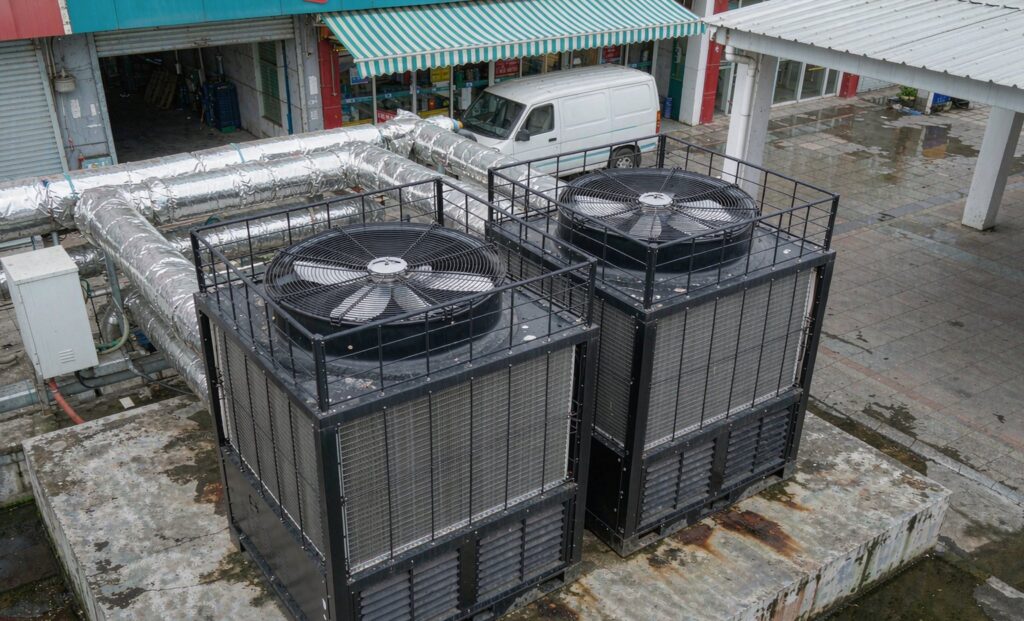
An air cooled screw chiller for supermarket refrigeration is usually selected against a store’s total refrigeration tonnage, and that is where the selection starts going wrong. A supermarket does not have one refrigeration load. It has a set of display cases with different temperatures, a defrost schedule that fires in sequence through the day, a produce department that needs humidity rather than cold air, and a building load that peaks when the store is fullest and the outside temperature is highest. The chiller sees the sum of those, hour by hour, and the sum moves.
This is what that load actually looks like, where an air cooled screw machine fits a retail store and where it does not, why defrost and part load decide more of the annual energy than peak capacity does, what glycol does to the selection, and which inputs a supplier needs before the number means anything. There is a broader comparison of chiller types and their evaporator duties in our chiller and heat exchanger selection guide; this page is about the retail case specifically.
What a supermarket refrigeration load actually is
Four groups, and they behave differently enough that adding their nameplate capacities together produces a number that is wrong in both directions.
- Low temperature display cases. Frozen food, ice cream, frozen meat. Case air around -18 to -22 °C, which means an evaporating temperature well below that and a compressor working at a high pressure ratio. This is the load that dominates compressor power.
- Medium temperature cases. Chilled meat, dairy, deli, cooked foods. Case air around 0 to 4 °C. Large surface area, long opening hours, and the group most affected by how often a case door is left open.
- Produce. Not simply “cold”. Produce wants a temperature range and a humidity range, and misting or humidification may be part of the duty. A produce case run too dry loses saleable weight and looks tired by mid-afternoon.
- Back-of-house and building. Preparation rooms, staff areas, and the store’s own comfort cooling. Often served from the same chilled water circuit, and often the load that keeps running after the store closes.
The consequence is a load with a strong daily shape and a strong weekly shape. Sales floor activity, door openings,delivery periods, baking, and the outside ambient all move together, and the peak arrives in the late afternoon on the hottest day, which is exactly when an air cooled condenser is least efficient.
Why an air cooled screw chiller, and where it stops paying
Air cooling removes the cooling tower, the condenser water pump, the water treatment and the makeup water. For a store in a retail park or a town centre site with no plant room for a tower and no appetite for water treatment, that simplification is often the deciding argument. One package on a pad, one electrical connection, no plume, no legionella regime on a cooling tower.
The cost is efficiency and footprint. An air cooled condenser rejects heat to ambient air, so condensing temperature sits above the dry-bulb by the coil approach, and that gap widens as the coil fouls. On a 35 °C afternoon with a dirty coil, the compressor lift is materially higher than the same machine would see on a water cooled circuit, and the power per kW of cooling rises with it. A screw compressor is the right choice for a large store with a broad load range because it modulates well; it is the wrong choice for a small store that would spend its life at a fraction of capacity.
If you are sizing a unit for a store, send us five things: the fluid (water, or glycol with its concentration), the flow rate, the inlet and outlet temperatures you need, the heat duty in kW, and the design ambient dry-bulb temperature. We will come back with a sized selection against those figures and a quotation built on them, not on a nominal tonnage. The sizing and selection tools walk through the same inputs if you want to prepare them first.
The display case is the load, and it is not steady
A display case is an open or glazed refrigerated box in a warm room with people walking past it. Its load has four parts: transmission through the panels, radiation through the glass or the open front, infiltration of warm room air, and the internal load of the product going in. Infiltration is the one that varies most, because it depends on the air curtain, the room draughts from the store’s own air conditioning, and whether the case is loaded to its marked load line.
Overloading a case above its load line is the single most common cause of a case that “does not hold temperature” while the refrigeration plant is doing exactly what it was asked. The plant cannot fix an air curtain that is being broken by a pallet of stock stacked above the load line, and no amount of extra capacity will make it.
For the chiller selection the consequence is that case capacities should be taken from the case manufacturer’s data at the store’s design ambient, not at a laboratory condition, and then diversity applied honestly. A store with forty cases does not have all forty at full load simultaneously, but a store with forty cases and no doors on the medium temperature run has far less diversity than the arithmetic suggests.
Defrost is a load, not a detail
Every low temperature case and most medium temperature cases accumulate frost, and defrost has to be removed. Electric defrost puts heat into the case and then the plant has to pull the temperature back down, which means a step load immediately after each defrost termination. Hot gas defrost uses compressor discharge instead, which changes the load shape rather than adding to it, but it needs a plant arranged to provide it.
What matters at the chiller is the schedule. If defrosts are staggered across the store, the plant sees a series of small steps. If they are all timed to the same hour — which happens when a store sets them for “when it is quiet” — the plant sees one large step and the chilled water temperature swings, and the cases that finish defrost last are the ones that take longest to recover.
Ask for the defrost schedule with the load calculation, and check that the chiller’s control can absorb the step without the chilled water temperature leaving its band. A selection with no allowance for defrost recovery is a selection that will be reported as undersized in the first winter, when defrost frequency rises.
Chilled water or glycol, and the temperature the store needs
Medium temperature cases can usually be served by a secondary fluid at a temperature that plain water can carry. Low temperature cases generally cannot: the secondary fluid has to go below 0 °C to serve a case at -20 °C, so it needs glycol, and glycol changes the whole selection.
Propylene glycol at 30% reduces heat transfer and raises viscosity, so the same duty needs more flow, more pump head and slightly more evaporator surface. A unit selected for water and then filled with glycol will underperform, sometimes by enough to miss the duty at peak, and the shortfall will be blamed on the cases. State the fluid and the concentration in the enquiry, and the evaporator is sized once, correctly.
There is also a design choice between a distributed system, where a small chiller serves a group of cases, and a central plant with a secondary loop. Distributed systems shorten pipe runs and reduce the refrigerant charge, which matters under current refrigerant rules, but they multiply the number of machines to maintain and put heat rejection into the sales floor ceiling rather than on a pad outside. Central plant is easier to maintain and easier to monitor; it also commits the store to one large machine and its failure mode.
Refrigerant choice and the direction of travel
Refrigerant policy is moving faster than chiller life cycles, and a store that installs a high-GWP refrigerant today is installing a future retrofit. The EU F-Gas Regulation (Regulation (EU) 2024/573) tightened the phase-down schedule and the rules on leakage checks and refrigerant recovery, and other jurisdictions are following similar paths at different speeds.
In practice that pushes retail refrigeration toward natural refrigerants — CO2 (R-744) in transcritical or subcritical arrangements, and propane (R-290) in small charge systems — or toward lower-GWP HFO blends and A2L refrigerants where the charge and the space allow. Each has consequences for the chiller: CO2 runs at high pressure and needs different components and different leak detection, propane is flammable and carries charge limits and ATEX considerations, A2L refrigerants are mildly flammable and change the electrical and ventilation requirements.
The refrigeration engineer decides the refrigerant; the chiller supplier has to be told which one, because it changes the evaporator, the materials, the pressure rating and the controls. A selection made before the refrigerant is fixed is a selection that will be revised.
Part load, night blinds and the hours nobody counts
A store’s refrigeration load at 3 a.m. is not zero. Cases are closed with night blinds or covers where they exist, doors are shut, the sales floor is empty, and the load falls to something like a third of the afternoon peak. If the chiller is a single screw machine selected for the peak, it spends the majority of its hours at a small fraction of capacity, unloading and cycling.
That is where the annual energy is decided, not at the peak. A screw compressor with slide valve control modulates down to a minimum, typically around a quarter to a third of full capacity, and below that it unloads and cycles. Two smaller machines staged on load, or a screw with a variable-speed drive, will hold the night load far more efficiently than one large fixed-speed machine.
Ask for the part-load curve at the store’s ambient profile, in kW input against kW cooling, and check it at the points the store actually runs — the night load, the morning pull-down, and the afternoon peak. A machine that is excellent at full load and poor at a third of it is the wrong machine for a supermarket, however good its nameplate figure looks.
Siting: noise, heat rejection and the neighbours
A supermarket chiller usually sits where somebody can hear it. The pad behind the loading bay is often metres from a residential boundary or a neighbouring unit, and a bank of axial fans running through a summer night is a noise complaint waiting to happen. Fan selection, acoustic attenuation and the orientation of the coil faces are all part of the selection, not a post-installation fix.
The thermal side matters as much. Air cooled units need unobstructed air in and out, and they need to be sited so they do not recirculate their own discharge. A row of chillers against a wall, or in a compound with a fence close to the coil face, will see inlet air several kelvin above ambient and lose capacity exactly when it is needed. Leave clear space in front of each coil face, keep the discharge away from walls and from the store’s own air intakes, and plan for cleaning access because a retail site with a kitchen extract nearby will load the coil with grease as well as dust.
Also check where the condensate goes. Defrost and case cleaning produce water, and a pad that drains towards a doorway or a neighbour’s boundary is a problem that appears in the first week.
Controls and integration with the case controllers
The chiller does not run the store; the case controllers and the store’s monitoring system do. What the chiller has to provide is a stable secondary fluid temperature, a demand signal the store system can read, and alarms that reach somebody. Modbus RTU or TCP is the common baseline, BACnet where a building management system is in place, and a dry contact for run and alarm as the minimum.
Decide who owns the setpoint before commissioning. A chiller controlling its own leaving water temperature while a store controller trims the same loop will oscillate, and the fault will be reported as a chiller problem for as long as it takes somebody to look at both graphs. Agree one master, document it, and make sure the alarm routing goes to a person who is on site at 6 a.m. when the cases are warm.
The inputs a selection actually needs
| Input | Why the selection depends on it |
|---|---|
| Heat duty, kW, split by temperature level | Low and medium temperature duty cannot simply be added; the evaporating temperatures differ |
| Secondary fluid and concentration | Glycol changes heat transfer, flow and pump head |
| Flow rate and supply/return temperatures | Fixes evaporator approach and pass arrangement |
| Design ambient dry bulb | Derates an air cooled machine above its rating condition |
| Defrost schedule and recovery allowance | Sets the step load the control has to absorb |
| Part-load profile, including night load | Determines machine count, staging and whether a drive is justified |
| Refrigerant | Changes pressure rating, materials, leak detection and controls |
| Site constraints: noise, space, discharge direction | Determines fan selection, acoustic treatment and layout |
| Electrical supply and starting limitation | Determines motor, starter or drive |
Nine lines. Without the ambient, the fluid and the night load, the same nine lines produce a number that is only correct on the day it was quoted.
Commissioning checks worth insisting on
Measure the condenser approach on the first hot day rather than on a mild one. The difference between condensing temperature and ambient should match the selection; several kelvin more means the coil is restricted, the airflow is short-circuiting, or the machine is not what was ordered.
Check the secondary fluid flow against design and the temperature difference across the evaporator at full load. A flow well below design with a large ΔT usually means a throttled valve or a bypass, and it will surface later as erratic temperature control at the cases. Record compressor current against the nameplate full-load value at the design condition, and check oil pressure and level after the first week — the first week is when a charge or piping error shows itself.
Then watch a defrost cycle through to recovery. That is the test that finds a plant with no allowance for the step load, and it is much cheaper to find on the commissioning sheet than in a trading week.
Mistakes that cost a summer
Sizing on added nameplate tonnage instead of a load at the store’s ambient. Ignoring defrost recovery. Selecting for water and filling with glycol. One large machine for a load that spends most of its hours at a third of capacity. Siting the unit against a wall where it recirculates its own hot air. Choosing a refrigerant after the chiller is ordered. And treating the case load line as a suggestion.
An air cooled screw chiller for supermarket refrigeration is a sound machine for the duty when the load is built honestly and the part-load behaviour is checked. That work happens before the purchase order. If any of the nine inputs is still open, the contact page is the place to start.
