
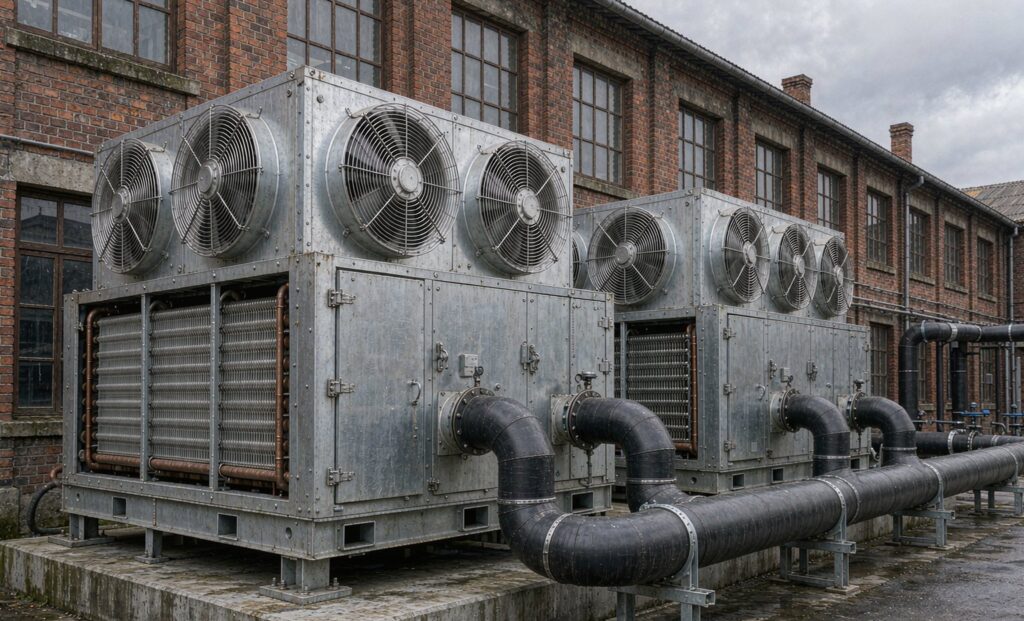
An air cooled screw chiller for a textile mill is usually bought to solve a temperature complaint and then spends its life being judged on humidity. That mismatch is where most of the disappointment comes from. A mill does not fail because the hall is 2 K warm; it fails because the relative humidity drifted, the yarn lost its moisture regain, and the ends started breaking at the loom. The chiller is only one part of that chain, but it is the part whose selection decides whether the chain can hold its setpoint at three in the afternoon in July.
This is about the load a textile mill actually presents, why the chilled water temperature is set by the air washer rather than by comfort, how an air cooled condenser behaves on a hot day and in a mill’s own dust, and the sizing method that produces a machine which still works in the fourth week of summer rather than only on the day it was commissioned.
Why a textile mill is a humidity problem before it is a temperature problem
Every fibre used in spinning and weaving has an equilibrium moisture content that depends on the air around it, and its strength, elongation and tendency to generate static all follow that moisture content. Cotton loses strength as it dries; synthetic fibres become static-prone and balloon in the carding and drawing processes; and a warp that has dried out abrades and breaks at the heald frames. The practical result is that a mill controls relative humidity to a tolerance of a few percent, and it controls temperature mainly because temperature is what sets the humidity at a given moisture content.
Typical spinning and weaving halls are held somewhere in the mid-twenties Celsius and around 55–65 % relative humidity, with weaving often running slightly more humid than spinning and certain processes running warmer. Those figures are process-specific and should come from the mill’s own process specification, not from a textbook — but the structure is always the same: a temperature target, a humidity target, and a tolerance on both.
What that means for the chiller is that it is not serving a comfort load with a flexible setpoint. It is serving a process load where the supply water temperature fixes the leaving air condition from the air washer, and the leaving air condition fixes the humidity in the hall. A chiller selected on tonnage with no view of that chain will be run at whatever water temperature keeps the hall comfortable, and the humidity will be whatever falls out.
The three loads in a mill, and which one sizes the machine
The cooling load in a textile mill is dominated by internal gains, not by solar or fabric, and it splits into three parts that behave differently through the day and the year.
- Machine load. Motors, gearboxes, spindles and bearings. Steady, large, and almost independent of the weather. This is the base load that keeps a mill needing cooling in December.
- Lighting and people. Also steady, also internal. In a modern LED-lit mill the lighting load has fallen sharply, which has changed the balance of many retrofits and is worth re-measuring rather than carrying forward from an old load schedule.
- Ventilation and infiltration. The weather-dependent part. Fresh air has to be introduced for humidity control and for air quality, and in summer that outside air is both hot and humid, which makes it the largest single variable in the load.
If you would rather not build the load case and the water-side design separately, send us what any chiller selection needs — the fluid, the flow rate, the inlet and outlet temperatures and the heat duty, together with the summer design ambient and the leaving air condition the hall has to hold. The sizing and selection tools take those inputs and return a sized unit, and the contact page puts the same numbers in front of an engineer who can confirm the design basis. What comes back is a sized quotation for the chiller that fits the duty.
In a weaving shed the machine load alone can be large enough that the mill needs cooling on a day when the outside air is cold, which produces the situation that confuses people new to the industry: a mill running chillers in winter while the offices are heating. That is not waste. It is the internal gain being removed, and it is why air-side free cooling is such a large opportunity in a mill.
Sizing an air cooled screw chiller for textile mill duty
The sizing sequence that produces a machine which still works in August runs in this order, and it is not the order most quotations are built in.
Start from the air side, not the water side. For each air handling unit or air washer, the cooling coil load is the mass flow of air multiplied by the enthalpy difference between the entering and leaving conditions, plus the spray water load where an air washer is used. Enthalpy, not dry-bulb temperature difference, because a mill’s load is dominated by latent heat in summer and a dry-bulb calculation understates it badly.
Fix the chilled water temperatures. The supply temperature has to be low enough to dehumidify at the coil, which means below the apparatus dew point of the air being handled, and the return temperature follows from the flow and the load. A warmer supply saves compressor energy and loses dehumidification; the balance point is a process decision, not a chiller decision, and it belongs in the datasheet.
Add the diversity, honestly. Not every AHU runs at design simultaneously, but in a mill the machine load does not switch off either. Diversity factors carried over from comfort cooling tend to be far too generous here, and a chiller sized on 70 % diversity in a plant running three shifts will be short.
Then derate for ambient. An air cooled condenser rejects heat to outside air, so its condensing temperature rises with ambient and its capacity falls. A machine rated at a nominal condition loses a meaningful fraction of that capacity at a 40 °C ambient, and the loss grows on a site where the condenser is partly blocked with lint. The design point has to be the summer design ambient at the actual installation position, not the catalogue rating condition.
Check the result against the part-load year. A chiller that is exactly right on the design day is oversized for the other 350 days. The question is not whether it can meet the peak; it is whether it can run stably at 40 % of the peak for months at a time.
Part-load behaviour and why screw compressors suit a mill
A textile mill runs long hours at a load that tracks production rather than weather, and the load profile is characterised by long periods at part load with occasional peaks. That profile favours a compressor that keeps its efficiency as it unloads.
A screw compressor with a slide valve or with variable speed control holds capacity down to a modest fraction of full load without the cycling losses of a fixed-speed machine, and multiple compressor circuits in one chiller allow staging so that a small load is met by one circuit running efficiently rather than by a large machine short-cycling. Short cycling is the failure mode to design out: it costs energy, it stresses the contactors and the compressor, and on a mill it produces chilled water temperature swings that show up as humidity swings in the hall.
The practical specification point is to ask for the part-load performance, not just the full-load capacity and efficiency. A quotation that gives one capacity figure and one coefficient of performance has told you what the machine does on a day that will not occur.
Air-cooled or water-cooled on a mill site
The choice is usually made on water availability and on plot space, and both are real constraints in an existing mill.
A water-cooled machine with a cooling tower is more efficient, because the condensing temperature follows the wet-bulb rather than the dry-bulb and is therefore lower for most of the year. It also moves the heat rejection to a tower that can be sited away from the building. What it needs is makeup water, water treatment, and a tower that will not become a legionella risk or a maintenance orphan.
An air cooled machine needs no water and no tower, which in a mill with limited water supply or no space for a tower is decisive. It costs more energy per unit of cooling, it is sensitive to ambient, and its condenser is exposed to the mill’s own airborne fibre, which is not a small matter in a textile plant.
Where the site has water and space, a hybrid arrangement is often the honest answer: a water-cooled base machine for the base load and air cooled capacity for peaks. What is not honest is an air cooled selection justified on capital cost alone with no view of the summer energy penalty.
Ambient derating and the summer design day
Air cooled chiller capacity is quoted at a rating condition, and every catalogue carries the derating that follows from a higher ambient. Two things about that derating catch buyers out.
First, the ambient at the condenser is not the weather station ambient. A chiller installed against a wall, in a recess, or in a row with other units recirculates its own discharge air and sees an inlet temperature several kelvin above the official figure. A machine selected to the meteorological design ambient and installed in a hot corner is a machine that is short every afternoon.
Second, the derating is not linear in a way that a rule of thumb captures. As ambient rises, the condensing pressure rises, the compressor’s pressure ratio rises, and both capacity and power consumption move against you at the same time. A machine at 90 % of nominal capacity may be drawing more than nominal power, so the summer penalty is worse than the capacity shortfall alone suggests.
The defensible method is to take the manufacturer’s performance table at the actual design ambient and the actual leaving water temperature, add a margin for recirculation and fouling, and check that the resulting capacity exceeds the design load. If the table does not extend to the site’s design ambient, the machine is being sold outside its published envelope.
The lint problem: condenser fouling
Textile air is full of fibre, and an air cooled condenser is a filter that nobody cleans often enough. Lint and dust bridge across the fin gaps, airflow falls, the condensing temperature rises, capacity falls and power rises — and because the effect is gradual, it is read as “the chiller is getting old” rather than as a maintenance problem.
The countermeasures are partly selection and partly discipline. On selection: a condenser with a wider fin pitch fouls more slowly and cleans more easily than a tight one, and a coil with a protective coating is easier to wash without damaging the fins. On installation: site the unit so that the prevailing wind does not carry fibre from the mill’s own extract outlets into the coil face, and leave access for a pressure washer on the coil face rather than on one end of it. On operation: a coil cleaning interval set by inspection rather than by the calendar, because a mill’s lint load varies with what it is running.
The measurable symptom is the condensing temperature relative to ambient. A machine that used to run 15 K above ambient and now runs 25 K above ambient at the same load has a fouled condenser, and the fix is a wash rather than a service call to the refrigeration contractor.
Chilled water temperature, coils and the approach
The relationship between chilled water temperature and hall humidity is the part of the design that most often gets negotiated away after commissioning. It is worth fixing in the specification.
A cooling coil dehumidifies only when its surface is below the dew point of the air passing over it, and the closer the water temperature is to that dew point, the less moisture is removed and the more the coil behaves as a sensible cooler. Raising the chilled water temperature to save compressor energy is a legitimate efficiency measure in a comfort building; in a mill it directly trades away humidity control, and the trade is not visible until the weather turns humid.
The coil itself has to be selected for the duty at the design water temperature with a realistic fouling allowance, and the water-side pressure drop has to be compatible with the pumps. A coil selected for a 5 K water rise at design will need more flow than one selected at 8 K, and the pump and pipe sizes follow from that choice.
There is also a control interaction worth designing rather than discovering: if the chilled water is reset upwards on mild days, the coil stops dehumidifying and the humidity in the hall rises even though the temperature looks correct. A humidity-driven reset with a floor on the water temperature behaves.
Air washers, air handling units and the interface
Many mills use air washers rather than, or in addition to, finned cooling coils: a spray chamber where the air is washed and cooled by contact with chilled water. The interface between an air washer and a chiller has two characteristics that need stating.
The first is that the washer’s cooling is limited by the water temperature and by the air’s wet-bulb, and it saturates the air. A washer cannot produce a leaving condition drier than saturation at the water temperature, so the water temperature sets the achievable humidity. The second is that a washer is a large, open water system with a sump, and its return water temperature to the chiller is lower and more stable than a coil’s, which affects the chiller’s part-load behaviour and the flow balancing between circuits.
Where both washers and coils are on the same chilled water loop, the loop has to be balanced so that the washer does not take more than its share of flow at the expense of a coil that is trying to dehumidify. That is a commissioning item and it needs a balancing valve on every branch, not a single valve at the plant room.
Controls, staging and the night
The control requirement in a mill is a schedule plus a limit, not a room thermostat.
Chilled water supply temperature should be controlled to a setpoint that is derived from the most demanding air handler, with a floor that protects dehumidification. Compressor staging should bring circuits on in a fixed order with a deadband wide enough to prevent hunting. And the night period needs thought: a mill that stops production still has a building full of warm machinery and, in a humid climate, a hall that will absorb moisture overnight and cost more to dry out in the morning than it would have cost to keep the chiller running gently.
Instrumentation worth paying for at installation: chilled water flow and temperature on both sides of the plant, condensing temperature and ambient at the condenser, and a kWh meter on the chiller alone. Without those four, a seasonal performance argument cannot be settled and a fouling trend cannot be seen.
Siting, noise and structural loading
An air cooled screw chiller is a large, heavy, vibrating box that moves a lot of air, and a mill site is usually tight.
Structurally, the operating weight includes the refrigerant charge and the water in the evaporator, and the unit’s weight is concentrated at a few points. A roof-mounted machine needs the structural engineer’s numbers before the steel is designed, and the numbers have to be the operating weight, not the shipping weight.
Acoustically, the fans and the compressor are both sources, and the tonal component of a screw compressor travels further than the broadband fan noise. Ask for the sound pressure at a stated distance before the plot is fixed, not after.
Airflow is the third constraint. A row of units has to be spaced so that each one draws its own air, and a unit under a canopy or in a recess will recirculate. The manufacturer’s minimum clearances are a minimum for a reason.
A selection checklist
- Hall temperature and relative humidity targets, with tolerances, from the process specification.
- Air-side load per unit at design enthalpy difference, including fresh air and washer spray load.
- Chilled water supply and return temperatures, and the dehumidification floor.
- Design ambient at the actual installation position, with a recirculation allowance.
- Summer and winter load cases — a mill needs cooling in both.
- Part-load performance over the expected operating band, not a single full-load point.
- Condenser fin pitch and coating, and the planned cleaning method and access.
- Operating weight, point loads, sound pressure at the nearest sensitive location.
- Water treatment and tower provision if a water-cooled option is being compared.
An air cooled screw chiller for a textile mill is not a difficult selection. It is a selection that has to be made from the air side of the hall rather than from a tonnage figure, at an ambient the condenser will actually see, with a condenser that can be kept clean. Our air cooled screw chiller range and the wider chiller category are selected from a stated duty, a stated ambient and a stated leaving water temperature, and the performance is quoted at the conditions the mill will run at rather than at a rating point. Where a mill’s condensers are already fouling, the air cooled heat exchanger range covers the coil side of the same problem.
None of this replaces the mill’s own process knowledge. It replaces the habit of buying cooling capacity by tonnage and then discovering, in the first humid week of the year, that the hall is at the right temperature and the wrong humidity.
