
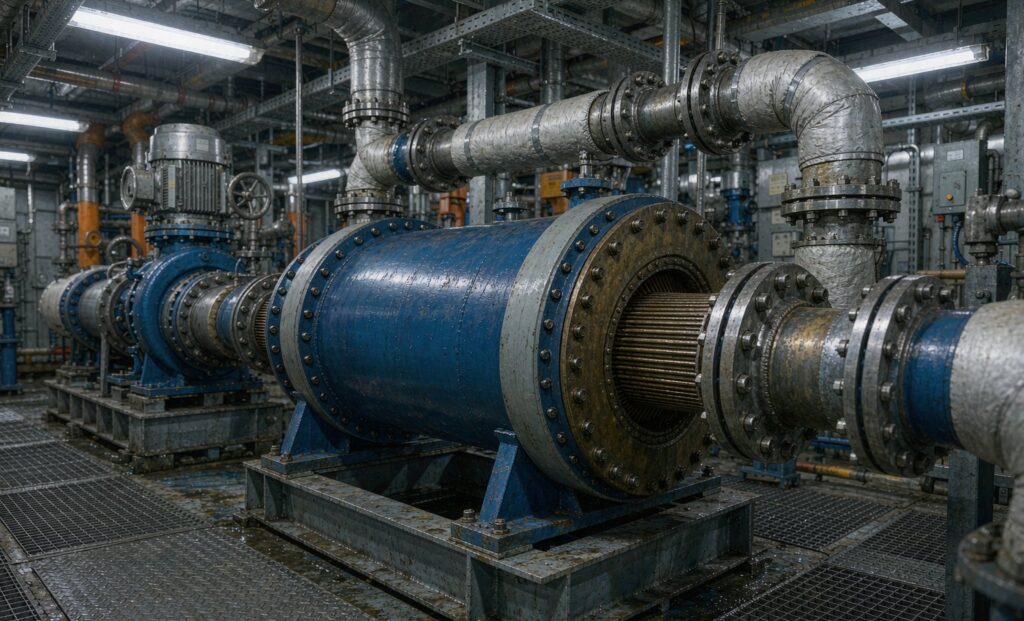
What the Central Cooling Exchanger Actually Has to Survive
A marine central cooling heat exchanger is the single point where every heat load on a ship meets the sea. Engine jacket water, lubricating oil, charge air, air-conditioning condensers and sometimes cargo cooling all reject into one fresh-water circuit, and that circuit rejects into seawater through one or two plate or shell-and-tube units. Everything about the selection follows from that arrangement: the exchanger is sized on a seawater temperature the ship may never see, built from materials that must last the life of the hull, and certified by a class society that will inspect the paperwork before it inspects the tubes.
Most marine cooling problems that reach a supplier are not thermal. They are velocity, material and fouling problems that were locked in at the quotation stage. This guide works through the decisions in the order they actually bind: circuit architecture, seawater quality, exchanger type, sizing numbers, and the documentation a surveyor will ask for.
The Three Circuits and Where the Exchanger Sits
Nearly every commercial vessel built since the 1980s uses a central cooling arrangement rather than direct seawater cooling of each item. The reason is simple: seawater in a jacket-water cooler means seawater in a jacket-water cooler that will eventually leak into the engine.
- High-temperature (HT) circuit: 80–90 °C, engine jackets and cylinder heads, cooled against the low-temperature circuit or directly against seawater on small vessels.
- Low-temperature (LT) circuit: 30–38 °C, charge-air coolers, lube-oil coolers, alternator and gearbox coolers.
- Seawater circuit: taken from a sea chest, screened at 5–8 mm, passed through the central cooler and discharged above the waterline.
The central cooler is normally on the LT circuit, with the HT circuit dumping into the LT circuit through a temperature-regulating valve. That cascade matters for sizing: the central cooler sees the sum of HT and LT loads at once, but at a mixed inlet temperature that is 10–20 K below the HT outlet. If a quotation is built only from the LT load, the unit will be undersized by 20–35% on a ship running hot.
Seawater Quality Decides the Material, and the Material Decides the Cost
Seawater is roughly 19,000 mg/L chloride and 2,700 mg/L sulphate, saturated with oxygen in the top few metres and loaded with biological activity in any coastal or estuarine service. Three families of material are in normal use, and the choice is driven by chloride level, temperature and velocity rather than by preference.
| Material | Where it works | Velocity limit | Watch out for |
|---|---|---|---|
| Aluminium brass (CuZn20Al2) | Box coolers, clean open seawater, traditional tonnage | 2.5–3.0 m/s | Ammonia and sulphide in polluted harbours cause stress corrosion; needs ferrous sulphate dosing on new tube bundles |
| 90/10 cupronickel | General marine duty, slightly polluted water, sand-laden flows | 3.0–3.5 m/s | Higher cost than brass; good resistance to erosion-corrosion |
| 70/30 cupronickel | High-velocity, high-solids, warm tropical seawater | 4.0–4.5 m/s | Cost; not for ammonia-contaminated water |
| Grade 2 titanium | Plate exchangers, severe fouling, low maintenance tolerance | 5.0 m/s (practical) | Initial cost 3–5x brass; no copper ion so biofouling is worse, not better |
| Super duplex 2507 | Piping, headers, brackish and low-chloride service | 3.5 m/s | Not a seawater tube material above 40–45 °C; crevice corrosion risk at gaskets |
| 316L stainless | Fresh-water side only | — | Pits in stagnant seawater above about 30–35 °C. Do not accept it on the seawater side |
Two rules of thumb save most of these arguments. Below 3 m/s in clean seawater, 90/10 cupronickel or titanium will outlast the ship; aluminium brass will too, provided the water is not polluted. Above 3.5 m/s, or where the seawater carries sand, titanium is usually cheaper over twenty years than the cupronickel it replaces, because the tube failure that stops the ship costs more than the metal.
Which Exchanger Type Fits the Machinery Space
The four options below are all in service on merchant ships today, and each one has a niche it wins.
| Type | Strong at | Weak at | Typical use |
|---|---|---|---|
| Gasketed plate (titanium plates) | Small approach (1–2 K), compact, easy to open and clean | Pressure limit 16 bar, gasket life 5–8 years, poor with fibrous debris | LT circuit central cooler on ferries, offshore vessels, cruise ships |
| Semi-welded plate | Seawater side welded, fresh-water side openable; 25–40 bar | Cannot mechanically clean the welded side | Where a gasket leak into the fresh water is unacceptable |
| Shell and tube (fixed or U-tube) | Forgiving of debris, high pressure, mechanical cleaning by brush or drill | Large, heavy, approach 3–5 K, tube-to-tubesheet joints are the failure point | Main engine LT coolers, cargo and piston cooling |
| Box cooler (hull-mounted) | No seawater pump power, thermosiphon circulation, near-zero maintenance | Needs vessel speed or a dedicated head; adds 1–3% propulsive penalty; retrofits are a dry-dock job | Small and medium vessels, tugs, inland shipping, workboats |
For the LT central cooler on a modern vessel, a titanium plate unit is usually the first choice, and the marine shell and tube heat exchanger is the fallback when the water is dirty, the pressure is high, or the crew needs to rod tubes rather than open a plate pack. A titanium tube bundle in a steel shell gives the fouling tolerance of a tubular unit with the corrosion resistance of titanium — the comparison of titanium against cupronickel in marine cooling works through the material trade in detail.
Sizing: The Seven Numbers to Send With an Enquiry
- Design seawater temperature. ISO 21147 and most class rules assume 32 °C for unrestricted service, 36 °C for tropical. Using 25 °C because that is the average on the route is the most common cause of a hot ship in the Persian Gulf.
- Total heat rejection. Sum the HT and LT loads at MCR plus 10% margin. A 10 MW main engine typically rejects 1.4–1.9 MW through the central cooler at full load.
- Circuit temperatures. LT water in and out, HT water in and out, and the flow rates. Without flows, a supplier will assume 1.5 m/s and may be wrong by a factor of two.
- Allowable pressure drop. 0.4–0.8 bar on the fresh-water side, 0.3–0.6 bar on the seawater side. A plate pack that meets the duty at 1.5 bar will cost a bigger seawater pump for the next twenty years.
- Fouling allowance. 0.00009 m²·K/W for clean open-ocean intakes, 0.00017 for coastal and estuarine, 0.00025 for river or harbour service. On a plate unit this is worth 8–15% of surface.
- Design pressure and temperature. 6 bar is typical for the LT circuit; 10 bar if the exchanger sits below the waterline with the sea chest head on it.
- Class and flag requirements. Class rules, IMO MODU code where applicable, and the pressure-vessel directive of the flag state if the unit is over the volume threshold.
Velocity Is the Fouling Control You Actually Have
Marine fouling is a velocity problem before it is a chemistry problem. Below about 1.0 m/s, sediment settles and the first bacterial film forms in days; above 2.5 m/s in a plate unit, erosion of the gasket seat starts to compete with fouling as the dominant failure. The band 1.2–2.2 m/s in the seawater passages is the practical target, and it should be stated in the specification rather than left to the supplier’s default channel geometry.
Biofouling needs a second line of defence. Chlorination at 0.2–0.5 mg/L residual for one to two hours a day holds mussel and barnacle settlement in check; electro-chlorination from the sea chest is the usual marine solution. Copper-nickel tube bundles suppress fouling slightly through copper ion release, which is one reason they remain popular despite titanium’s better corrosion resistance. A titanium bundle is entirely inert and will foul faster unless the chlorination is working.
Class Society Paperwork That Stops a Delivery
The thermal design is the easy part. The documentation package is where projects lose weeks, so build it into the purchase order from the start:
- Material certificates to EN 10204 3.1 for plates, tubes, tube sheets and shell; class society approval marks on the pressure-retaining parts where the rules require it.
- Hydrostatic test at 1.5x design pressure with a surveyor witness, and a test certificate that names the unit serial number.
- Non-destructive examination of welded seams — usually 10–20% radiography on longitudinal and circumferential welds, dye penetrant on tube-to-tubesheet joints.
- Pressure-relief valve sized and set, with the discharge piped to a safe location; a marine cooler without a relief valve will not pass commissioning.
- Shop primer and finish to the owner’s paint specification, with the seawater side of a shell-and-tube unit either unlined or epoxy-lined depending on the shell material.
Where the unit also serves as a pressure vessel in land-based or offshore service, the Chinese D1/D2 registration and ISO 9001 / ISO 14001 management certification are the documents most often requested alongside the class certificate — Zhenggong holds all three, and they are listed on the certification page.
Commissioning and the First Year
Most marine exchanger failures happen in the first twelve months, and almost all of them trace back to one of four causes. Watching for them early is cheaper than a dry-dock repair.
- Air in the seawater circuit. A cooler that runs with an air pocket loses 30–50% of its surface. Vent at the highest point after every sea chest cleaning, not just at commissioning.
- Over-chlorination. Above 1 mg/L residual, chlorination attacks the passive film on 90/10 cupronickel and accelerates erosion-corrosion at tube inlets. Dose to residual, not to timer.
- Gasket creep on plate units. A plate pack that was tightened cold will weep at 60 °C. Re-torque to the supplier’s dimension after the first week and after the first thermal cycle of each season.
- Tube-inlet impingement. Belly-punched tubes at the seawater inlet mean the velocity is too high for the material or the inlet is unshielded. Fit a sacrificial impingement plate rather than slowing the whole circuit.
What to Put in the Enquiry
A quotation that can be compared line for line needs the duty, the four terminal temperatures, both flow rates, the design seawater temperature, the allowable pressure drops on each side, the design pressure, the material for each side, the class society, and the space available. Give those nine items and the offer comes back with a surface area, a velocity and a weight — the three numbers that decide whether the unit fits the engine room and whether it will still be clean in five years.
If the vessel is a newbuild, send the machinery arrangement drawing as well; a plate unit and a shell-and-tube unit of the same duty differ by a factor of three in footprint, and that usually settles the choice before the thermal calculation matters. For a selection review against an existing duty, or a replacement bundle for a unit that has already failed, the engineering team can work from a photograph of the nameplate and the current operating temperatures — start at the contact page and include the class society in the first message.
