
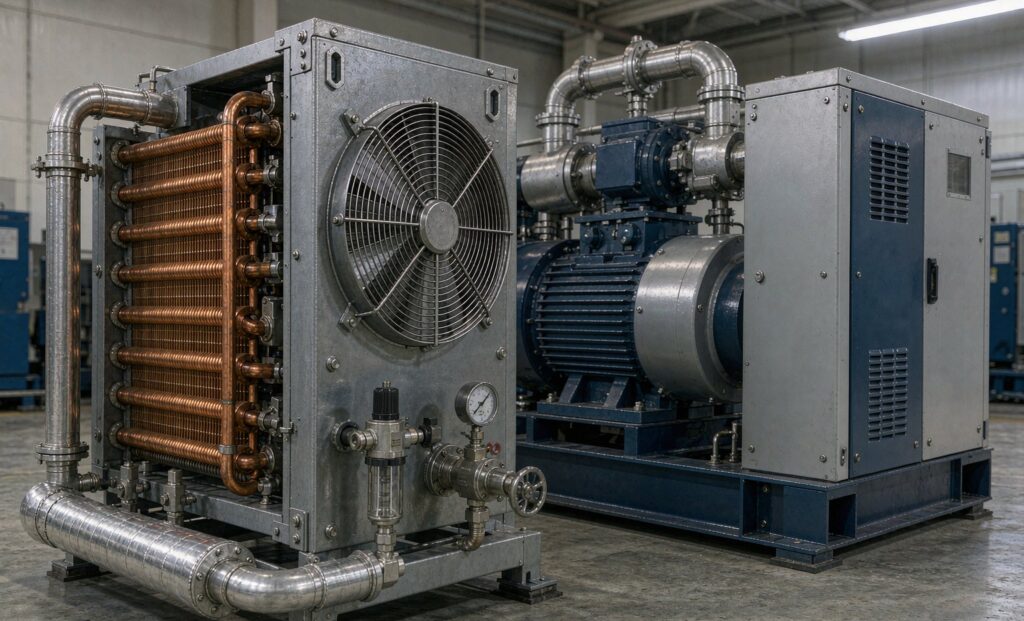
A compressed air aftercooler is the heat exchanger that sits immediately downstream of the compressor element and removes the heat of compression before the air reaches a dryer, a receiver or a production line. Roughly 70–90 % of the electrical energy a screw or piston compressor consumes leaves the machine as heat in the air stream, and almost all of it passes through this one component. Specifying it badly does not just cost energy — it puts liquid water into every tool, valve, actuator and instrument on the site.
This guide covers the duty calculation, the air-cooled versus water-cooled decision, the approach temperature and pressure dew point relationship, and the pressure drop that quietly adds to the compressor’s running cost for the next fifteen years.
Why the Aftercooler Matters More Than Its Price Tag
Compressed air leaves a lubricated screw element at 80–110 °C, saturated with water vapour and carrying oil carry-over as an aerosol. The aftercooler’s job is to bring that stream down to a temperature the downstream equipment can work with — conventionally within 8 °C of the cooling medium, so around 40 °C with 32 °C cooling water, or 40–45 °C with ambient air.
Cooling the air does three things at once:
- Condenses water. Cooler air holds less vapour. Everything removed here is water the dryer does not have to remove later, which directly reduces dryer load and regeneration energy.
- Protects the dryer. A refrigerated dryer downstream of a failed or fouled aftercooler will be over-loaded and will deliver air above its rated pressure dew point.
- Reduces volume and improves compressor efficiency. Cooler air is denser, so the same mass flow moves in less volume through the distribution system.
Conversely, an aftercooler that is under-sized, fouled or bypassed produces the classic symptoms: water in the lines, rust in the headers, sticky valves, failed pneumatic instruments, and product contamination in food, pharmaceutical and electronics plants.
Air-Cooled or Water-Cooled?
| Factor | Air-cooled aftercooler | Water-cooled aftercooler |
|---|---|---|
| Approach achievable | Limited by ambient dry bulb — typically 10–15 °C above ambient air | 8 °C or better above cooling water inlet, or tighter with more surface |
| Outlet air temperature | 40–50 °C in summer, lower in winter | 35–40 °C, stable year-round |
| Footprint | Large — needs fan airflow and clearances | Compact, but needs pipework, valves and a water circuit |
| Consumables and running cost | Fan power; periodic coil cleaning | Pump and cooling water cost; water treatment; fouling management |
| Corrosion risk | Coil fin and tube corrosion in coastal, humid or chemical atmospheres | Tube-side scaling and fouling; shell-side usually clean |
| Freeze risk | Ambient-dependent — needs drainage strategy in cold climates | Needs insulation or a glycol circuit, but not ambient-dependent |
| Best fit | Sites with no water supply or a preference for water-free cooling; moderate ambient temperatures | Hot climates, process plants with cooling water already available, and where a stable low outlet temperature is required |
The decision usually follows the site rather than the thermodynamics. A plant that already runs cooling water will find a water-cooled shell and tube unit cheaper to buy, smaller and more stable. A plant that does not — a remote site, a package plant, a data hall — will pay more for a large air-cooled unit rather than build a water circuit for it. Where water is scarce or expensive, the air-cooled option becomes the default, the same logic that drives air-cooled heat exchangers and dry coolers in other cooling duties.
Sizing the Duty
The thermal duty of an aftercooler is easy to estimate to within the accuracy the selection needs. A well-designed lubricated screw compressor rejects about 70–75 % of its shaft power as heat that must be handled downstream; for oil-free and reciprocating machines the figure is higher, and the intercooler handles part of it in multi-stage designs. In practice, design the aftercooler for 100 % of the compressor’s installed shaft power when the machine is air-cooled and oil-injected, treating that as a conservative allowance, and treat 80 % of shaft power as the realistic continuous figure for a water-cooled, thermostatically controlled machine.
The air-side energy balance is the other half of the calculation:
- Duty (kW) = air mass flow (kg/s) × specific heat (≈1.005 kJ/kg·K) × (inlet temperature − outlet temperature).
- Free air delivery in m³/min converts to mass flow using the air density at the compressor’s rated condition — about 1.2 kg/m³ at 20 °C and sea level.
- A 55 kW compressor delivering roughly 9 m³/min has a mass flow near 0.18 kg/s. Cooling that air from 95 °C to 40 °C requires about 0.18 × 1.005 × 55 ≈ 10 kW of heat removal, plus the heat of condensation of the water that drops out.
- Cross-check the answer against the electrical input. The air-side calculation should land within about 10 % of the 70–90 % shaft-power figure. If it does not, one of the two inputs is wrong.
Do the calculation at the worst-case cooling medium temperature, not at a design average. An air-cooled unit selected at 25 °C ambient and required to perform on a 38 °C afternoon will miss its outlet temperature for exactly the weeks when the plant is least willing to tolerate it.
Approach Temperature and Pressure Dew Point
The aftercooler outlet air temperature sets the moisture content of the air that the dryer receives. Air leaving an aftercooler at 45 °C is saturated at 45 °C, which corresponds to roughly 65 g/m³ of water vapour at atmospheric pressure — far more than most processes tolerate. The dryer’s job is to reduce the pressure dew point; the aftercooler’s job is to make that job affordable.
- Decide the required pressure dew point first. General plant air is normally −20 °C or −40 °C PDP; instrument air to ISO 8573 classes may be tighter; breathing air is tighter still.
- Then set the aftercooler outlet temperature. As a rule of thumb, a refrigerated dryer with an outlet of 40 °C and a dew point of 3 °C is thermally sensible; pushing the aftercooler colder than the dryer can hold is wasted surface area.
- Do not over-cool. An aftercooler delivering 30 °C air when the dryer is rated at 3 °C PDP buys nothing and adds pressure drop.
- Do not under-cool. Every degree of aftercooler outlet temperature above design loads the dryer and raises the delivered dew point.
Pressure Drop: The Cost You Pay Every Hour
An aftercooler adds resistance to the compressed air path, and compressed air is the most expensive utility on most sites. Pressure drop across the unit is not a one-off — it is repaid continuously for as long as the compressor runs.
A useful rule: on a typical 7 bar system, every 1 bar of pressure lost across the unit costs roughly 7 % of the compressor’s power — work that was paid for at the compressor and then thrown away before the air reached the tool. In practice a well-designed aftercooler should be specified at 0.3 bar or less on the air side at rated flow, and the datasheet should state the flowing condition rather than the clean value.
Two things destroy that figure in service. Fouling on the cooling side reduces heat transfer and can force the air to be pushed through at a higher flow for the same duty. Oil carry-over from the compressor element migrates onto the air-side surfaces where the air is coolest and progressively narrows the passages. Both are visible as a rising differential pressure across the unit, which is why a differential pressure gauge — or at least a pair of test points — belongs in the specification.
Materials, Condensate and Corrosion
The air side of an aftercooler is wet, and often slightly acidic because the condensed water absorbs atmospheric CO₂ and any sulphur compounds from the local environment. Material decisions follow from that:
- Tubes and plate surfaces on the air side are normally copper alloy or stainless. Stainless is the safer choice in coastal, chemical or food-grade environments.
- Shell and water side may be carbon steel with proper water treatment, but the air side must not be.
- Condensate drainage must be positive, with the trap at the lowest point of the separator, sized to handle the peak condensing rate — not the average. Traps that cannot keep up do not fail visibly; they simply pass water downstream.
- Separator efficiency matters as much as exchanger surface. A high-efficiency separator with modest total pressure drop is often a better investment than extra heat transfer area.
In coastal and offshore installations, external corrosion of an air-cooled unit is the failure mode that ends its life, not internal fouling. Coil coating, alloy fins or a fully stainless construction are worth the premium where salt-laden air is being drawn across the unit.
Recovering the Heat You Are Already Paying For
An aftercooler is a waste heat source with an unusually good set of properties: it is located at one fixed point, it runs whenever the compressor runs, and its output is 40–90 °C — useful for space heating, pre-heat of boiler feedwater, wash water, or make-up air. Capturing it does not require a new heat source, only a heat exchanger arranged so the compressor is never dependent on the heat recovery circuit for its own cooling.
The control principle is straightforward: the recovery circuit must be able to be bypassed or dumped, and the compressor’s own temperature control must take priority. Where that is respected, recovered compressor heat typically displaces the most expensive fuel on site. The financial method for evaluating the project is the same one used for other plant heat recovery and is set out in our guide to waste heat recovery ROI.
Specification and Installation Checklist
- Compressor shaft power, free air delivery, and motor control method (load/unload, variable speed).
- Design ambient or cooling water temperature at worst case, plus the summer extreme.
- Required air outlet temperature and the target pressure dew point downstream.
- Air-side flow and maximum allowable pressure drop, stated at flowing condition.
- Cooling medium: air, tower water, chilled water or closed glycol loop, with its temperature programme.
- Materials for both wetted sides, and external finish or coating for the local atmosphere.
- Condensate volume, separator type, trap type and drain routing.
- Design pressure, design temperature and the applicable pressure equipment directive or certification requirement.
- Inspection points: air-side differential pressure, water-side temperatures, access for coil or tube cleaning.
- Heat recovery provision, if any, with its bypass and dump arrangement.
Sourcing an Aftercooler
An aftercooler is a small, unglamorous purchase that is usually made on price — and then re-made three years later. Quoting it against a real duty, with the summer ambient stated and the pressure drop guaranteed at flow, is what separates a unit that lasts its whole service interval from one that quietly passes water downstream.
Zhenggong Cooling and Heating Equipment manufactures air-cooled and shell and tube heat exchangers at its 35,000 m² facility in Shandong, China, for compressor, industrial cooling, HVAC and process duties, and exports to customers worldwide. Pressure-retaining parts are built under D1/D2 pressure vessel certification with ISO 9001 and ISO 14001 management systems, and material and test documentation is issued with the equipment; the certificates are listed on the certification page. The full manufacturing scope, including both exchanger families, is set out on the product range page, and the sector breakdown is on the industry applications index.
Next Step
Send the compressor shaft power and free air delivery, the worst-case cooling medium temperature, the required outlet air temperature or downstream dew point, the allowable air-side pressure drop and the site atmosphere. That is enough to select an air-cooled or water-cooled unit and to quote it properly rather than by catalogue size. Send your compressor data to Zhenggong for a quotation and ask for the guaranteed pressure drop and the material certificates to be included with the offer.