
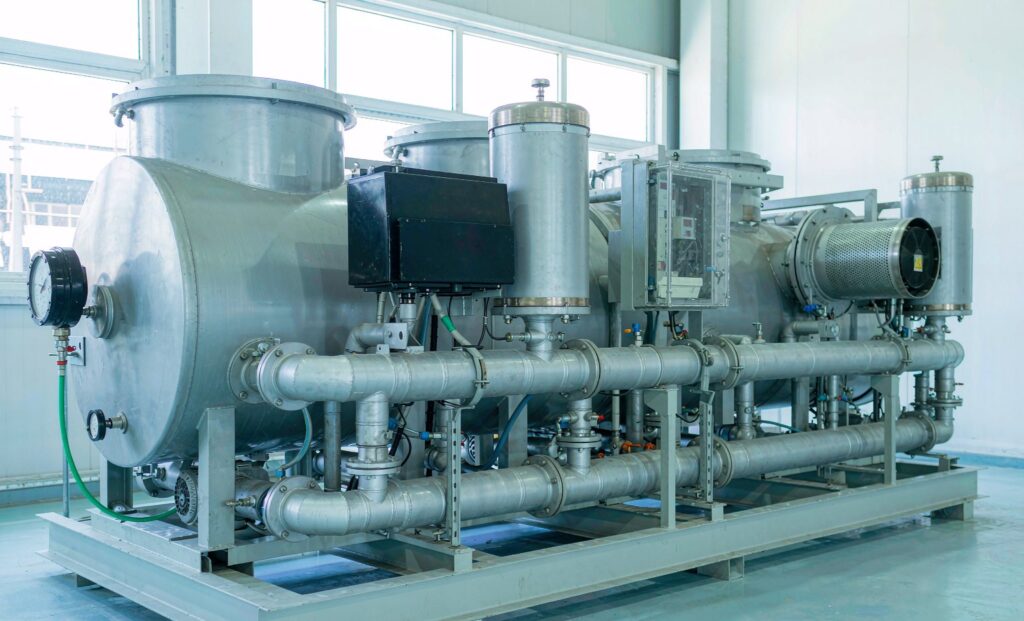
Why 90 °C Steam Is the Hard Part of Industrial Heat Pumps
Most industrial heat pump discussions stop at hot water. A plant that needs 60 °C for washing or space heating can be served by equipment that has been commercially mature for two decades. The moment the requirement climbs to 90 °C steam or a 95 °C hot water loop feeding a process, the engineering gets genuinely difficult — compressor discharge temperature limits, refrigerant selection, evaporator approach, and the pressure vessel classification of every component in the circuit all start to bind at once.
This guide is written for plant engineers and procurement teams specifying a high temperature industrial heat pump for steam generation. It covers the temperature lift that is realistically achievable, the refrigerant families that make it possible, how to size the unit against a real steam load rather than a nameplate boiler rating, and how to model whether the project pays back before you commit capital.
What “High Temperature” Actually Means in a Heat Pump
The industry uses “high temperature” loosely. For specification purposes, three bands matter:
- Low grade (up to 55 °C): domestic hot water, space heating, low-temperature drying. R134a and R513A dominate; COP of 4.0–5.5 is routine.
- Medium grade (55–80 °C): process washing, pasteurisation preheat, district heating. R245fa, R1234ze(Z) and R515B appear; COP of 2.8–4.0.
- High grade (80–120 °C): steam generation, sterilisation, chemical reactor jacket heating, CIP circuits. Cascaded circuits or high-pressure transcritical designs; COP of 2.0–3.2, falling sharply as the sink temperature rises.
The single most important number in a high-temperature heat pump specification is not the output temperature. It is the temperature lift — the difference between the heat source and the heat sink. A unit producing 95 °C from a 70 °C waste water stream is doing 25 K of lift and will perform very differently from the same unit producing 95 °C from 20 °C groundwater, which is 75 K of lift. Vendors who quote a COP without stating both temperatures are not giving you enough information to compare offers.
Three Architectures That Reach 90 °C and Above
1. Single-stage with a high-pressure screw or scroll compressor
The simplest arrangement. One refrigerant circuit, one compressor, discharge temperature managed by liquid injection or an economiser port. Practical upper limit is around 95 °C condensing with R245fa or R1233zd(E). Above that, the compressor discharge and the lubricant both start to see temperatures that shorten service life. This is the cheapest architecture and the right answer when the lift is modest and the sink is below 95 °C.
2. Cascaded two-stage circuits
One circuit runs at a low temperature, another at a high temperature, and a shared intermediate heat exchanger couples them. The low-stage circuit lifts heat from the source to an intermediate level; the high-stage circuit lifts it from intermediate to the process temperature. Cascading lets each circuit use a refrigerant matched to its own temperature band, which is why this is the standard architecture for 100–120 °C output. The cost is a second compressor, a second refrigerant charge, and an intermediate exchanger — all of which are pressure vessels requiring their own certification.
3. Mechanical vapour recompression (MVR) hybrids
Where a plant already generates flash steam or has a low-pressure steam header, an MVR unit compresses that steam directly rather than using a refrigerant cycle. MVR is not a heat pump in the conventional sense but delivers the same outcome — upgraded steam — often at lower specific power cost. It only makes sense where a continuous low-pressure steam source exists.
Refrigerant Choice Is Now a Regulatory Decision, Not Just a Thermal One
Refrigerant selection for a high-temperature heat pump is constrained by three things at once: the critical temperature (you cannot condense above it), the F-Gas trajectory of your target market, and the compressor’s discharge limit.
| Refrigerant | Critical temp (°C) | Practical sink limit | GWP | Notes |
|---|---|---|---|---|
| R134a | 101 | ~75 °C | 1430 | Being phased down; fine for medium grade only |
| R245fa | 154 | ~120 °C | 1030 | Workhorse for cascaded high-stage; high GWP |
| R1233zd(E) | 166 | ~120 °C | 1 | Low-GWP replacement for R245fa; higher cost, larger volume |
| R1336mzz(Z) | 171 | ~130 °C | 2 | Very high critical temperature; growing adoption in EU projects |
| R718 (water) | 374 | >150 °C | 0 | Water-vapour centrifugal; niche, high capex |
For a plant exporting to the EU, an R245fa high-stage circuit purchased today carries a real regulatory risk over a 15-year asset life. R1233zd(E) and R1336mzz(Z) cost more per kilogram and need larger volumetric flow, but they remove that risk. For projects in markets without an F-Gas phase-down, R245fa remains the pragmatic economic choice.
Sizing Against a Real Steam Load, Not a Boiler Nameplate
The most common sizing error is to take the existing steam boiler’s rated output and specify a heat pump to match it. That number is almost always a peak, worst-case figure that the boiler meets for a small fraction of the year — and it includes standby capacity, distribution losses, and the thermal inertia of a system that was never instrumented.
Size against a measured load profile instead. The workflow:
- Log actual steam consumption for at least two weeks, at a resolution fine enough to capture shift changes. If you have a steam meter, use it. If you do not, log the boiler’s fuel input and back-calculate.
- Separate process heat from space heating. Space heating is seasonal and often has a different temperature requirement; mixing the two inflates the apparent duty.
- Identify the sustained baseload. The heat pump should be sized to cover the load that exists for the majority of operating hours — typically 60–80% of peak.
- Keep the existing boiler for peaks. A hybrid arrangement where the heat pump carries baseload and the boiler trims peaks almost always beats a heat pump sized for the absolute maximum. It reduces capex substantially and the boiler becomes the redundancy you need anyway.
- Check the source-side availability at the same time. A 500 kW heat pump needs a continuous source of waste heat. If the waste heat dries up when the process line stops, the heat pump has nothing to lift.
The Source Side: Where the Heat Actually Comes From
A high-temperature heat pump is a heat mover, not a heat maker. The source must be available whenever the sink is needed. Common sources and their practical constraints:
- Cooling tower return water (25–35 °C): abundant and continuous, but low grade, so lift is high. Best paired with a cascaded architecture.
- Compressor jacket water (75–90 °C): high grade and therefore cheap to lift, but volume is limited by compressor size.
- Process effluent (40–70 °C): the best source where available. Requires filtration and a fouling allowance on the evaporator.
- Air compressor aftercooler discharge: steady and clean; a useful source in plants with large compressed-air demand.
- Condensate return (80–95 °C): excellent grade, often overlooked. Every kilogram of condensate returned is heat you do not have to buy.
Where the source is dirty — effluent carrying fibres, solids or scale-forming salts — the evaporator becomes the fouling-critical component. Wide-gap or shell-and-tube evaporators with removable bundles are the safer choice over brazed plate units, even at a thermal performance penalty. The reasoning is the same as for any stainless shell and tube heat exchanger handling a fouling stream: access for cleaning beats a compact core you cannot open.
Modelling Payback Before You Commit Capital
The economic case for a high-temperature heat pump turns on four numbers: annual heat delivered, the cost of the energy it displaces, the electricity price, and the achieved COP. Everything else is secondary.
| Parameter | Typical range | Why it matters |
|---|---|---|
| Annual heat delivered | 1.5–8 GWh | The larger the baseload, the faster the payback |
| Displaced fuel cost | €30–70/MWh (gas) | High fossil prices shorten payback dramatically |
| Electricity price | €80–200/MWh | The dominant sensitivity; a 20% swing changes payback by a year or more |
| Seasonal COP | 2.0–3.2 for 90 °C+ | Use a seasonal figure, not the best-case design-point COP |
| Operating hours | 4,000–8,000 h/yr | A unit running 8,000 hours pays back roughly twice as fast as one at 4,000 |
A worked example for a food plant needing 90 °C process water for cleaning and sterilisation:
- Baseload: 600 kW thermal, 6,000 operating hours per year → 3.6 GWh/yr
- Seasonal COP: 2.6 → electricity input 1,385 MWh/yr
- Electricity at €120/MWh → €166,000/yr running cost
- Displaced gas boiler at 92% efficiency, gas at €45/MWh → €176,000/yr fuel, plus ~€12,000/yr in boiler maintenance and emissions charges
- Net annual saving: ~€22,000
- Capex for a 600 kW cascaded unit with integration: €450,000–650,000
On those numbers the payback is long — beyond 20 years — and the project does not stack up. Raise the gas price to €70/MWh and lower electricity to €90/MWh, and the same system saves roughly €190,000 per year, giving a payback near three years. This is why heat pump feasibility work must be done with the plant’s own tariff structure, not with generic assumptions. Grants and tax incentives in the EU, UK and parts of Asia frequently move a marginal project into a fundable one.
For a fuller treatment of the ROI mechanics, including how to treat carbon pricing and maintenance, see our guide to the industrial heat pump payback period, and for a straight comparison against the incumbent technology, the heat pump vs gas boiler efficiency and total cost breakdown.
Pressure Vessel Certification: Do Not Skip This
A high-temperature heat pump contains multiple pressurised components: the condenser, the evaporator, the intermediate exchanger in a cascaded design, and the receiver. Depending on the jurisdiction and the refrigerant charge, some or all of these fall under pressure equipment directives.
For buyers in China, the relevant classification is the D1/D2 category of special pressure equipment. Zhenggong holds D1/D2 pressure vessel certification together with ISO 9001 and ISO 14001 — meaning the exchangers supplied for the circuit are manufactured and documented against that regime, not assembled from uncertified components. Buyers should verify what the certification actually covers rather than accepting a claim at face value; the useful questions are which directive, which notified body or authority, and whether the paperwork names the specific vessel design or only the company.
The same discipline applies to the heat exchanger specification itself, and our earlier article on D1/D2 certification for heat exchanger buyers sets out the documents to request.
Integration Pitfalls That Show Up After Commissioning
- Condensate contamination. Where the heat pump feeds an existing steam header, any carryover of boiler treatment chemicals into the circuit can attack the high-stage exchanger. Specify the water chemistry limits in the purchase order.
- Turndown mismatch. Process steam demand varies by shift. A heat pump sized for average load may modulate poorly at 30% capacity. Confirm the minimum stable capacity with the manufacturer.
- Standby heat source. If the heat pump is the only heat source and the waste heat stream stops, the process stops. Retain a boiler or an immersion element as backup, and interlock the changeover.
- Electrical supply. A 600 kW heat pump draws roughly 230 kW electrical at COP 2.6. Confirm the incoming supply and transformer capacity before ordering.
- Fouling on the evaporator. The source stream is usually dirtier than the sink stream. Budget for a cleaning cycle and design for access.
Specification Checklist for a 90 °C+ Industrial Heat Pump
- Source fluid, flow rate, and temperature at worst-case (winter) conditions
- Sink fluid, required flow, required supply and return temperatures
- Sustained baseload duty in kW, and the required operating hours per year
- Temperature lift at design conditions, and the achievable seasonal COP
- Refrigerant, and its regulatory status in every market the plant ships to or operates in
- Architecture: single stage, cascaded, or MVR hybrid
- Compressor type, minimum turndown, and control strategy
- Evaporator construction and the fouling allowance applied
- Pressure vessel category for each pressurised component, with documentation
- Materials of construction for wetted parts, including chloride content of both streams
- Electrical supply available and the unit’s design power input
- Integration points: existing boiler, steam header, condensate return, controls interface
- Guaranteed performance figures — and the penalty if they are not met
A high-temperature heat pump is a capital project with a 15–20 year asset life, and the decisions made at specification stage determine whether it delivers the savings promised. Getting the lift, the refrigerant, the load profile and the certification right at the front end is worth more than any optimisation later.
Zhenggong Cooling and Heating Equipment designs and manufactures custom heat exchangers and heat pump equipment from a 35,000 m² facility in Shandong, China, exporting worldwide with D1/D2 pressure vessel certification and ISO 9001 plus ISO 14001 quality and environmental systems. For a duty-specific proposal covering your source, sink and load profile, send the operating conditions to the engineering team — the more of the checklist above you can supply, the more precise the selection will be.