
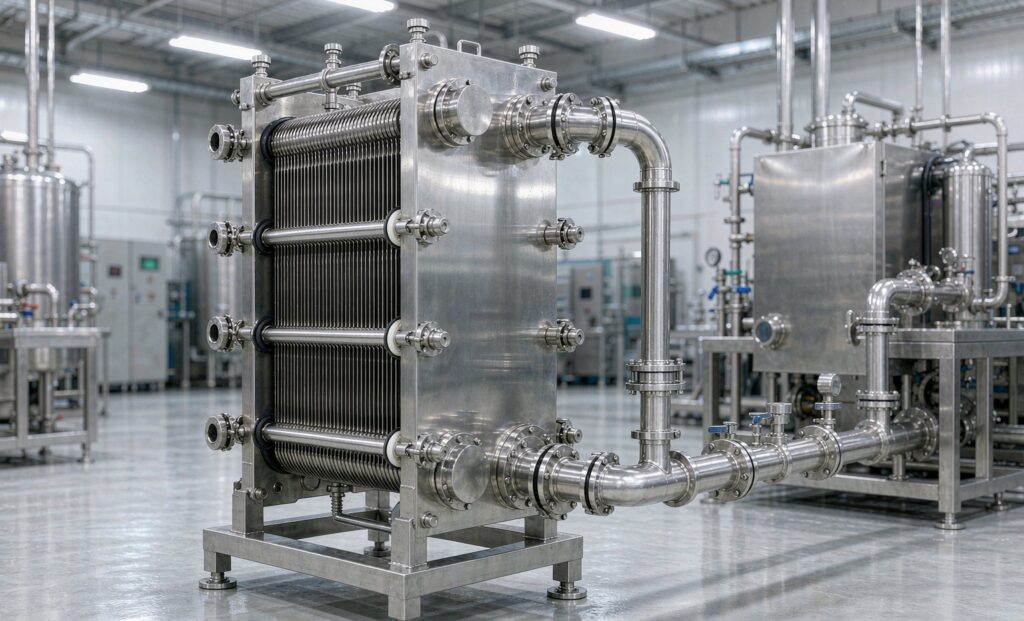
A sanitary plate heat exchanger is built so that every surface touching the product can be cleaned, inspected and validated — not merely washed. In dairy, beverage and prepared-food plants the unit is usually the heart of the pasteurisation line, and it does two jobs at once: it holds a precise temperature profile for a defined time, and it recovers most of the thermal energy the process would otherwise throw away.
Specifying one correctly is a different exercise from buying an industrial plate exchanger. Hygiene standards, cleanability, gasket material and residence time all constrain the selection before thermal performance is even discussed. This guide covers the decisions an engineer should make in that order.
What Makes a Sanitary Plate Heat Exchanger Different
A standard gasketed plate unit transfers heat efficiently. A sanitary one does the same while meeting food-contact rules:
- Product-contact surfaces in 316L stainless with a controlled surface finish, so soil cannot hide in the roughness.
- Gaskets made from food-grade elastomers, seated so that no crevice, dead zone or adhesive joint traps product.
- Flow paths designed with uniform distribution and no low-velocity pockets, so nothing is left behind when the run ends.
- Drainability — the unit can be emptied and the plate pack opened for inspection without dismantling the piping.
- Documentation covering material certificates and elastomer compliance for the relevant food-contact standard.
Those requirements rule out a brazed or fully welded plate pack where the product side must be opened and inspected. For most dairy and beverage lines the practical answer is a gasketed plate-and-frame unit with clip-on gaskets and a hygienic port arrangement.
Hygiene Standards and What They Demand in Practice
Which standard applies depends on the market and the customer, but the engineering consequences are similar:
- 3-A Sanitary Standards (North America) — construction and cleanability requirements, product-contact finishes, no threads in product zones, drainable design.
- EHEDG (Europe) — hygienic design guidance for open and closed equipment, with an emphasis on avoiding dead areas and ensuring CIP reaches all surfaces.
- FDA-compliant elastomers — the gasket material must be listed for food contact, which typically means EPDM, NBR or FKM grades specified for the application rather than general industrial equivalents.
The practical test is whether the CIP circuit can wet every product-wetted surface at a velocity high enough to remove soil. A unit that merely looks polished but has a stagnant corner will fail an audit sooner or later, whatever certificate hangs next to it.
Dairy Pasteurisation: How the Sections Work
A high-temperature short-time (HTST) pasteuriser is normally one frame containing several sections in series, each with its own duty but sharing the same plate pack. Typical figures for milk are shown below.
| Section | Function | Typical duty or condition |
|---|---|---|
| Pre-heating / regeneration | Cold raw product absorbs heat from hot pasteurised product | Brings raw milk from about 4 °C toward 60–65 °C |
| Heating | Hot water raises the product to pasteurisation temperature | 72 °C for at least 15 s (HTST) |
| Holding | Holding tube or holding section maintains the time–temperature pair | Residence time set by the legal standard, not by heat transfer |
| Cooling / regeneration | Cold raw product and chilled water cool the pasteurised stream | Down to about 4 °C for filling |
Because the regeneration section recovers heat from the outgoing product, energy consumption falls sharply as regeneration efficiency rises. Regenerative configurations in dairy service routinely recover well over 80% of the heat, and that single design choice often decides the operating cost of the whole line.
Where the Heat Goes, and Why Regeneration Pays
Two numbers matter commercially. The first is the regeneration ratio — the share of the heating duty supplied by the outgoing product rather than by hot water or steam. The second is the temperature difference the heating section must still lift. Increasing regeneration reduces both the live steam demand and the cooling load on the chilled-water side, so the benefit appears twice.
The limit on how far regeneration can be pushed is the approach temperature inside the regeneration section, together with the required thermal stability of the product. Tightening the approach always costs surface area, and in dairy service it also raises the risk of fouling at the point where raw milk is warmest.
Materials and Gaskets for Product Contact
| Consideration | Common specification | Why |
|---|---|---|
| Plate material | 316L stainless, 0.5–0.7 mm | Corrosion resistance against acidic and alkaline CIP chemicals, plus smooth hygienic surface |
| Alternative plate material | Titanium | Highly acidic products, high-chloride water, or aggressive sanitation regimes |
| Gasket material | EPDM, food grade | Standard for water, milk and most beverages across the usual temperature range |
| Gasket, high temperature or fats | FKM / Viton | Where CIP temperatures or product fats exceed EPDM service limits |
| Gasket attachment | Clip-on, adhesive-free | Removable without residue; enables cleaning behind the gasket |
| Frame and connections | Stainless-clad frame; sanitary unions or DIN/ANSI flanges | Hygienic external finish and matching plant pipework standards |
Gasket selection is a common failure point, and the symptoms are distinctive — swelling, hardening or extrusion of the elastomer, followed by leakage at the plate edge. Our diagnostic guide to plate heat exchanger gasket failure sets out how to tell a chemistry problem from a mechanical one.
Designing for Clean-in-Place
CIP compatibility is easier to design in than to retrofit. A pre-purchase checklist:
- Product channels drain freely; there is no horizontal surface where liquid can pool.
- Every product-wetted surface is reached at a measurable velocity during the CIP cycle.
- Gaskets are clipped rather than glued, so the plate edge can be cleaned.
- Ports and piping are arranged for full drainage, with the CIP return at the lowest point.
- Cleaning chemical compatibility is confirmed for both plate and gasket material.
- Inspection access allows the plate pack to be opened and checked at the defined interval.
- Temperature and flow during CIP are recorded as part of the run data.
Pressure Drop, Residence Time and Product Quality
Sanitary duties add two constraints that have nothing to do with heat transfer. The first is residence time: in pasteurisation the holding section must guarantee a minimum time at temperature, which is set by regulation and verified by a flow-diversion valve, not by the exchanger’s thermal design. The second is product sensitivity — shear-sensitive products, viscous sauces and particulate-bearing fluids may need wider channels and gentler flow than a thermally ideal selection would use.
Pressure drop must also be checked on both sides, because a high drop on the product side can defeat the requirement to keep the loop above the pasteurisation pressure so that any leak flows from product into service medium rather than the reverse. That pressure relationship is the reason a plate pack with an internal leak can be detected without contaminating the product.
Common Selection Mistakes
Buying on duty alone. A unit that meets the kW figure with a channel geometry unsuitable for the product will foul, damage the product or fail CIP verification.
Choosing gaskets by price. The cheapest elastomer that fits is rarely the one that matches the CIP regime, and premature gasket failure stops the line.
Designing regeneration without checking the fouling window. Pushing regeneration harder moves the raw product to a higher temperature inside the exchanger, exactly where milk protein deposits form fastest.
Ignoring the frame envelope. Sanitary packs need space to open for inspection. Units that fit the room but not the service clearance are a maintenance problem from day one.
Sourcing a Hygienic Unit
Dairy and food lines reward a supplier who will quote against a real process duty rather than a catalogue range. Zhenggong Cooling and Heating Equipment manufactures gasketed plate heat exchangers with food-contact 316L plates and food-grade clip-on gaskets from its Shandong facility, and supports hygienic duties across dairy, beverage, edible oil and prepared-food processing — the industry applications page sets out the sectors served. Pressure-retaining parts are produced under D1/D2 pressure vessel certification with ISO 9001 and ISO 14001 quality and environmental management, and material documentation is supplied for audit purposes; the certificates are listed on the certification page.
For product-contact plate units, the plate heat exchanger product range shows the configurations available, including frames sized for multi-section pasteurisation duties.
Next Step
Provide the product and service fluids, flow rates, inlet and outlet temperatures, viscosity and solids content, the required regeneration duty, the CIP programme and the applicable hygiene standard, and a hygienic selection can be produced in one pass. Send your process data to Zhenggong for a quotation and ask for the material certificates and elastomer compliance documents to be included with the offer.