
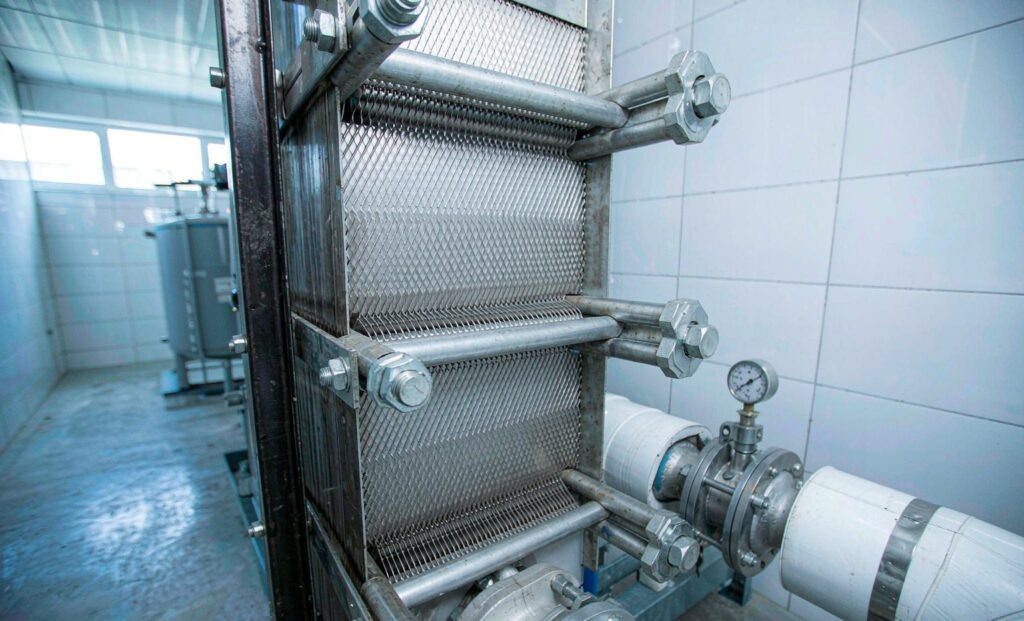
A chilled water plate heat exchanger moves cooling between two liquid circuits across a thin corrugated stainless wall, keeping the fluids permanently separate. In modern HVAC plants it has largely replaced shell and tube equipment for this duty, because a gasketed plate unit can hold a 1 °C approach temperature in a fraction of the floor area. That same tight approach, however, is where most weak selections are made — and the consequences show up as an oversized chiller, a starved pump, or a plate pack that fouls within a season.
This guide sets out the numbers to fix before a unit is quoted, the checks that expose an optimistic datasheet, and the material decisions that determine whether the exchanger still performs five years from now.
What a Chilled Water Plate Heat Exchanger Actually Does
The exchanger is a hydraulic separator as much as a heat transfer device. It lets the plant side — chiller evaporator, district cooling network, cooling tower, dry cooler, or free-cooling source — run at its own pressure, flow rate and water quality, while the building side serves fan coils, air handling units and chilled beams. Where the two circuits are owned or maintained by different parties, that separation is contractual as well as technical.
Three jobs are done across the plate pack:
- Cooling transfer from the colder source circuit into the warmer building return water.
- Hydraulic separation, so pump head on one side does not disturb flow on the other.
- Contamination isolation, keeping old pipework, glycol and untreated tower water away from clean equipment.
Where the Unit Sits in an HVAC Plant
Chiller isolation
The building loop and the chiller evaporator are separated so each can carry its own water treatment regime. The heat exchanger must absorb the entire cooling duty at the worst-case condition, including the fouling allowance the chiller manufacturer assumed.
District cooling connection
A district cooling utility delivers chilled water under a contract that specifies supply and return temperatures, maximum flow and pressure limits. The interface exchanger is where those terms are actually met, so the design pressure and the metering requirements of the utility usually govern the selection rather than the duty alone.
Free cooling and economiser mode
When outdoor wet-bulb temperature falls far enough, a cooling tower or dry cooler can supply water cold enough to meet part of the load directly. A plate heat exchanger transfers that free cooling into the building loop and is bypassed when conditions are not favourable. This is one of the highest-value uses of a plate unit, because every hour in free cooling is an hour of compressor energy avoided.
Heat pump and thermal storage loops
Heat pump condenser and evaporator circuits, plus chilled water and ice storage tanks, are all served through plate exchangers. In storage duties the unit must be selected at both the charge and discharge condition, which are rarely the same point.
Retrofit protection
On plant-room retrofits, a new chiller is often tied into twenty-year-old pipework. A sacrificial plate exchanger protects the new machine from the debris and water chemistry generated by the old system.
The Numbers You Need Before Anyone Quotes a Unit
A supplier cannot select a reliable unit from cooling capacity alone. Assemble this data set first — omitting any item changes the plate count, the connection size, the pressure drop and the price:
- Cooling duty in kW, with the design and part-load cases.
- Inlet and outlet temperature on both sides, for each case.
- Flow rate on each side, or the flow that the existing pumps can deliver.
- Fluid type, including glycol concentration where freeze protection is used.
- Maximum allowable pressure drop on each side.
- Design pressure and design temperature.
- Fouling factor and the expected water quality.
- Plate, gasket and connection materials, plus any water-treatment chemistry.
- Installation limits: frame length, connection orientation and service clearance for opening the pack.
For water, a quick sanity check on flow is flow (m³/h) = duty (kW) / (1.163 × ΔT). A 1,500 kW duty with a 7 °C rise needs roughly 184 m³/h. If a datasheet implies a very different flow for the temperatures stated, one of the two numbers is wrong.
Approach Temperature Is Where Selections Are Won or Lost
The approach temperature is the closest difference between the two streams anywhere in the unit. It sets how much surface area is required, so a tight approach is expensive and sensitive to fouling, while a generous one is forgiving and cheap.
| Temperature program | Closest difference | What it means for selection |
|---|---|---|
| Primary 14 → 7 °C / Secondary 6 → 13 °C | 1 °C at both ends | Very tight duty. Needs maximum surface, clean water, realistic fouling factors and a verified pressure drop. |
| Primary 14 → 7 °C / Secondary 5 → 13 °C | 1 °C and 2 °C | Tight but workable. Confirm which end drives the area requirement. |
| Primary 14 → 8 °C / Secondary 6 → 12 °C | 2 °C at both ends | Comfortable. Still confirm pressure drop, control margin and fouling allowance. |
A 1 °C approach is achievable in stainless plates with a clean, closed loop — it is not achievable with raw tower water and no filtration. If a quotation claims a tight approach with surprisingly few plates, ask to see the full thermal selection rather than the summary offer sheet.
Pressure Drop and Pump Energy
Higher plate corrugation produces more turbulence and better heat transfer, and it also raises pressure drop. Since pump power rises roughly with flow cubed, a unit that meets the duty but doubles the loop pressure drop can cost more in electricity over its life than it saves in capital. State the allowable pressure drop on both sides before selection, and check the chosen plate pattern against it. A thermally adequate unit that pushes the pumps outside their available head is not a good HVAC selection.
Materials, Gaskets and Water Quality
| Circuit condition | Plate material | Gasket |
|---|---|---|
| Treated closed-loop water | 304 or 316L stainless | EPDM |
| Cooling tower water, chlorides present | 316L stainless, titanium where chlorides are high | EPDM |
| Seawater or brackish source, free cooling | Titanium | EPDM or FKM |
| Glycol loops and higher temperatures | 316L stainless | FKM where temperatures exceed EPDM limits |
Gasket choice follows temperature and chemistry, not habit. EPDM covers most water duties but has a ceiling; above it, or with oils and some glycol blends, FKM earns its price. On critical systems where a cross-contamination risk is unacceptable, specify a double-wall plate or a leak-detection groove so that a failure announces itself externally rather than mixing the circuits.
A Pre-Quotation Checklist
- Both circuits defined: fluid, temperatures, flows, design pressure.
- Worst-case and part-load duty stated, not just the design point.
- Approach temperature confirmed against the real client duty, not a marketing figure.
- Fouling factor agreed and written into the selection.
- Allowable pressure drop given per side, and checked against available pump head.
- Heat balance verified: both sides must agree within a small tolerance.
- Service clearance available to open the frame and replace gaskets.
- Insulation and drainage planned, including a drip tray where condensing can occur.
Three Mistakes That Recur in HVAC Projects
Selecting on duty alone. Two 800 kW duties can need plate packs of very different size once the approach and pressure drop are applied. Capacity is the least informative number in the enquiry.
Ignoring the eventual fouling condition. A unit that meets the duty on day one and fails by the second summer has been selected at an optimistic cleanliness factor. Design for the water the loop will actually carry.
Forgetting the hydraulic picture. Adding a plate exchanger into an existing loop changes the system curve. If the primary pumps are not re-checked, the result is reduced flow, a wider temperature difference than design and a chiller that trips on low evaporator temperature.
Engineering the Unit Rather Than Buying From a Catalogue
A chilled water plate heat exchanger is only as good as the duty it was selected against. Zhenggong Cooling and Heating Equipment builds gasketed and brazed plate units for HVAC, district cooling and industrial cooling duties from its 35,000 m² facility in Shandong, China, and issues the thermal selection behind every quotation rather than a rounded catalogue figure. The company holds D1/D2 pressure vessel certification and operates to ISO 9001 and ISO 14001, so design pressure and traceability are documented for project approval — see the certification and quality page for the certificates themselves.
If the exchanger is one part of a larger plant package, it helps to see how the unit is applied across industries on the applications page, and to compare it against shell and tube options in our guide to shell and tube versus plate heat exchangers.
Next Step
Send the duty data set above — both sides, design and part-load, allowable pressure drop, and water quality — and the selection can be fixed in one pass instead of three. Request a quotation and thermal selection from Zhenggong with your project conditions, and ask for the pressure drop and fouling assumptions to be shown explicitly on the datasheet.