
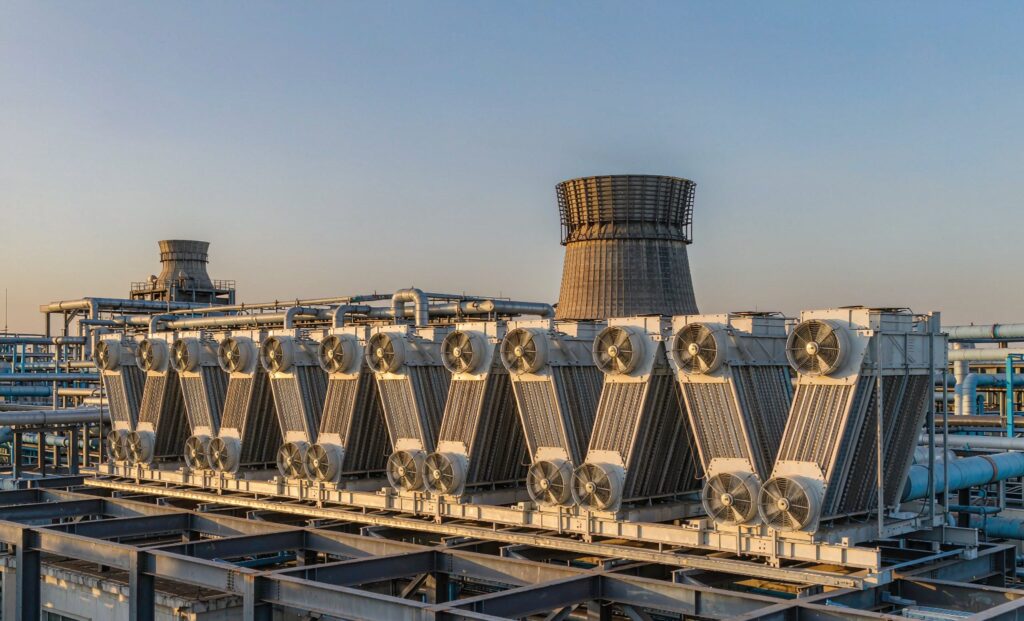
Choosing between a dry cooler vs cooling tower is one of the first heat-rejection decisions a plant engineer has to close, and it is rarely settled by capacity alone. Both reject heat to outdoor air; both use fans and pumps; both can serve a chiller plant or a process loop. They differ in how they reject the heat, and that single difference cascades into water consumption, achievable temperatures, maintenance burden, hygiene risk and lifecycle cost. This guide sets out the trade-off in plain engineering terms and gives you a checklist to run against your own site.
Dry Cooler vs Cooling Tower: The Core Difference
A dry cooler is a finned-coil heat exchanger with fans. The process fluid — water or a glycol mix — stays inside a closed circuit and never touches the air. Heat leaves the coil by sensible cooling only, so the coldest the fluid can approach is the outdoor dry-bulb temperature plus the coil approach.
A cooling tower rejects heat by evaporation. Water is sprayed into an air stream, a fraction of it evaporates, and the latent heat absorbed cools the remaining water. Because evaporation is driven by wet-bulb temperature, a tower can push the water colder than a dry cooler can on the same day — but it does so at the cost of continuous water consumption, chemical treatment and blow-down.
Dry Cooler vs Cooling Tower Comparison
| Parameter | Dry cooler | Cooling tower |
|---|---|---|
| Heat rejection medium | Outdoor air only | Air plus evaporating water |
| Process circuit | Closed loop | Open loop, or closed coil with spray water |
| Make-up water | None for heat rejection | Continuous, to replace evaporation, drift and blow-down |
| Water treatment | Limited to the closed loop | Essential: scale, corrosion and biocide programme |
| Temperature limit | Dry-bulb based | Wet-bulb based, colder in summer |
| Fan energy at peak | Higher (larger coil, more air) | Lower (colder water reduces chiller lift) |
| Hygiene risk | Low | Legionella management required |
| Maintenance profile | Coil cleaning, fans, motors | Basin, nozzles, fill, drift eliminators, water chemistry |
| Best fit | Water-scarce, remote or unmanned sites | Sites with reliable, cheap water and a low wet-bulb design |
Where Each System Wins
Water consumption and water treatment
A conventional dry cooler uses no water during normal operation. A cooling tower consumes water on every operating hour through evaporation, drift and blow-down, and the concentrated blow-down has to be treated and discharged. Where water is scarce, expensive, trucked in or subject to discharge limits, the dry cooler usually wins on lifecycle cost before efficiency is even considered. Where water is plentiful and cheap, the tower’s lower summer temperature can cut chiller compressor energy enough to outweigh the water bill.
Temperature capability and summer design
This is the decision the climate makes for you. On a 35 °C design day a dry cooler might hold a 42–45 °C leaving-water temperature, whereas a tower operating to a 24 °C wet-bulb could deliver water near 30 °C. If your process or chiller genuinely needs cold condenser water in midsummer, a dry cooler alone will not deliver it and you will need a larger coil, a supplementary chiller or a hybrid unit.
Maintenance and hygiene
Dry-cooler service is mechanical: keep the fins clean, inspect fans, motors and sensors, watch the closed-loop fluid quality. A cooling tower adds an open water system — basin cleaning, nozzle and fill inspection, drift eliminator checks, chemical dosing and a documented legionella control programme. That is ongoing labour and compliance load, not a one-off cost.
The Hybrid Option: Adiabatic and Spray-Assisted Coolers
You do not have to choose one extreme. An adiabatic cooler is built on a dry-cooler platform and sprays water over evaporative pads only when the ambient temperature is high. For most of the year it runs fully dry; on the handful of peak days it sprays to pull the air temperature down and recover capacity. Water consumption falls by an order of magnitude against a tower, the process circuit stays closed, and the summer design point is rescued without a supplementary chiller. For a worked example of dry cooling in a mission-critical setting, see our article on the dry cooler for data centre cooling.
A Selection Checklist for Plant Engineers
- Heat load profile: peak and part-load kW, and how many hours at each.
- Design temperatures: required leaving-fluid temperature, approach, and the local dry-bulb and wet-bulb design values.
- Water: availability, quality, cost, treatment obligation and discharge restrictions.
- Electrical supply: available fan power at peak, and the cost of the extra load.
- Site: footprint, clearance for air recirculation, noise limits, and structural load on the roof or deck.
- Operation: manned or unmanned, redundancy requirement, and winter freeze protection.
- Lifecycle cost: fan and pump energy, water and chemicals, cleaning, repairs and downtime over 15 years.
Run those seven lines and the choice usually makes itself. If water is the binding constraint, it is a dry cooler or an adiabatic unit. If cold summer water is the binding constraint and water is cheap, it is a tower.
Winter Operation and Freeze Protection
In cold climates the dry cooler’s advantage and its risk come from the same feature: the closed loop. Because the fluid is always in the coil, a low ambient night can freeze it if the design does not account for it. The usual answers are a glycol mix, drainable coils, or a control sequence that modulates fan speed and, at the coldest end, bypasses flow. A cooling tower has its own winter problem set — basin heating, icing on the fill, and a bypass arrangement to stop the tower over-cooling the loop — and its spray water must be managed rather than simply switched off. Design the winter sequence deliberately and test it at commissioning; do not assume the summer control logic will cover it.
When to Combine with a Chiller
The cleanest way to read the dry cooler versus cooling tower trade-off is to look at the whole cooling system, not the single component. In a chiller plant, a dry cooler earns its place by providing free cooling in shoulder seasons and winter: when the outdoor dry-bulb is below the required coolant temperature, the chiller can be shut down entirely and the dry cooler carries the load. A cooling tower can do the same and reach lower temperatures, but it commits you to a water and treatment regime all year. In many facilities the optimum is a dry cooler for free cooling, a chiller for the peak, and a hybrid or adiabatic unit to bridge the gap on the hottest days — a combination that keeps water use near zero while still meeting the design summer point.
How the Equipment Is Built
Zhenggong manufactures both sides of this decision: air-cooled heat exchangers and dry coolers with galvanised fin-tube coils and axial fans, and closed-circuit cooling towers that keep the process fluid isolated from the spray water. Both are produced under an ISO 9001 and ISO 14001 system, and the pressurised circuit components carry D1/D2 pressure vessel certification. Full ranges for each technology are on the product pages.
Get a Selection, Not a Catalogue
Send us the duty, the design dry-bulb and wet-bulb temperatures, your water situation and the site constraints. We will size a dry cooler, a cooling tower and a hybrid solution for the same duty so you can compare them on lifecycle cost rather than on face value. Request a heat rejection study and our engineers will return a sized selection and a comparison table within a few working days.