
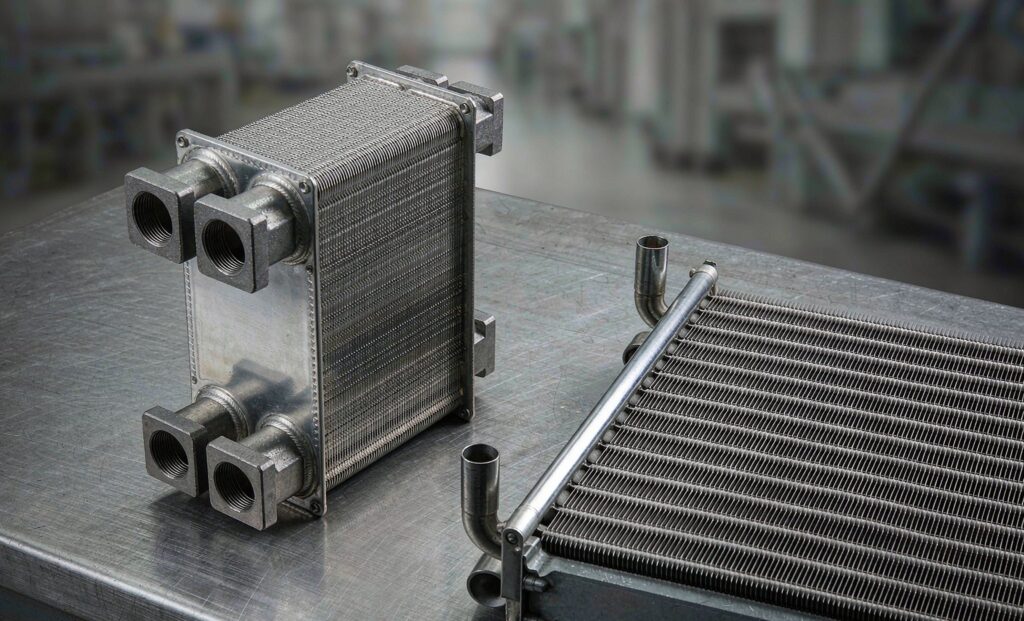
Why CO2 changes the heat exchanger brief
Carbon dioxide (R744) has a global warming potential of 1, is non-flammable, non-toxic and cheap, and it is now the default refrigerant for new supermarket refrigeration across much of Europe, with rapid adoption in industrial cold storage, heat pump water heating and data-centre cooling. The catch is that a CO2 transcritical heat exchanger works in a pressure regime no conventional unit was designed for. The high-pressure side of a transcritical circuit runs at 75–120 bar in normal operation and can touch 130–140 bar on a hot day — roughly three to five times the 30–45 bar rating of a standard brazed plate exchanger, and well beyond what a conventional finned coil was ever asked to hold. Specification, not price, decides whether the system survives.
This guide covers what changes on the heat exchanger side of a transcritical CO2 system: the gas cooler duty, the evaporator duty, pressure rating, materials, and the documentation a buyer should demand.
Transcritical versus subcritical duty: what changes at the exchanger
Below the critical point (about 31 °C and 73.8 bar for CO2) the cycle behaves like any other refrigeration cycle: the refrigerant condenses at a near-constant temperature and the heat rejection component is a condenser. Most of the year in a temperate climate, a CO2 booster system operates subcritically exactly like that. Above the critical point — on warm days, typically whenever ambient exceeds roughly 26–31 °C — the refrigerant no longer condenses. It stays supercritical, and heat is removed by dropping the temperature of a dense, high-pressure fluid.
That single change rewrites the design brief:
- Temperature glide instead of constant condensing temperature. A gas cooler rejects heat over a sliding temperature profile, which is why true counter-flow geometry matters far more here than in an HFC condenser.
- Pressure becomes an efficiency variable. High-side pressure is actively optimised by the controls; the exchanger must tolerate the full range without fatigue.
- Very low approach targets are achievable and valuable. Because the refrigerant glides, a well-designed gas cooler can run a 3–7 °C approach and lift system COP noticeably.
Gas cooler selection: air-cooled coil or high-pressure brazed plate
The gas cooler is where most CO2 projects make their first technology choice, and the answer usually follows the heat sink rather than the refrigerant.
Air-cooled and microchannel gas coolers
When the heat sink is ambient air — the dominant case in supermarkets, cold stores and transport refrigeration — the gas cooler is an air-cooled coil: finned tubes or microchannel flat tubes, stainless steel or high-pressure-rated copper circuits depending on rating, with EC fans and often an adiabatic pre-cooler for hot climates. Capacities run from about 5 kW to well over 500 kW, with working pressures of 90–130 bar. Coil material and fin coating decide corrosion life in coastal or urban environments, where aluminium fins will not survive without protection.
High-pressure brazed plate for water and secondary loops
Where there is a water or brine loop to reject to — industrial heat pump water heaters, district heating, CO2-to-water heat recovery and cascade systems — a high-pressure brazed plate exchanger takes the gas cooler duty. These are purpose-designed units, not thickened versions of a standard R410A product: reinforced plate geometry, tighter brazing tolerances, ports rated to 140 bar, and cycling fatigue considered in the plate pack. True counter-flow plate channels track the refrigerant’s glide closely, which is precisely why brazed plate performs so well on transcritical CO2 duty.
Comparing the two formats in practice:
| Factor | Air-cooled / microchannel gas cooler | High-pressure brazed plate gas cooler |
|---|---|---|
| Heat sink | Ambient air | Water, brine or secondary loop |
| Typical high-side pressure | 90–130 bar, peaks to 140 bar | Up to 140 bar design |
| Approach temperature | 5–10 °C above ambient | 2–5 °C, counter-flow |
| Footprint per kW | Large — needs free air path and fans | Very compact |
| Maintenance | Coil cleaning, fan and bearing service | Chemical cleaning only |
| Best fit | Supermarkets, cold storage, transport | Heat pumps, heat recovery, cascade systems |
| Charge held | High circuit volume | Very low hold-up |
Evaporator and internal duties in a CO2 booster system
Selection does not stop at the gas cooler. A transcritical booster rack has several other exchangers whose duty looks conventional but whose pressure and flow regime does not:
- Low- and medium-temperature evaporators on the subcritical side, where CO2’s high volumetric refrigeration capacity allows notably smaller channels and lower mass flow than an equivalent HFC system.
- Internal heat exchangers (IHX), which recover cold from the suction gas to subcool the liquid line — a standard and highly effective CO2 component because it improves both capacity and efficiency.
- Cascade exchangers, where CO2 condenses against a second refrigerant and a robust brazed or shell and tube unit is typically the correct answer.
- Suction-line heat exchangers and oil coolers, still small plate duties but again at higher working pressure.
Pressure rating and the certification question
A high-pressure CO2 exchanger is a pressure component in every jurisdiction that regulates them, and the design pressure puts it in a demanding class. Two practical rules follow.
First, never accept a catalogue pressure figure without the test behind it. Ask for proof-pressure and burst-test data specific to the CO2-rated product line, plus helium leak-test records at a stated rate ceiling. A manufacturer’s standard R410A plate pack with thicker walls is not the same product as a design engineered for the CO2 envelope. Second, confirm the manufacturing certification matches your market: the design pressure class will drive which pressure equipment directive or standard applies at import, and the exporter’s documentation has to line up. Zhenggong’s D1/D2 pressure vessel qualification and ISO 9001 / ISO 14001 systems are the evidence base we supply with CO2-rated units.
Selecting a CO2 transcritical heat exchanger: checklist
- Define transcritical and subcritical duty separately — gas cooler (supercritical) and evaporator (subcritical) need different optimisation.
- State minimum, normal, maximum and peak high-side pressures, including ambient extremes and compressor trip settings.
- Give the secondary fluid, its flow, and the approach temperature you are targeting.
- Confirm plate or coil material against the corrosion environment — coastal air, chlorides and urban pollutants all matter.
- Verify port size and connection type suit CO2 piping and the higher pressure class.
- Request thermal performance data at both design and part-load conditions, plus pressure-drop curves.
- Require proof/burst test records and helium leak-test data for the specific rated line.
- Check that the certification and documentation package matches the destination market’s rules.
- Plan cleaning access and water treatment at the design stage, not after commissioning.
Materials, corrosion and connections
On the water side, 316L stainless covers most secondary loops; titanium is justified where chloride levels are high. On the refrigerant side, the high-pressure regime favours stainless steel tubing and brazed plate designs over copper in the largest sizes, and demands welded or brazed joints with verified integrity rather than field-made connections. Where the low side of the system still uses copper evaporators, isolate the two materials properly so galvanic corrosion never gets a path. Insulation specification also deserves attention: CO2 evaporators run colder than HFC equivalents in many duties, and condensation control on cold surfaces is a design decision, not a finishing detail.
What to ask a CO2 heat exchanger supplier
Three questions separate a genuine CO2 supplier from a catalogue seller. Has this exchanger line been engineered for the CO2 envelope from the start, or is it an existing product with thicker walls? What is the rated design pressure on the refrigerant side, and what test data supports it? And who signs the pressure documentation that accompanies the shipment? The answers, in writing, matter more than the datasheet headline. Background on how air-cooled heat rejection equipment is specified in general sits in our guide to air cooled heat exchangers, and the format-specific options are visible on the brazed and fusion bonded plate heat exchanger page and the air cooled heat exchanger and dry cooler page.
Get a CO2 transcritical heat exchanger selection
Send your refrigerant-side pressures, secondary fluid, capacity and target approach, and Zhenggong’s engineers will confirm whether a high-pressure brazed plate or an air-cooled gas cooler is the right fit, with thermal data, pressure ratings and the certification package your market requires. For quotes and custom CO2 designs, contact the engineering team.