
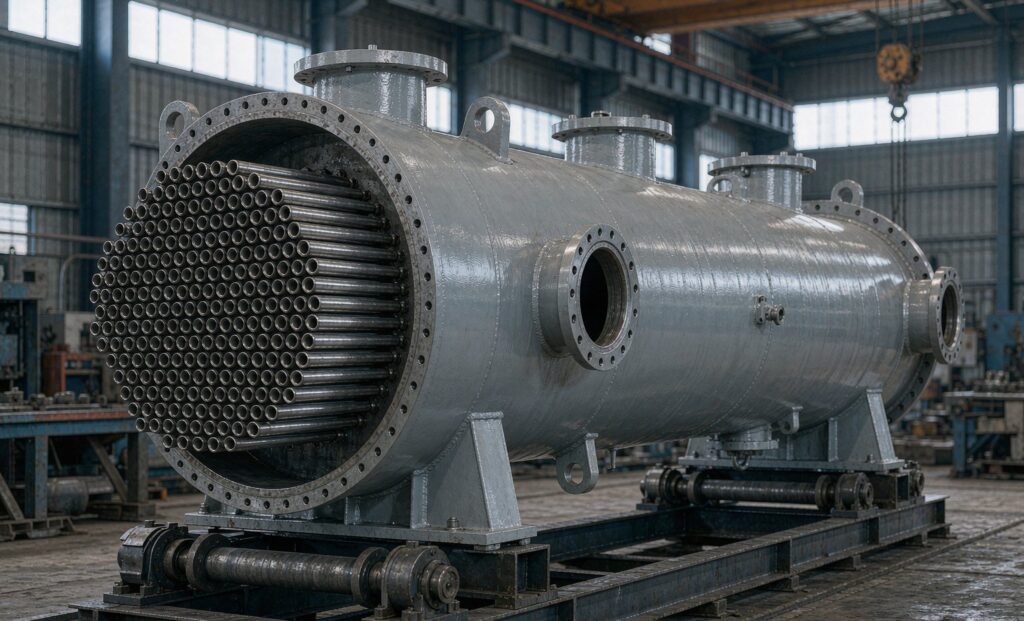
What a Shell and Tube Heat Exchanger Costs, and Why the Number Moves
Buyers ask for a shell and tube heat exchanger cost as if there were a list price. There is not. A heat exchanger is priced the way a pressure vessel is priced: from a thermal rating, a mechanical design and a material list, all three of which change with the duty. Two units with the same 100 m² of surface can differ by a factor of three in price and still both be correctly priced, because one is carbon steel at 6 bar and the other is titanium at 25 bar with full radiography.
What can be given honestly is a band. The tables below are budgeting bands for units fabricated in China and sold FOB, based on 2026 material and labour costs, for water-to-water duties at 1.6 MPa design pressure with a fixed tubesheet (TEMA BEM) and a surface between 50 and 300 m². They are accurate to about ±30%, which is enough to sanity-check a quotation and not enough to place a purchase order.
Price per Square Metre by Material
| Construction | Cost per m² of surface (USD, FOB China) | Typical use |
|---|---|---|
| Carbon steel shell and tubes | 180 – 320 | Cooling water, lube oil, closed loops with treated water |
| Carbon steel shell, 304/316L tubes | 300 – 520 | Process water, condensate, light chemical duty |
| All 316L wetted parts | 400 – 700 | Food, pharma, deionised water, mild chloride |
| Duplex 2205 tubes | 650 – 1,000 | Brackish water, moderate chloride with higher temperature |
| Titanium Gr2 tubes, steel shell | 1,300 – 1,900 | Seawater, desalination, marine cooling |
| All titanium Gr2 | 1,600 – 2,400 | Seawater on both sides, chlorinated brine |
| Nickel alloy (C276, 800H) | 4,000 – 7,000 | Hot acids, chlorinated organics, HF service |
Three corrections apply on top of those bands:
- Small units cost more per m². Below about 20 m², fixed costs — heads, flanges, testing, documentation — dominate. Multiply the band by 1.5 to 2.5.
- Code stamps add real money. An ASME U-stamp adds 15–30%; a PED/EN 13445 design with a notified body adds 10–20%; TEMA R instead of TEMA C adds 8–15%, mostly in radiography and tube-to-tubesheet joint details.
- Pressure class is not linear. Going from 1.6 to 4.0 MPa adds roughly 20–35%; going to 10 MPa can double the price, because wall thickness, flange rating and heat treatment all step up together.
Why the Area Is a Design Output, Not an Input
This is the single most useful idea in heat exchanger purchasing, and it is the one most often missed. The supplier does not sell you square metres; the supplier sells you a duty. The area falls out of the thermal design, and the thermal design is where a cheap quotation is made cheap.
A unit designed with a 4 K approach and 90 kPa of pressure drop needs roughly 30% less surface than one designed with a 2 K approach and 40 kPa of pressure drop. The first is cheaper to buy and more expensive to run, every hour, for twenty years. When one quotation comes in 25% below the others on a like-for-like datasheet, one of these has usually happened:
- the fouling allowance was cut from 15% to nothing, so the unit meets the duty on day one and misses it in eighteen months;
- the tube length was stretched and the tube count cut, which raises velocity and pressure drop and can push the pump outside its curve;
- the shell or channel wall is one nominal size thinner than the calculation requires;
- the tube-to-tubesheet joint is expanded only, with no seal weld and no grooving;
- radiography, dye penetrant and the hydrostatic test record were quietly left out of the scope;
- the unit is priced ex-works with no sea packing, and the freight line appears later.
A Worked Budget: 100 m² of 316L, 1.6 MPa
A worked breakdown is the fastest way to see where the money sits. This is a 100 m² fixed-tubesheet unit, 19.05 × 2.0 mm 316L tubes at 6 m, carbon steel shell, 1.6 MPa design, water both sides, exported in a seaworthy crate.
| Line item | Share of price | Notes |
|---|---|---|
| Tube bundle (285 tubes × 6 m) | 30 – 34% | The largest single item; tube OD and wall are the main levers |
| Shell, nozzles, saddles | 7 – 9% | Plate cost is small; welding and rolling are not |
| Tube sheets, baffles, tie rods | 10 – 12% | Thick plate, drilled on a CNC; ligament efficiency governs thickness |
| Heads, flanges, gaskets, bolting | 9 – 11% | Flange rating drives this more than size |
| Fabrication labour and machining | 20 – 24% | Falls per m² as units get larger |
| NDT, hydrotest, documentation | 3 – 5% | Material certs to EN 10204 3.1, radiography, test records |
| Surface prep, pickling, sea packing | 2 – 4% | Often excluded from headline prices |
| Factory overhead and margin | 18 – 25% | Varies with order size and schedule |
At 2026 costs that unit lands near USD 38,000, or about USD 380/m². The carbon steel version of the same duty comes out near USD 21,000. The difference is almost entirely the tube bundle: 316L tube at roughly four times the cost per metre of carbon steel, and a titanium bundle at ten to fifteen times.
Comparing Quotations on Equal Terms
Most of the spread between quotations is scope, not price. Normalise before you compare, and ask every supplier for the same eight items:
- Thermal rating sheet with U, LMTD, fouling factors, and the resulting area — not just an area figure.
- Pressure drop per side at design flow. A unit 30 kPa over budget is not a cheaper unit, it is a pump upgrade.
- Material specification line by line: tube grade, tube sheet grade, shell grade, and the corrosion allowance on each.
- Tube-to-tubesheet joint type: expanded, expanded and grooved, or seal welded.
- NDT and test plan: percentage of radiography, penetrant testing on welds, hydrotest pressure and duration, and whether a third-party inspector is included.
- Documentation package: material certificates, welding procedure and welder qualifications, test records, nameplate data, and the operating manual.
- Delivery terms: FOB, CIF or DAP, plus packing specification and the lifting and transport weights.
- Warranty and spares: duration, what it covers, and the price of a spare bundle and a set of gaskets.
Only when those eight are identical does the price comparison mean anything. In practice a 20% gap usually resolves into a 6% real gap plus a different scope.
The Cost That Does Not Appear on the Quotation
Purchase price is typically 15–25% of the installed cost of a heat exchanger. Piping, valves, supports, insulation, painting, installation and commissioning make up the rest, and a marginally cheaper unit that needs a larger pump, a heavier support or a crane that the site does not have can erase the saving before it starts.
Pressure drop is where this bites hardest. Take a 100 m³/h circuit where the cheap unit runs 30 kPa above the efficient one. Hydraulic power is flow times pressure, so 30 kPa at 100 m³/h is about 0.83 kW of shaft power; at 70% pump efficiency that is 1.2 kW of electricity, and at 8,000 operating hours a year it is roughly 9,500 kWh. At USD 0.10/kWh that is USD 950 a year — about USD 14,000 over fifteen years, discounted, against a saving of perhaps USD 6,000 at purchase. The cheap unit is the expensive one.
The second hidden cost is cleaning. A unit designed with generous fouling allowance and accessible tube ends can be cleaned in place in a shift. A unit designed to the minimum area with a welded channel and no cleaning lane needs a bundle pulled, which in most plants means a crane, a contractor and three days of downtime.
Where the Price Actually Comes From
Two levers move the number more than anything else, and both are set by the datasheet you write:
- Tube diameter and wall. Moving from 19 mm to 25 mm tubes cuts the tube count for the same area by about 40%, and cuts the tube cost with it, at the price of a larger shell and lower velocity. On clean water duties that trade is usually worth taking.
- Design pressure and temperature. Specify the real maximum, not a round number with margin stacked on margin. A unit designed for 1.6 MPa because the system runs at 1.0 MPa is 15–25% cheaper than one designed for 2.5 MPa because someone was cautious twice.
Correctly specified, a shell and tube unit is the cheapest reliable way to move heat at pressure and temperature. Zhenggong builds them as D1/D2 certified pressure vessels under ISO 9001 and ISO 14001, which is the certificate set most export buyers and their insurers now ask to see; the stainless steel shell and tube range covers the 316L and duplex cases above, and the full product range includes the air-cooled and plate alternatives when the duty does not need a shell.
What to Send for a Firm Quotation
Six numbers get you from a band to a firm price. Everything else is negotiation.
- Duty in kW, and which side you know best (flow and temperatures).
- Fluid, concentration and a water or product analysis — chloride, hardness, suspended solids, pH.
- Design pressure and design temperature per side, plus the test and vacuum cases if any.
- Allowable pressure drop per side, in kPa, at design flow.
- Code and certification required: D1/D2, ASME, PED, and any third-party inspection.
- Interface: connection sizes and facing, orientation, available footprint, and the lifting route into the plant room.
Send those to an engineer rather than a sales inbox and you will get a rating sheet back with the assumptions visible, which is the only way to tell whether two quotations are really the same unit. Send your duty and water analysis to our engineering team and we will return a thermal rating, a material recommendation with the reasoning, and a price band before any drawing is issued. For the certification paperwork buyers should verify first, see our guide to D1/D2 pressure vessel certification.
