
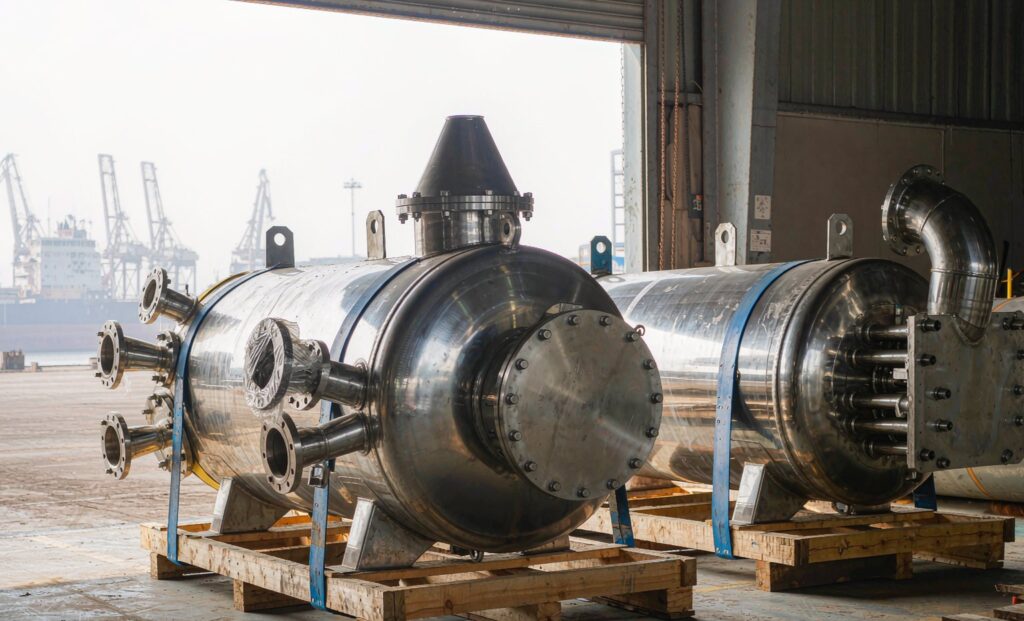
A heat exchanger supplier Vietnam buyers can rely on has to solve a different problem from a supplier working into a temperate market, because the operating envelope is different in three ways at once: high humidity, warm seawater, and design ambient temperatures that push air-cooled equipment past its nominal rating. This article is about specifying a unit that will actually perform on a Vietnamese site, inspecting it before it ships, and getting it through the port without the schedule collapsing. It is written from the supply side, so it says plainly where buyers get surprised.
Why the demand profile differs from a temperate market
Vietnam’s industrial load is concentrated in a few clusters: food and beverage processing in the Mekong Delta, textiles and footwear around Ho Chi Minh City and Bien Hoa, electronics in the north around Bac Ninh and Thai Nguyen, cement and steel in the north and centre, and a growing chemicals and pharmaceutical base. Almost all of it sits within a few tens of kilometres of the coast or a major river system.
Two consequences follow. First, cooling water is often river or seawater rather than a closed treated loop, which changes the material decision completely. Second, ambient conditions in the south sit near saturation for much of the year, so an air-cooled unit selected at a nominal 35 °C ambient with dry air will not deliver its catalogue duty in July.
The error that recurs is importing a specification written for a European or Chinese inland site and assuming the exchanger is agnostic to location. Thermal design is agnostic. Materials selection and air-side performance are not.
Heat exchanger supplier Vietnam: what buyers here actually order
The volume categories are fairly stable. Shell-and-tube units dominate steam, condensate and process cooling duties where pressure and temperature rule out a gasketed plate. Gasketed plate units dominate HVAC, food processing and any duty where the approach is tight and the fluid is clean. Air-cooled units and dry coolers dominate where there is no water at all, or where the water is too aggressive to put through a plate pack.
What buyers most often ask for and then discover they cannot have is a single unit covering a very wide flow range. A plate pack that is correctly sized at design flow will be poor at 30 percent of design flow, and a shell-and-tube selected for the maximum will be over-surfaced at the minimum. Two smaller units in parallel, or a unit with a variable flow arrangement, usually beats one oversized exchanger on both control and cleaning.
If you are at the stage of fixing the duty rather than the hardware, the sizing and selection tools will give you an indicative area for a given set of temperatures and flows. Bring the result with you.
Send us the fluid on each side, the flow rate, the inlet and outlet temperature of both streams, and the heat duty, and we will come back with a sized quotation that names the exchanger type, the pass arrangement and the surface area it needs — not a catalogue model number chosen because it was nearest.
Seawater and the material decision
Seawater is the single largest source of premature failure in coastal installations, and the failure is almost always a materials decision made on price rather than on chloride level. Seawater total dissolved solids sit around 35,000 mg/L, with chloride around 19,000 mg/L, and the combination of chloride, dissolved oxygen and biological activity is aggressive to every common stainless.
The practical ladder looks like this. Carbon steel with a corrosion allowance is acceptable for a closed treated loop and unacceptable for once-through seawater. Type 316L is acceptable for brackish water at moderate temperature and is a poor choice for warm seawater, where it is vulnerable to crevice and pitting attack under deposits and under gaskets. Duplex and super-duplex stainless extend the range considerably. Titanium is effectively immune to seawater at any velocity and any temperature that a process exchanger will see, which is why it dominates plate packs on marine duties despite the cost.
Copper-nickel alloys, 90/10 and 70/30, remain a legitimate choice for shell-and-tube seawater service with a long track record in marine engineering, but they carry a velocity limit below which fouling accelerates and above which erosion-corrosion begins. That window has to be designed for, not hoped for.
The decision rule that saves the most money: match the material to the actual water chemistry measured on site, not to the sea it came from. A river intake 30 km inland can be far less aggressive than the estuary it discharges into, and a closed loop with biocide treatment is a different problem again.
Design ambient: the derating nobody asks for
An air-cooled heat exchanger is selected against an ambient air temperature and a required process outlet temperature. The gap between the two is the approach, and the approach sets the area. A unit selected at 35 °C ambient for a 45 °C process outlet has a 10 K approach and will need a certain face area. Select the same unit for a site that reaches 40 °C and the approach falls to 5 K, and the required area roughly doubles for the same duty.
This is not a small correction and it is not linear. It is also invisible in a quotation that lists only the duty and the unit model, which is why the ambient design condition has to be stated by the buyer in writing. Give the supplier the summer design dry-bulb, the altitude if the site is in the central highlands, and whether the unit will be in a plant room or on an open roof.
Humidity matters for a different reason. At high relative humidity, a dry cooler still works, but an evaporative unit’s performance and water consumption both change, and the plume behaviour becomes a siting problem. If the unit discharges near a neighbouring property or a road, that is a planning issue, not a thermal one.
The twelve fields on a usable specification sheet
Most enquiries that stall do so because one of these is missing. A complete sheet carries:
- Fluid name and composition on both sides, including concentration for any solution.
- Mass or volumetric flow rate on each side, with the basis stated.
- Inlet and outlet temperature on each side.
- Heat duty, and which stream it was computed from.
- Allowable pressure drop on each side.
- Design pressure and design temperature, with the code basis.
- Material for wetted parts, and the corrosion allowance if carbon steel.
- Connection sizes and orientation, and nozzle facing standard.
- Installation location: indoor, outdoor, coastal, altitude.
- Summer design ambient for air-cooled units.
- Cleaning method expected: chemical, mechanical, or none.
- Inspection and documentation requirements, and the third-party inspector if any.
That list is not bureaucracy. Each field maps to a decision the fabricator has to make, and a missing field gets filled with an assumption that the buyer will not see until the unit is on site.
Inspection before shipment
For anything with a pressure boundary, the buyer should witness or at least receive the records for: a hydrostatic test at the code-specified pressure, non-destructive examination of the longitudinal and circumferential welds to the extent the code requires, a dimensional check against the approved drawing, and a nameplate that matches the datasheet rather than the order description.
For a gasketed plate unit the checks are different: plate count against the drawing, plate thickness measured rather than assumed, gasket material verified against the certificate, and the plate pack dimension recorded so the buyer can reassemble to the same compression after cleaning. That last number is the one nobody records and everybody needs.
Third-party inspection is worth commissioning when the unit is going into a process where a leak is a safety event rather than a maintenance event. It is not worth it for a utility water cooler, and paying for it there only adds weeks.
Documentation for import into Vietnam
The commercial documents are the usual set: commercial invoice, packing list, bill of lading, and a certificate of origin. The certificate of origin matters financially — under the ASEAN-China free trade arrangement, goods of Chinese origin can enter Vietnam at a preferential rate against a Form E certificate, and without it the duty is assessed at the general rate. A Form E has to be applied for before shipment, not after, and the consignee details must match the import documents exactly.
Beyond customs, pressure equipment may fall under Vietnamese conformity requirements, and the applicable inspection regime depends on the equipment type and the receiving authority. Confirm this with the buyer’s local inspection body before the unit is built rather than at the port, because a documentation gap discovered on arrival can hold a unit for weeks and there is no expedited route that a supplier can offer.
The packing list deserves care. A consignment described as “heat exchangers” with no weights, dimensions or serial numbers per unit is difficult to clear and impossible to insure properly. One line per unit with its serial, net and gross weight, and dimensions is the standard to insist on.
The lanes, and what they do to a schedule
Most Chinese fabrication for the Vietnamese market ships from Guangdong and Fujian. The southern gateway is the Cai Mep–Thi Vai complex and Ho Chi Minh City’s Cat Lai terminal; the northern gateway is Hai Phong, which serves Hanoi and the electronics belt. Choosing the port is a function of the consignee’s address, not of freight rate alone — a unit landed at Hai Phong and trucked to Binh Duong has crossed the country.
The schedule risk is not the sea leg. It is the inland leg and the port dwell. A shell-and-tube unit on a flat rack needs a crane at both ends, a low-bed trailer, and a route survey if it is over-dimensional. That chain has to be arranged before the vessel sails, and the party who arranges it should be named in the contract.
Packaging for a humid sea transit
A month in a container crossing the South China Sea in the rainy season will find every weakness in packaging. The failures that recur are condensation inside sealed plastic, carbon steel components shipped without desiccant, and nozzle faces protected by tape that dissolves and leaves adhesive in the gasket groove.
What works: solid timber or plywood crating rather than cardboard, the unit bolted to the crate base rather than strapped, vapour-barrier bags with an adequate desiccant quantity for the enclosed volume, and rigid nozzle covers rather than tape. For a plate pack, ship the plates compressed and the spare gaskets in a separate sealed bag with their own desiccant, labelled with the plate and gasket part numbers.
Plates, gaskets and the aftermarket
A plate heat exchanger is a consumable assembly in a way that a shell-and-tube is not. Gaskets have a finite life, plates foul and eventually crack at the port area, and the unit is only as good as the availability of those two items five years after commissioning.
Before ordering, ask for the plate drawing and the gasket material specification, and confirm that both will remain available. A plate pack with a proprietary plate pattern and no spares commitment is a unit with a fixed life. The same question applies to tube bundles: a shell-and-tube with a standard tube size and a removable bundle can be retubed locally, which is a meaningful advantage in a market where a replacement bundle may be weeks away.
Heat exchanger supplier Vietnam checks before you pay
Five questions separate a manufacturer from a trader, and none of them requires a factory visit.
Ask for the pressure vessel manufacturing licence and the scope it covers, because a licence for atmospheric tanks does not cover a coded exchanger. Ask which code the unit will be designed and stamped to, and whether the fabricator holds that certification itself or subcontracts it. Ask for a recent third-party inspection report with the inspector’s name on it. Ask for the plate pattern and gasket source so you can check spares availability independently. And ask for two references in the same industry, then contact them without the supplier present.
A supplier who answers all five in writing is a different proposition from one who answers four and changes the subject on the fifth. Trade background is not disqualifying — many traders are competent — but the buyer should know which one they are dealing with, because the warranty is only as good as the entity that signed it.
References
Mechanical design of shell-and-tube units for export typically follows ASME Section VIII, Division 1, with TEMA class governing mechanical allowances where the client specifies it. Plate-and-frame units for food and pharmaceutical duty are commonly built to the applicable sanitary design guidance rather than to a pressure vessel code, and the two are not interchangeable. Buyers should confirm the code basis in the purchase order rather than inferring it from the datasheet.
For a specific duty, send the fluid, flow rate, inlet and outlet temperatures and heat duty through the contact page, along with the installation location and the summer design ambient, and we will come back with a selection and a quotation. The product range covers shell-and-tube, gasketed plate, brazed plate and air-cooled configurations.
