
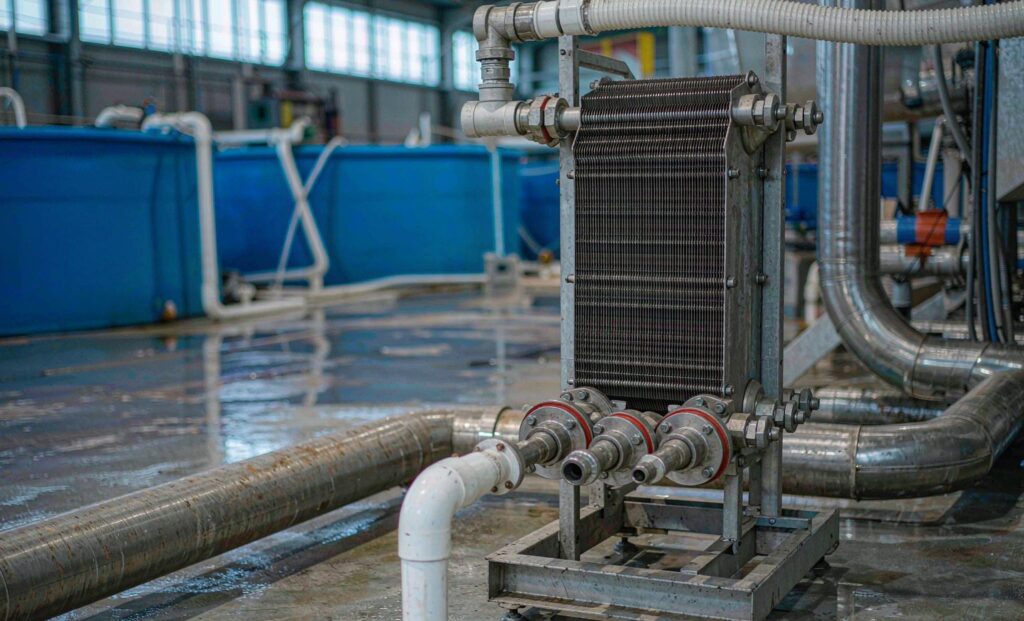
Why an Aquaculture Heat Exchanger Is Sized Differently
An aquaculture heat exchanger does a simple job — hold a body of water at a set temperature — under constraints that almost no other industrial duty shares. The process fluid is alive. It carries stock, eggs, and the nitrifying biofilm that keeps a recirculating system viable, and that same biofilm will colonise any warm surface inside the exchanger within a few weeks. The flows are large and the temperature lift is small, typically 3–8 K, so the unit is sized on approach temperature rather than on a generous LMTD. And the water is frequently seawater, which removes copper alloys from the table entirely — copper is lethal to shellfish larvae and damaging to most finfish at concentrations measured in micrograms per litre.
The result is a heat exchanger that looks oversized on a thermal calculation, needs a cleaning strategy designed at the quotation stage, and must never become the path by which treated heating water reaches a tank. This guide works through load calculation, type selection, materials, velocity limits, biosecurity and control in the order those decisions actually bind.
Calculating the Heat Load Before You Choose Anything
Most undersized farm installations fail at this step, not at the exchanger. A duty quoted only on make-up water ignores the three loads that dominate a real system.
The three loads that actually matter
- Make-up water: the flow that replaces evaporation, backwash and purge. In a RAS this is often only 2–10% of system volume per day, but it enters at groundwater or mains temperature, so the lift is the full 10–25 K.
- Tank and pipe losses: 30–70 W per m² of exposed water surface, plus 20–40 W per m² of uninsulated tank wall in a cold plant room. A 500 m³ hall with 300 m² of open surface loses 15–25 kW continuously.
- Process heat sinks: biofilter nitrification is exothermic but small; the real sinks are degassing towers, drum filters, UV units and ozone contactors, each of which returns water 1–3 K cooler than it arrived.
Add the three, then apply a 15–20% margin for the coldest week and for the fact that a farm at 08:00 on a January morning is not at design conditions. The single most common error is sizing to the average: a heat exchanger that is exactly right in October is 30% short in a cold snap, and a 1 K shortfall in a smolt tank is a growth-rate problem that shows up six weeks later.
Worked Example: 209 kW for a 30 m³/h Smolt Circuit
A land-based smolt facility circulates 30 m³/h through a 400 m³ tank cluster and holds 14 °C. Make-up water arrives at 6 °C in winter. Total measured duty is 209 kW, which corresponds to lifting the full circulating flow by 6 K.
Q = m · cp · ΔT = (30 ÷ 3.6) × 4.186 × 6 = 209 kW
Heating water is available at 45/40 °C from a biomass boiler through a buffer tank. Counterflow gives terminal differences of 31 K and 32 K, so the LMTD is 31.5 K — almost identical to the arithmetic mean, which is the signature of a tight-approach duty. With a titanium plate pack at U = 4,500 W/m²·K clean, the required area is:
A = 209,000 ÷ (4,500 × 31.5) = 1.47 m²
That is a single-pass plate unit with roughly 25 plates, a footprint under a square metre. Apply a 15% fouling allowance for the culture-water side and it becomes 1.7 m². The point of the calculation is not the number — it is that the exchanger is small and cheap, while the buffer tank, the control valve and the cleaning access around it are not. Budget accordingly, and do not let the exchanger be the item that gets value-engineered.
Which Exchanger Type Fits Which Farm
Five families are in normal use for aquaculture water temperature control. The choice is driven by flow, water quality, cleanability and how much space exists between the tank and the wall.
| Type | Typical duty | Cleanability | Best fit | Weak point |
|---|---|---|---|---|
| Gasketed plate, titanium plates | 20–2,000 kW | Excellent — pack opens in minutes | RAS, hatcheries, seawater, tight approach | Gaskets are the maintenance item; 1.6 MPa ceiling |
| Semi-welded plate | 100–3,000 kW | Culture side open, heating side welded | Heating water with glycol or inhibitors | Cannot mechanically clean the welded side |
| Brazed plate | 5–150 kW | None — disposable or CIP only | Small hatchery loops, clean freshwater | Not rebuildable; copper braze unsuitable for seawater |
| Shell and tube, straight tubes | 200–10,000 kW | Good — brush or pull tubes | Large flow, low approach is not critical, solids present | 3–5× the footprint of a plate unit |
| Immersed coil or PE pipe | 5–80 kW | Manual, in-tank | Ponds, low-head systems, no pump budget | Poor U, occupies tank volume, cannot control tightly |
For a seawater farm above roughly 50 kW, a gasketed titanium plate unit is the default, and a straight-tube shell and tube exchanger is the choice when the water carries sand, shell grit or uneaten feed and the operator would rather brush tubes than open a plate pack. Large low-head systems — raceways, ponds, flow-through smolt units — frequently cannot afford the pressure drop of a plate pack at all, and that is a pumping-cost decision, not a thermal one.
Material Selection: Titanium, 316L or 254SMO
Chloride decides this, and temperature decides how fast chloride wins.
- Titanium Grade 1 or 2: the standard for seawater and brackish water. Effectively immune to chloride pitting and crevice attack below 120 °C, and it tolerates the hypochlorite used in biofouling control. Thin (0.5–0.6 mm) plates keep the unit compact despite titanium’s lower conductivity.
- 316L: acceptable for freshwater RAS at low chloride and below about 60 °C. Above 60 °C with more than roughly 200 mg/L chloride it will pit, and the pits are under the gasket where you cannot see them.
- 254SMO or AL-6XN: the compromise when titanium lead time is unacceptable and chloride sits between 200 and 1,000 mg/L. Higher cost than 316L, lower than titanium.
- CuNi 90/10 and aluminium brass: never on the culture-water side. Copper ions are toxic to molluscs, crustaceans and many larvae at ppb levels; a single corroding cupronickel tube can shut down a shellfish hatchery.
Gaskets matter as much as plates. EPDM is the default for aquaculture: it handles the 60–90 °C range, tolerates hypochlorite and ozone residuals, and does not support bacterial growth the way some older nitrile compounds did. NBR is chosen only where the heating circuit carries oil. Note that EPDM swells in contact with some fish oils and feed residues, so on a line that sees tank sludge, verify compatibility before committing.
Velocity, Fouling and the Approach Temperature
Culture water carries a living suspension. Below about 0.8 m/s, bacteria settle and a biofilm forms; the film is 1–2 mm thick within a month and its thermal resistance exceeds that of the plate. The workable band for the culture side is 1.0–1.8 m/s, which is high enough to keep surfaces scoured and low enough to avoid erosion–corrosion on titanium and damage to anything small enough to pass the screens.
Design fouling factors for plate units in this service:
| Side | Fouling factor (m²·K/W) | Comment |
|---|---|---|
| Treated heating water, closed loop | 0.00003–0.00005 | Essentially clean if the loop is dosed and air-free |
| Freshwater RAS culture water | 0.00008–0.00012 | Biofilm, feed fines, biofloc |
| Seawater, filtered to 100 µm | 0.00012–0.0002 | Higher in summer, in estuaries, and after a bloom |
| Estuarine or algal-bloom water | 0.00025–0.0004 | Plan a CIP skid, not just a bigger exchanger |
The approach temperature is where aquaculture differs most from HVAC. A 1–2 K approach is normal and desirable because it lets a 45 °C heating circuit hold a 20 °C tank without a control valve hunting. Achieving that approach means more area and a larger plate pack than an HVAC engineer would quote — accept it. A 4 K approach on a fish tank shows up as a 2 K temperature swing every time the boiler cycles.
Biosecurity: Keeping the Heating Circuit Out of the Tank
Two water circuits meet inside the exchanger, and one of them contains the product. Design the pressure regime deliberately:
- Single-wall, culture side at higher pressure. Any leak pushes culture water into the heating circuit, where it is visible at a sight glass or as a conductivity alarm. This is the common arrangement for freshwater RAS with a clean, dosed heating loop.
- Double-wall plate or double-tube-sheet. Use it where the heating circuit carries corrosion inhibitors, glycol, or where the species is a high-value broodstock or shellfish line. A double wall with a drain or pressure port between the barriers turns a leak into a maintenance call instead of a mortality event.
- No dead legs. Bypass pipework and sample points that hold water at 25 °C for weeks are bacterial incubators. Keep the loop short and flush it.
A conductivity probe on the heating loop is inexpensive and catches a pinhole months before it becomes a stock loss. Fit one.
Control: Ramp Rate, Sensor Placement and the 0.5 K Band
Fish tolerate temperature change far less than they tolerate an absolute offset. The practical limit is 1 °C per hour for most species, and half that for eggs and early fry. That constrains the control loop more than the exchanger does: a 200 kW unit on a 400 m³ tank can move 0.4 K per hour at full output, so a step change on the valve is survivable — but a 2 MW unit on the same tank is not.
Practical rules that survive contact with a farm:
- Measure tank temperature in the tank, at mid-depth, with a shielded probe — not in the return pipe, where it reads the heater, not the stock.
- Use a modulating three-way or two-way valve with a 0.5 K proportional band, and add a minimum valve position limit so the loop never stalls.
- Rate-limit the setpoint ramp in the PLC, not in the valve actuator.
- Interlock the heating pump with circulation: no flow, no heat. A dry plate pack scorches its gaskets in minutes.
- Log the approach temperature. A rising approach at constant flows is the earliest reliable indication of fouling, weeks before the tank drifts.
What to Put in the Enquiry
A supplier who receives a duty in kW can quote a box. A supplier who receives the following can select a unit that survives five winters:
- Species and target temperature, with the acceptable band and maximum ramp rate.
- System volume, circulation flow and make-up flow, with make-up temperature for the coldest month.
- Water type: freshwater, brackish, seawater, with chloride and suspended solids if known.
- Heating source: boiler, heat pump, chiller waste heat, with supply and return temperatures.
- Available pressure on both sides, and whether the culture-water pump can carry the extra drop.
- Space envelope and access for opening the plate pack.
- Cleaning method available on site: CIP skid, manual, or nothing.
Zhenggong manufactures plate, shell and tube and air-cooled units under a D1/D2 pressure vessel licence with ISO 9001 and ISO 14001 certification — the certification and approvals page lists the scope, which is what a farm’s insurer or export authority will ask to see. For large-flow, solids-tolerant duties the stainless shell and tube heat exchanger is the usual starting point; where seawater chlorides rule out stainless, the material guidance in our titanium seawater heat exchanger guide applies directly, and the wider set of farm and hatchery duties is covered under applications by industry.
Maintenance That Fits a Farm Schedule
Aquaculture maintenance windows are short and staff are not fitters. Design for a two-hour job:
- Monthly: log approach temperature and both flow rates. A 2 K rise in approach at unchanged flow is a cleaning trigger, not a curiosity.
- Quarterly: backflush at 1.5× design flow for ten minutes; check differential pressure across the strainer.
- Twice a year: open the plate pack, inspect for biofilm and gasket deformation, CIP with 1–2% caustic at 60–70 °C followed by a light acid step if scaling is present.
- Annually: pressure-test, replace gaskets that have hardened, and check the heating-loop conductivity probe against a reference.
Keep one spare gasket set and a torque wrench on site. The most common cause of a mid-season shutdown in a plate unit is a gasket refitted at the wrong torque after an emergency clean, not a failed plate.
Getting the Selection Right the First Time
An aquaculture heat exchanger is cheap relative to the stock it protects and the tanks it serves, which is exactly why it is worth specifying properly. Send the duty, the water analysis, the ramp-rate limit and the cleaning capability, and ask for the approach temperature and the fouling factor in writing. If a quotation does not state both, it is a price, not a selection.
For a farm expansion, a new hatchery or a seawater conversion, send your process data through the contact form and our engineers will return a sized unit, a materials proposal and a P&ID sketch. More selection guides for water treatment, food and process duties are indexed on the heat exchanger article library.
