
Cold Storage Is Not a Comfort Cooling Job
A cold store asks a chiller to do something an office building never does: hold a room at −25 °C, for 8,000 hours a year, with a compressor that has to lift from a suction pressure close to atmospheric to a condensing pressure set by a 45 °C summer afternoon. That is a compression ratio of eight to thirteen, and it changes every part of the selection.
An air cooled screw chiller for cold storage is usually specified when there is no cooling tower, no water treatment, and no operator on site at night — which describes most third-party logistics facilities, food processing plants and distribution centres. The trade is real: you pay roughly 15 to 25% more compressor power than a water-cooled or evaporative system for the same duty, in exchange for no water, no tower maintenance and a footprint that fits on a roof.
The purpose of this guide is to get the specification right before the enquiry goes out, because at low evaporating temperatures a chiller that is 10% undersized at design ambient becomes a chiller that cannot hold the room in August.
What Makes a Cold Store Duty Different
Four characteristics separate a cold store from any other chiller application, and each has a design consequence.
- Low evaporating temperature. A frozen store at −25 °C runs an evaporating temperature of −30 to −33 °C. Blast freezers go to −40 °C. Capacity per unit of compressor displacement drops by half or more compared with a chilled water duty.
- Continuous operation. Cold stores run 24 hours, all year. Annual hours are two to three times a comfort cooling plant, so a 5% efficiency difference is worth real money and part-load behaviour matters more than nominal full-load COP.
- Winter operation. The chiller must keep running at −10 °C ambient without losing condensing pressure control, which means fan speed control, condenser flooding or a receiver sized for the lowest expected ambient.
- Defrost cycles. The air coolers in the room ice up. Defrost adds load, disturbs room temperature, and on electric defrost adds a significant electrical demand that must be in the supply capacity.
Build the Load Before You Size the Chiller
Cold store loads are dominated by items that comfort cooling engineers forget. Transmission through insulated panels is often under 20% of the total; infiltration through doors and product load can together exceed it.
| Load component | Typical share | How to get it right |
|---|---|---|
| Transmission | 10–20% | Panel U-value 0.15–0.25 W/m²K, plus floor heating where the ground is frost-susceptible |
| Product pull-down | 20–40% | Mass per day x specific heat x temperature change, plus latent heat above freezing |
| Respiration | 0–15% | Fresh produce only; strongly temperature dependent, doubles roughly every 10 K |
| Infiltration | 15–30% | Door openings, air changes, strip curtains or air locks; the biggest single uncertainty |
| Internal | 5–15% | Evaporator fans, defrost, lights, people, forklifts |
| Safety margin | 10–15% | Applied last, and never used to cover an unknown infiltration figure |
Two rules of thumb that hold up in practice. Frozen product entering at −18 °C and leaving at −25 °C carries about 4 kJ/kg·K of sensible heat; the same product arriving at +5 °C carries roughly 300 kJ/kg including the latent heat of freezing, so a single pallet of warm product can equal a day of transmission load. And an open door 2 m wide, 2.5 m high, with a 12 K difference across it, moves enough air to add tens of kilowatts — which is why air locks pay back faster than a bigger chiller.
Why a Screw and Not a Scroll
Below about 150 kW of cooling capacity, scroll compressors in parallel are cheaper and simpler. Above that, the screw wins on three counts.
- Part-load efficiency. A screw with a slide valve unloads to about 25% of capacity continuously; below that it needs hot gas bypass, which is pure waste. A variable-speed screw holds efficiency down to 15 to 20%, which matters in a cold store because the load profile is flat but the ambient is not.
- Economiser. A screw can take an economiser port, subcooling the liquid by 15 to 25 K. At low evaporating temperature that is worth 5 to 8% in capacity and a similar amount in power.
- Fewer moving parts per kW. One screw replaces four to eight scrolls, with one oil system, one starter and one control panel.
What a screw does not tolerate is poor oil return. At −30 °C evaporating, oil viscosity rises sharply and oil that leaves the separator will settle in the evaporator and in low points of the suction line. Every cold storage screw installation needs properly sized suction risers, oil traps at the base of each riser, and a separator efficiency of at least 99.5%. If the chiller arrives with a low-efficiency separator, the compressor will lose oil and trip on low level within weeks.
Evaporating Temperature Drives Everything
Capacity falls steeply as evaporating temperature drops, and the fall is not linear. The table below is indicative for an HFC blend in a screw chiller at constant condensing temperature; always use the manufacturer’s selection software for the actual machine, because economiser and injection arrangements change the slope.
| Evaporating temp | Typical room | Capacity factor | Power factor |
|---|---|---|---|
| −5 °C | +2 to +8 °C chilled | 1.20 | 1.00 |
| −10 °C | 0 °C chill store | 1.00 | 1.10 |
| −20 °C | −15 °C frozen | 0.68 | 1.45 |
| −30 °C | −25 °C frozen | 0.44 | 1.85 |
| −40 °C | −35 °C blast freezer | 0.28 | 2.40 |
The design evaporating temperature should sit 5 to 8 K below the room temperature for a frozen store, and 4 to 6 K below for a chill store. Push it lower and you buy coil area you do not need and pay for it in compressor power. Push it higher and the coil grows until it no longer fits the room.
The other half of the lift is the condensing side. At 45 °C ambient an air-cooled condenser needs a condensing temperature of 55 to 58 °C, and every kelvin there costs 2 to 3% in compressor power. That is the real penalty of air cooling, and it is why the condenser selection deserves as much attention as the compressor.
The Air-Cooled Condenser in a Cold Store
The condenser has to work across the full ambient range, and the two ends of that range cause different problems.
At design ambient, the constraint is surface area and fan power. A condenser selected for a 10 K approach at 45 °C ambient will be noticeably larger and more expensive than one selected for 15 K, and will pay that back in about two years of compressor power at 8,000 hours a year. Do not let a 15 K approach into a cold store specification without a written reason.
At low ambient, the constraint is minimum condensing pressure. Below about 8 to 10 bar the thermostatic or electronic expansion valve loses authority and the evaporator starves. The usual fixes, in order of preference:
- Variable-speed EC fans with floating condensing pressure control, which lets the chiller follow ambient down to the valve’s limit.
- Condenser flooding, using a receiver and a hold-back valve to keep a liquid seal on part of the coil. Costs refrigerant charge but keeps pressure stable.
- Fan cycling in stages, cheap and crude, with a pressure step at each stage that shows up as a temperature swing in the room.
- Disconnecting part of the coil, viable only on multi-circuit condensers and only if the circuits are truly independent.
Our guide to air cooled condenser sizing for cold storage and refrigeration works through the approach and ambient correction in detail, and the air cooled heat exchanger and dry cooler range covers the coil and fan configurations available for these duties.
Refrigerant Choice After the F-Gas Squeeze
Most cold stores still in service run R404A, and most new ones in Europe cannot. The substitutes are HFC blends with roughly a third of the global warming potential and a temperature glide that the coil design has to accommodate.
| Refrigerant | GWP | Glide | Notes for cold storage |
|---|---|---|---|
| R404A | 3922 | ~0.5 K | Legacy; near-azeotrope, drop-in simplicity, being phased down |
| R507A | 3985 | 0 | Azeotrope, lowest glide, highest GWP; retrofit convenience only |
| R448A | 1387 | ~5 K | Common R404A replacement; 5–8% capacity penalty, similar power |
| R449A | 1397 | ~5 K | Close alternative to R448A; check oil and elastomer compatibility |
| R717 ammonia | 0 | 0 | Best efficiency at low temperature; needs plant-room safety case |
| R744 CO2 | 1 | 0 | Excellent at low temperature, poor in transcritical warm ambient |
Glide of 5 K means the evaporator inlet and outlet saturation temperatures differ, so the mean effective temperature is lower than the gauge reading suggests and the coil needs slightly more area. It also means a leak changes the blend composition, and the charge must be recovered and recharged rather than topped up.
Direct Expansion or a Glycol Secondary Loop
This decision is made early and is hard to reverse, so make it deliberately.
Direct expansion puts refrigerant into the room air coolers. It is more efficient — no approach loss, no pump power — and cheaper in capital cost for a single large room. It also means every coil, valve and joint in the freezer is a refrigerant joint, and a leak inside a −25 °C room is expensive to find.
A glycol secondary loop uses the chiller to cool propylene or ethylene glycol, which is then pumped to the air coolers. It costs an extra 2 to 4 K of approach and 1 to 3% pump power, and it concentrates all the refrigerant in one machine room. For multi-room facilities, ammonia plant rooms or anywhere a leak in the freezer would be a major event, that is usually the right trade.
| Glycol | 30% vol | 40% vol | 50% vol |
|---|---|---|---|
| Propylene (PG) | −13 °C | −21 °C | −33 °C |
| Ethylene (EG) | −15 °C | −24 °C | −37 °C |
Size the concentration for a freeze point at least 8 K below the lowest loop temperature, not the average. A 40% propylene mix at −21 °C is marginal for a loop running at −28 °C, and a marginal mix turns to slush in the evaporator on a cold start. Expect 12 to 20% capacity penalty against water at 40% concentration, and specify the chiller on the glycol duty, never on the water duty.
Part Load, Staging and Control
A cold store rarely runs at design load. Product arrives in batches, doors open and close, and ambient swings through the day. The chiller spends most of its life between 40 and 70% load.
- One screw at 50% is usually better than two at 25% each, because a screw at 25% is at the bottom of its slide valve range with falling efficiency.
- Lead-lag rotation equalises run hours and keeps both machines exercised.
- Floating condensing pressure is the single largest free efficiency gain available on an air-cooled cold store machine, and it is a control setting, not hardware. Enable it and set the minimum by the expansion valve’s authority.
- Suction pressure reset based on the warmest room should be used with care: raising suction pressure saves power but can compromise the coldest room.
What to Put in the Enquiry
- Room temperature and humidity for each room, and the design ambient dry bulb.
- Load breakdown by component, not just a total.
- Evaporating temperature you expect, and whether you want the supplier to propose it.
- Refrigerant, and whether there is a corporate policy on GWP.
- DX or glycol, and if glycol, the concentration and loop volume.
- Electrical supply, starting method, and whether a soft starter or VSD is required.
- Lowest ambient the plant will run at, and whether it must run through it.
- Sound limit at the nearest boundary, measured at night.
- Redundancy expectation in N+1 terms, and acceptable room temperature rise during a failure.
- Whether the unit needs pressure vessel certification for the destination country.
Item 10 catches more overseas projects than any other. A chiller shipped into a jurisdiction that requires a design review and a certificate for the pressure side needs the paperwork designed in at the quotation stage, not added afterwards. Zhenggong holds D1 and D2 pressure vessel certification with ISO 9001 and ISO 14001, and every unit ships with material certificates and hydro test records.
Common Selection Mistakes
Sizing on water duty and derating later. A 500 kW water-cooled chiller is roughly 430 kW on 40% glycol at the same conditions, and 15% below that again at −30 °C evaporating. Multiply the corrections before you compare quotations.
Ignoring the defrost load. Electric defrost on a large frozen store can add 5 to 10% to the connected electrical load and a real heat load to the room during the cycle. It is not free.
Buying the smallest condenser that meets the duty. On an air-cooled cold store machine the condenser is where the efficiency is decided, and the cheapest quotation usually has the smallest one.
Forgetting the floor. A freezer on grade needs a heated floor or a ventilated void, and that load belongs in the total.
Getting the Numbers Right
An air cooled screw chiller for cold storage is a long-life asset selected on a short conversation if you let it be. Give the supplier the load breakdown, the room conditions, the ambient range and the refrigerant policy, and the machine that comes back will hold the room in August at year ten, not just at commissioning.
Zhenggong builds shell and tube, plate and air-cooled heat exchangers and industrial heat pumps at our 35,000 m² facility in Shandong, and supplies condenser and evaporator packages to chiller OEMs and cold store contractors worldwide. For help with the heat exchanger side of a cold storage chiller — condenser sizing, evaporator selection or a glycol loop review — send us the duty and we will come back with a selection. The applications by industry page lists the cold chain work we do, and chiller heat exchanger selection covers how the evaporator and condenser are matched to the compressor.
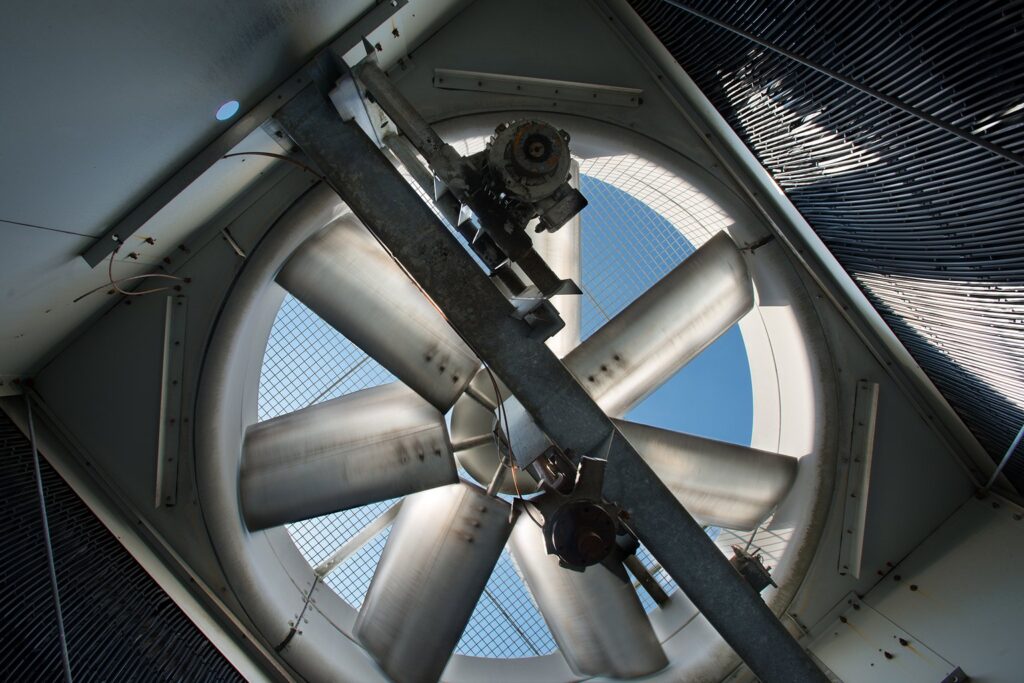
Featured image: the condenser fan deck of an air cooled chiller, viewed from below. Photograph by beeveephoto, CC BY-SA 2.0, via Wikimedia Commons.
