
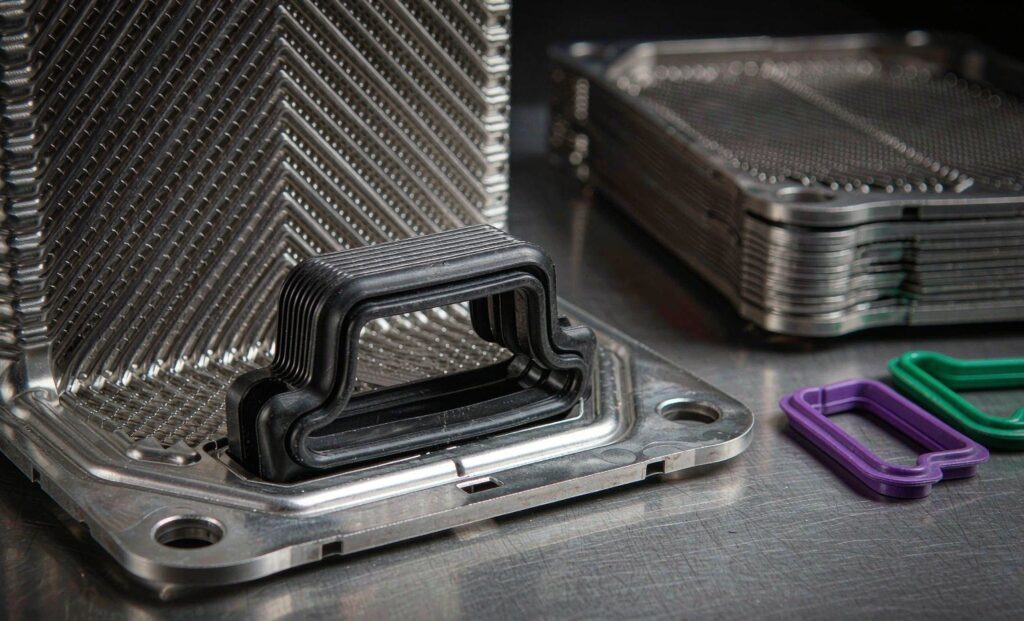
Start With the Medium, Then the Temperature
Most gasket failures on gasketed plate heat exchangers are not manufacturing faults. They are selection faults, and they follow a predictable pattern: someone specified the elastomer that was on the shelf, or the one that worked on the previous unit, and the new duty has one variable that the old one did not — a hotter CIP cycle, a solvent that swells NBR, or a steam circuit where FKM was never going to survive.
Plate heat exchanger gasket material selection is a four-step decision, and the order matters:
- Medium. What is on each side, at what concentration, including the cleaning chemicals. A gasket sees the CIP caustic as surely as it sees the product.
- Temperature. Continuous operating temperature, plus the peak during cleaning or sterilisation, plus the ambient it sits in when idle.
- Mechanical duty. Design pressure, port size, plate size, and whether the pack is opened frequently.
- Attachment and geometry. Glued or clip-on, groove profile, gasket cross-section — the part that fits the frame but not the groove is not a candidate at all.
Reverse that order and you end up with a chemically perfect gasket that will not stay in the groove, which is the most expensive outcome because it fails at commissioning rather than in service.
The Four Elastomers That Cover Most Duty
NBR, EPDM, HNBR and FKM cover the overwhelming majority of industrial plate exchanger duty. Knowing where each one stops is more useful than a long list of exotic options.
- NBR (nitrile). The default for oils, fats, glycols and refrigerants. Poor against ketones, esters, aromatic solvents and ozone, and it does not like hot water above about 90 °C for long.
- EPDM. The default for hot water, steam and caustic cleaning. Excellent ageing resistance and ozone resistance. Very poor against mineral oils, greases and hydrocarbon solvents — it swells and softens.
- HNBR (hydrogenated nitrile). NBR chemistry with the unsaturated bonds removed, which buys roughly 30 K more temperature and much better ageing. The right answer where NBR is marginal on temperature but the medium is still an oil.
- FKM (fluorocarbon, Viton type). The widest chemical resistance of the four and the highest temperature ceiling, but it is the wrong choice for hot water and steam, and it is attacked by amines and ammonia.
| Elastomer | Continuous range | Hot water and steam | Oils and glycols | Acids and caustics | Ammonia |
|---|---|---|---|---|---|
| NBR | −20 to 110 °C | Fair | Best | Fair | Fair |
| HNBR | −20 to 140 °C | Good | Best | Good | Good |
| EPDM | −35 to 150 °C | Best | Poor | Best | Good |
| FKM | −10 to 180 °C | Poor | Best | Good | Poor |
| CR | −35 to 100 °C | Fair | Good | Fair | Best |
| PTFE-faced | −30 to 150 °C | Good | Best | Best | Best |
Those are indicative figures. Every compound is different — a peroxide-cured EPDM and a sulphur-cured EPDM behave differently at 150 °C, and a 70 Shore A gasket and an 85 Shore A gasket of the same polymer have different compression-set behaviour. Treat the table as a screening tool, and the compound datasheet as the specification.
Temperature Ratings Are Continuous, Not Burst
A gasket rated to 150 °C is rated to 150 °C continuously, in that medium. It is not rated to 170 °C occasionally, and the difference matters more than most maintenance teams assume, because elastomer ageing is roughly Arrhenius: every 10 K above the continuous limit substantially reduces the time to a given compression set.
The practical consequence is that a gasket run at 145 °C in a 150 °C-rated compound may last two years, while the same gasket at 160 °C may last four months. There is no visible warning — compression set is silent until the pack weeps. If your duty spends a meaningful fraction of the year near the rating, move one compound class up rather than accepting the margin.
CIP and sterilisation peaks are part of the duty, not an exception to it. A 15-minute 90 °C caustic wash once a day is 90 hours a year at 90 °C, and on a dairy or pharmaceutical site that is enough to set the gasket life.
EPDM vs NBR: The Decision That Goes Wrong Most Often
This is the single most common specification error on plate exchangers, and it usually happens when a unit is repurposed. EPDM and NBR look similar, cost similarly, and are both stocked — but they are not interchangeable in either direction.
| Duty | Right choice | What happens with the wrong one |
|---|---|---|
| Hot water to 120 °C | EPDM | NBR hardens and cracks within a season |
| Hydraulic oil cooling | NBR or HNBR | EPDM swells, softens, extrudes out of the groove |
| Steam to 150 °C | EPDM | FKM degrades rapidly; NBR fails sooner |
| Diesel or kerosene | NBR | EPDM swells by 50% or more |
| Glycol loop, 60 °C | EPDM or NBR | Either works; check the inhibitor package |
| Caustic CIP at 80 °C | EPDM | NBR has limited resistance at concentration |
One diagnostic hint: EPDM gaskets are usually black but so are NBR; colour coding is not a reliable identifier across brands. If you are unsure what is fitted, take a small offcut, weigh it, soak it in toluene for 24 hours and weigh it again. NBR swells substantially; EPDM barely moves. It is a crude test, and it is far cheaper than rebuilding a pack twice.
Steam Service: Where FKM Fails
FKM has the highest temperature rating of the common elastomers, which makes it the instinctive choice for steam. It is the wrong one. Fluorocarbon elastomers degrade in hot water and saturated steam through dehydrofluorination, and the failure is fast once it starts — the gasket goes brittle, then crumbles at the port ring.
For saturated steam up to about 150 °C, EPDM is the standard answer and has been for decades. Above that, the elastomer options narrow sharply: FEPM compounds are used to around 200 °C, and beyond that the application usually moves to a welded or semi-welded plate exchanger, or to a shell and tube unit where the sealing is by compression of a graphite or spiral-wound gasket rather than an elastomer.
Steam also punishes the frame rather than the gasket alone. Thermal cycling between ambient and 150 °C moves the pack, and a clip-on gasket that was marginally retained at installation will walk out of its groove after a few hundred cycles. On steam duty, specify the gasket attachment with the same care as the compound.
Oils, Glycols and Refrigerants
Where the duty is a closed oil or glycol loop, NBR is usually right and HNBR is right where the temperature is above 100 °C. Two details are routinely missed.
- Glycol is not a solvent, but its inhibitors can be. A glycol loop with an amine-based corrosion inhibitor at 90 °C is a different chemical environment from pure glycol at 40 °C. Ask for the inhibitor chemistry, not just the glycol concentration.
- Refrigerant and oil travel together. In a chiller or heat pump, the plate exchanger sees refrigerant on one side and oil-laden refrigerant on the other. POE oil with a residual moisture content hydrolyses into acids, and those acids attack both the stainless plate and the gasket. Moisture control in the circuit is a gasket-life measure.
For CO₂ transcritical duty the pressures are the dominant constraint, not the elastomer: a gasketed plate is usually replaced by a brazed or semi-welded unit at those pressures, and the gasket question becomes moot.
Ammonia: the Gasket Is Fine, the Copper Is Not
Ammonia refrigeration is a case where the gasket selection is easier than the rest of the material selection. NBR is only fair against anhydrous ammonia and many suppliers will not warrant it; CR, EPDM and HNBR are the usual choices, and CR has the longest track record in industrial ammonia plant.
The real constraint is elsewhere: no copper, no copper alloys, no zinc-coated parts anywhere in the wetted path or in contact with leaked ammonia. That eliminates copper gaskets, brass fittings and many standard instrument connections. Stainless plates are fine. The material selection matrix for corrosive media covers the metal side of the same decision, and it is worth reading alongside this one because gasket and plate are chosen together.
Acids, Caustics and the PTFE Option
Dilute mineral acids and caustic soda are EPDM territory up to moderate concentration and temperature. Beyond that, or where the medium attacks every elastomer, the option is a PTFE-encapsulated gasket — a PTFE envelope over a silicone or FKM core.
PTFE-faced gaskets are close to universally chemically resistant, but they are not free of problems. They are more expensive, they have lower elasticity so they demand better groove and frame flatness, they creep under sustained compression, and they are more permeable to some small molecules than a solid elastomer. They are the right answer for a genuinely aggressive duty and the wrong answer as a general upgrade.
| Medium | Gasket | Note |
|---|---|---|
| Sulphuric acid, dilute to 50% | EPDM | Temperature-limited above 60 °C |
| Hydrochloric acid, dilute | PTFE-faced | Elastomers swell or degrade |
| Sodium hydroxide to 30% | EPDM | Standard CIP chemistry |
| Sodium hypochlorite | EPDM | FKM and NBR both poor |
| Ketones, esters, aromatics | FKM or PTFE | NBR swells badly |
| Amines, ammonia | CR or EPDM | FKM is attacked |
Hardness, Groove Fit and Mechanical Limits
Compound choice gets the chemistry right; hardness gets the mechanics right. Plate gaskets are normally 70 to 85 Shore A. Higher hardness resists extrusion at high pressure and large port diameters; lower hardness seals more easily on a lightly tightened pack or a slightly worn groove.
Go too hard and the gasket will not conform to a frame that is less than perfect, and you get a weep that no amount of tightening cures. Go too soft and the gasket extrudes into the port under pressure, which shows as a partial blockage and a rising pressure drop rather than a leak — a failure that is often misdiagnosed as fouling for weeks.
Groove geometry is not negotiable and is not standardised across brands. The gasket must match the groove profile, the groove width, the depth and the attachment method. This is why a “compatible” gasket bought on dimensions alone sometimes leaks: the section is right but the retention is wrong. On a frame that is opened frequently, clip-on is faster and more reliable; on a very large plate, glued is often the only option that stays put during closing.
Cleaning Chemistry Is Part of the Specification
Any CIP regime is a chemical exposure, and it belongs on the data sheet. Three rules cover most of it:
- Caustic at 1–3% and 80 °C is fine for EPDM and acceptable for HNBR; NBR has limited resistance at concentration and temperature together.
- Nitric acid at 1–2% is used for scale removal and is compatible with EPDM and FKM at ambient to moderate temperature.
- Hypochlorite is the one that catches people: it is a strong oxidiser and it attacks NBR and FKM, while EPDM handles it. A “mild” sanitising step with hypochlorite on an FKM pack is a slow failure that looks like a manufacturing defect.
Cleaning temperature also counts toward the thermal budget. A pack that runs at 60 °C in process and 85 °C during CIP is a pack rated for 85 °C, not 60 °C.
When to Stop Choosing Elastomers
There is a point where the correct answer is not a better gasket but a different exchanger. If the duty needs more than about 25 bar, above roughly 180 °C continuously, or a medium that attacks every affordable elastomer, the options are semi-welded (welded plate pairs, gasketed only at the perimeter), fully welded, brazed, or shell and tube.
The brazed and fusion-bonded plate range removes the gasket entirely and takes the pressure and temperature limits up with it, at the cost of cleanability. For a fouling duty that also needs high temperature, a stainless shell and tube exchanger is often the more honest choice — it is larger and less thermally efficient, but it can be mechanically cleaned and it does not depend on an elastomer for its integrity.
Data Sheet: What to Send a Supplier
- Both media, with concentration and any trace components that matter (chlorides, amines, oxidisers).
- Continuous operating temperature per side, and the CIP or sterilisation peak with duration and frequency.
- Design pressure per side, and whether the pack is subject to frequent thermal cycling.
- Frame make and plate code, plus the groove profile and attachment type — glued or clip-on.
- Plate dimensions and gasket section, measured rather than assumed.
- Cleaning chemicals, concentrations and temperatures.
- Required documentation: compound datasheet, food-contact or potable-water approval, and batch traceability.
With those seven items, the selection becomes a lookup rather than an argument. Without them, any supplier is guessing, and a guess that fails at commissioning is expensive for both sides.
Next Step
If you are replacing a plate pack and are not certain which compound the existing gaskets are, send photographs of the groove and the gasket section together with the medium and temperature data through our engineering enquiry form. We will identify the likely compound, propose the right one for the duty, and quote the pack — Zhenggong supplies gasketed, welded and brazed plate exchangers under D1/D2 pressure vessel certification with ISO 9001 and ISO 14001 quality and environmental systems, as set out on the certification page.
