
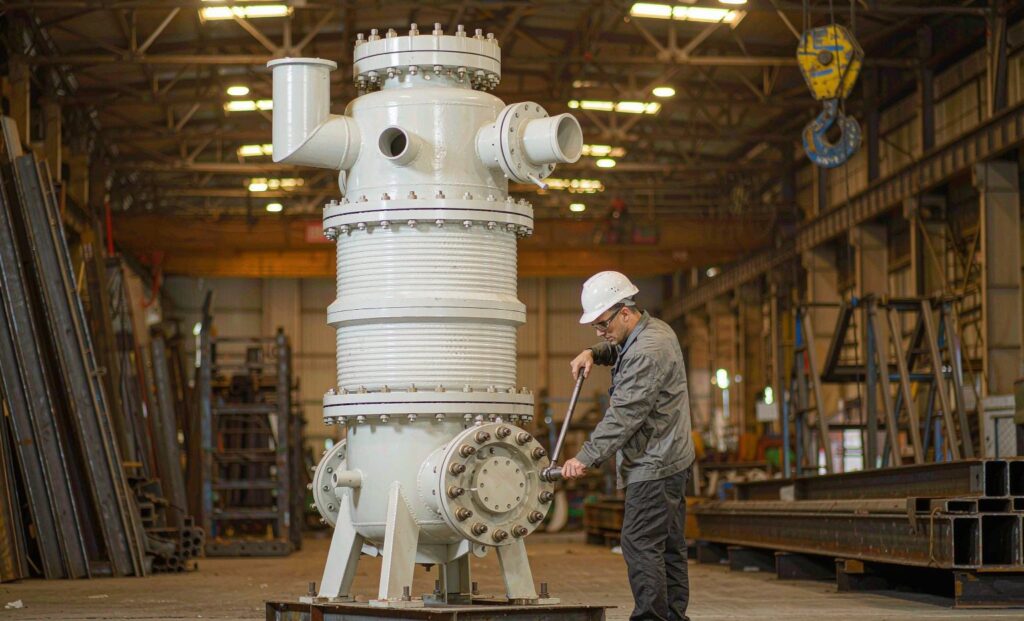
What D1 and D2 certification actually are
D1 and D2 pressure vessel certification are China’s pressure-vessel production qualification classes, issued to a manufacturer that has demonstrated the design, welding, inspection and quality-system capability to build vessels in the corresponding category. D1 covers the lower-pressure, lower-hazard classes and D2 the higher ones within China’s two-tier division of Category I and II pressure vessels; both are administered under the national special-equipment regime and were historically issued through AQSIQ, the function now sitting with China’s market-regulation authority. For a buyer, the practical meaning is simple: a manufacturer holding a valid D1/D2 certificate has been audited on the things that decide whether a vessel is safe — procedures, welders, materials, non-destructive testing and traceability — rather than only on the product it wants to sell you.
This guide explains what the certificate covers, how it differs from ASME and PED, what documentation actually accompanies a compliant vessel, and how to verify a supplier’s claim before you place an order.
Why D1/D2 matters when you buy heat exchangers from China
A shell and tube heat exchanger above the small-vessel thresholds is pressure equipment. Its shell, tubes, tube sheets and heads hold a working fluid at pressure and temperature, and the consequences of a failure are mechanical, not thermal. That is why every serious market regulates the category: the EU through the Pressure Equipment Directive, North America through ASME Section VIII, and China through its special-equipment licensing system.
When you buy from a Chinese manufacturer, D1/D2 certification is the domestic proof that the factory is entitled to build vessels in that class at all. It also underpins the export documentation: a buyer importing into a regulated market still has to satisfy their own directive, but a supplier with an audited pressure-vessel licence, a functioning quality system and consistent third-party inspection history is far easier to bring through that process than a fabricator working without a licence. Certification does not replace the destination market’s requirements — it establishes that the manufacturer is operating as a regulated pressure-equipment maker rather than a general metal shop.
D1/D2 compared with ASME U stamp and the PED
| Scheme | Region | What it certifies | Typical buyer use |
|---|---|---|---|
| D1 / D2 production qualification | China (domestic special-equipment regime) | Manufacturer licensed to build Category I / II pressure vessels; design, welding, NDT and QA audited | Confirms a Chinese fabricator is a licensed pressure-vessel maker; supports export paperwork |
| ASME Section VIII Div. 1, U stamp | North America, widely referenced globally | Vessel designed and built to the ASME code with an authorised inspection agency | Required for many US and Canadian projects |
| PED 2014/68/EU (with CE marking) | European Union | Conformity assessment against the PED for the fluid group and category | Required to place vessels on the EU market |
| Third-party inspection (TÜV, SGS, BV, Lloyd’s) | Global | Independent witness of materials, welding, NDT and pressure test | Contractual assurance for project buyers on any scheme |
The schemes overlap but are not interchangeable. A vessel can hold a D1/D2 production qualification and still need a U stamp or PED conformity assessment for its final destination. What a serious manufacturer offers is a documented route from one to the other — code-compliant design calculations, qualified welding procedures, and inspection records that a notified body or authorised inspector can review and witness.
What a complete pressure vessel documentation package contains
Certificates are the headline; the package behind them is what an inspector actually reads. For a shell and tube heat exchanger shipped internationally, expect at least the following.
- Design documentation — design calculations to the applicable code, general arrangement drawing, and the design conditions (pressure, temperature, fluid group, corrosion allowance).
- Material certificates — EN 10204 3.1 mill certificates traceable to the plates, tubes, forgings and fittings used, with heat numbers that match the physical tags.
- Welding records — qualified welding procedure specifications and procedure qualification records, plus welder qualification certificates for each welder employed.
- Non-destructive testing reports — radiographic or ultrasonic examination of main seams, dye-penetrant or magnetic-particle examination of nozzle welds, with acceptance criteria stated.
- Pressure test record — hydrostatic (or pneumatic where justified) test certificate stating test pressure, duration, ambient conditions and result, typically witnessed.
- Nameplate data — manufacturer, serial number, design pressure and temperature, test pressure, material of construction and code reference, permanently marked.
- Inspection release — third-party or authorised-inspector release certificate where the contract requires one.
- Operating and maintenance manual — installation, commissioning, cleaning and inspection intervals, and the exchanger’s pressure and temperature limits.
Ask for a sample package before you order, not after. A supplier who cannot produce one quickly is telling you something useful.
How to verify a supplier’s certificate before you order
- Request a copy of the full certificate, not a cropped image — the registered scope, address and validity dates all matter.
- Check the company name and works address on the certificate against the entity issuing your quotation and the address on the packing list.
- Confirm the certificate’s scope actually covers the vessel class and design pressure you are buying.
- Verify validity and, where the issuing channel allows, confirm the certificate number with the issuing authority or a third-party inspector.
- Ask who performs design review and pressure-test witnessing, and whether the buyer may nominate the inspection body.
- Request the documentation package index for a comparable vessel the factory has already shipped.
- If your market requires ASME or PED, confirm in writing whether the same works can build to that code and which notified body or authorised inspector will attend.
Which vessels need D1 or D2 classification
Whether a heat exchanger falls into a regulated class depends on design pressure, volume and the fluid’s group — not on the fact that it is a heat exchanger. In broad terms, small units with low pressure and volume fall below the thresholds and are treated as ordinary pressure components; larger shells, higher design pressures and hazardous fluids move a vessel into a higher category. Because the thresholds are defined by national rules rather than by a single global figure, the correct approach is to state your design conditions precisely on the enquiry and ask the manufacturer to state which class applies and under which code. Vague enquiries produce vague answers, and a vessel built to the wrong class is a customs and safety problem, not a paperwork inconvenience.
Third-party inspection, NDT and hydrostatic testing
Independent inspection is where certification stops being a wall certificate and becomes evidence for a specific vessel. Three points are worth building into the purchase order:
- Nominate the inspection body. TÜV, SGS, Bureau Veritas and Lloyd’s Register are all active in Chinese fabrication yards, and naming one in the contract removes ambiguity about who signs the release.
- Define hold points. Material review, root-pass inspection, final NDT and pressure test are the natural witness points; agree which are witnessed and which are documentary.
- Match the test to the service. Hydrostatic testing is the default; pneumatic testing is used only where water is impractical or where residual moisture is unacceptable, and it carries additional safety requirements that should be visible in the procedure.
Where certification interacts with shipping and customs
Certification documents travel with the vessel. Importers should expect to present the design and test documentation, and often the certificate, when clearing pressure equipment into a regulated market, and project insurers frequently require the same records. Mismatches are the common failure: the certificate names one works address, the commercial invoice another, and the mill certificates reference heat numbers that do not appear on the physical nameplate. Checking consistency before shipment is far cheaper than resolving it at the port, and it is the reason we send the documentation package to the buyer for review alongside the packing list rather than after arrival.
Certified heat exchangers with a complete documentation package
Zhenggong Cooling and Heating Equipment Co., Ltd builds shell and tube heat exchangers, plate exchangers and pressure vessels at its 35,000 m² facility in Shandong, China, under D1 and D2 pressure vessel production qualification certificates issued by the national inspection authority, together with ISO 9001 and ISO 14001 quality and environmental management systems. Each vessel ships with the design, material, welding, NDT and pressure-test records described above. The details are set out on our certification page, and the equipment itself on the stainless shell and tube heat exchanger page and the wider product range.
Background on the equipment family and how it is specified is in our guide to shell and tube heat exchangers. For export projects that need third-party inspection, nominated inspection bodies or documentation in a specific language, our engineering and export services cover the coordination.
Request certified equipment and documentation
Send your design pressure, design temperature, volume, fluid and destination market, and Zhenggong’s engineers will confirm the applicable vessel class, the certification route for your market and the documentation the shipment will carry. For quotations on certified shell and tube exchangers and pressure vessels, contact the engineering team.